Hey JavaScript developers! 👋
Have you ever passed a function into another function and wondered:
"Wait... functions can do that?"
Or maybe you've seen code like this:
setTimeout(() => {
  console.log("Hello!");
}, 1000);
and thought:
"Why are we passing a function as a value?"
Welcome to one of JavaScript's most important concepts:
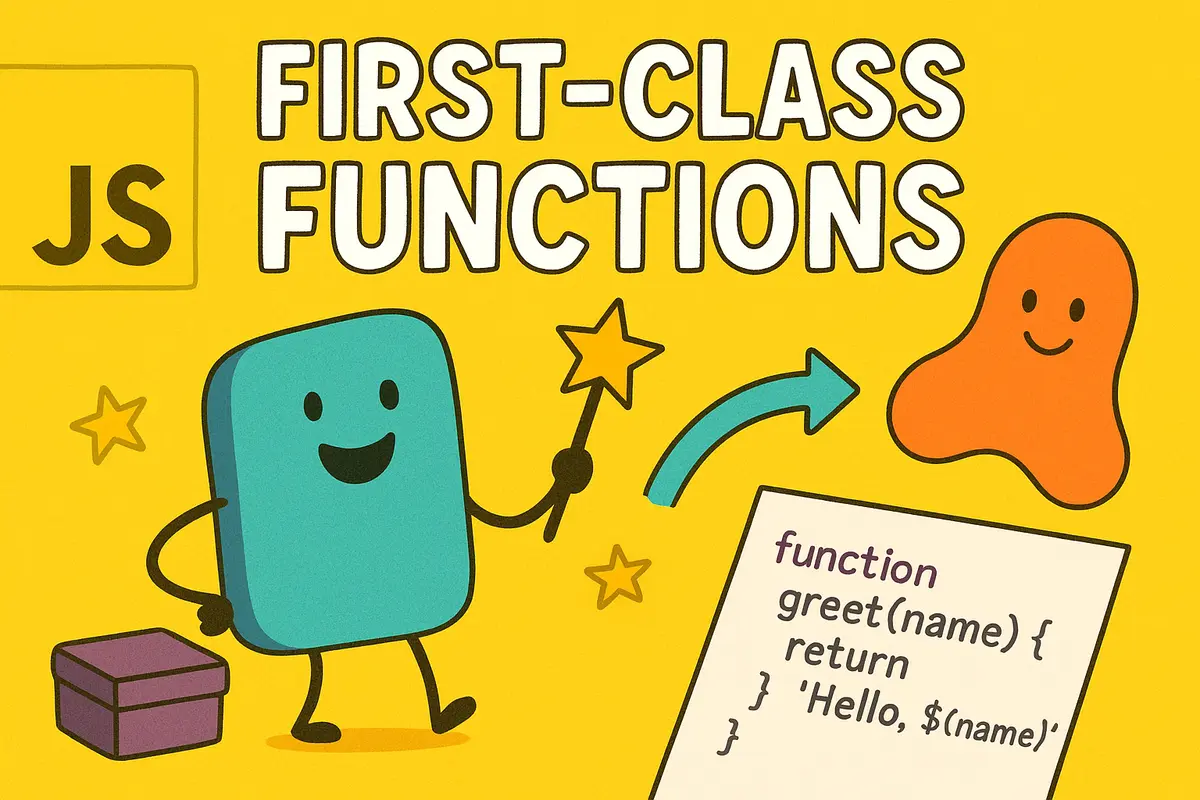
First-Class Functions.
This single feature powers:
- Callbacks
- Closures
- Event listeners
- Promises
- React
- Node.js
- Functional programming
In short:
Modern JavaScript wouldn't exist without first-class functions.
Let's explore why. 🚀
What Does "First-Class Function" Mean?
A language supports first-class functions when functions can be treated like any other value.
In JavaScript, functions can:
- Be stored in variables
- Be passed as arguments
- Be returned from other functions
- Be stored in arrays
- Be stored in objects
- Have properties attached to them
Think of functions as values with a special superpower:
They can execute code.
Functions Are Values
Let's start simple.
function greet() {
  console.log("Hello, world!");
}
Nothing surprising yet.
Now assign it to a variable:
const sayHello = greet;

sayHello();
Output:
Hello, world!
Notice:
We didn't call greet().
We assigned the function itself to another variable.
Both variables point to the same function object.
Anonymous Function Expressions
Functions don't even need names.
const greet = function () {
  console.log("Hello, world!");
};

greet();
Output:
Hello, world!
This is called a function expression.
The function lives inside the variable.
Arrow Functions
Modern JavaScript often uses arrow functions:
const greet = () => {
  console.log("Hello, world!");
};
Or even shorter:
const greet = () => console.log("Hello, world!");
Still a function.
Still a first-class value.
Functions as Arguments
This is where things get interesting.
Functions can be passed into other functions.
function sayHello(name) {
  console.log(`Hello, ${name}!`);
}

function processUserInput(callback) {
  const name = "Alice";

  callback(name);
}

processUserInput(sayHello);
Output:
Hello, Alice!
Here:
sayHellois a function- It's passed as an argument
- Another function executes it
This pattern is called a callback.
Why Callbacks Matter
Callbacks are everywhere.
Example:
button.addEventListener(
  "click",
  function () {
    console.log("Clicked!");
  }
);
Or:
setTimeout(() => {
  console.log("Done!");
}, 1000);
Without first-class functions, callbacks wouldn't exist.
And without callbacks, JavaScript wouldn't be asynchronous.
Higher-Order Functions
A function that accepts another function or returns a function is called a:
Higher-Order Function
Examples include:
map()
filter()
reduce()
forEach()
sort()
These are some of the most powerful tools in JavaScript.
Functions Returning Functions
Functions can also create and return other functions.
function multiplier(factor) {
  return function (x) {
    return x * factor;
  };
}
Usage:
const double = multiplier(2);

console.log(double(5));
Output:
10
This might seem magical at first.
But something even more interesting is happening behind the scenes.
Meet Closures
When a function remembers variables from its outer scope, it's called a closure.
Consider:
function multiplier(factor) {
  return function (x) {
    return x * factor;
  };
}
Even after multiplier() finishes executing:
const double = multiplier(2);
the returned function still remembers:
factor = 2
It's carrying that value around like a backpack. 🎒
That's a closure.
Closures power:
- React hooks
- Event handlers
- Middleware
- Function factories
- Private state
and countless advanced JavaScript patterns.
Functions Inside Arrays
Since functions are values, they can live inside arrays.
const actions = [
  () => console.log("Running"),
  () => console.log("Jumping"),
  () => console.log("Flying"),
];
Execute them:
actions.forEach(action => action());
Output:
Running
Jumping
Flying
Pretty cool.
Functions Inside Objects
Functions can also be stored inside objects.
const calculator = {
  add(a, b) {
    return a + b;
  },

  multiply(a, b) {
    return a * b;
  },
};

console.log(
  calculator.multiply(5, 3)
);
Output:
15
Object methods are simply functions stored as object properties.
Functions Are Objects Too
Here's where many developers have their minds blown.
Functions are actually objects.
Which means they can have properties.
function fun() {
  console.log("Fun!");
}
Attach a property:
fun.description =
  "This is a fun function.";

console.log(fun.description);
Output:
This is a fun function.
Yes.
Functions can store data too.
Real-World Example
Libraries often attach metadata to functions.
function routeHandler() {}

routeHandler.path = "/users";
routeHandler.method = "GET";
Frameworks can inspect those properties later.
This pattern appears in:
- Express.js
- Next.js
- NestJS
- Testing frameworks
- Dependency injection systems
Functions and Functional Programming
Because functions are first-class values, JavaScript supports functional programming patterns.
Examples:
const nums = [1, 2, 3, 4];
Map:
const doubled =
  nums.map(n => n * 2);
Filter:
const even =
  nums.filter(n => n % 2 === 0);
Reduce:
const sum =
  nums.reduce(
    (total, n) => total + n,
    0
  );
These methods accept functions.
That's only possible because functions are first-class citizens.
Why First-Class Functions Matter
This concept powers:
- Callbacks
- Closures
- Event listeners
- Middleware
- Promises
- Async/Await internals
- React components
- Hooks
- Functional programming
- Framework APIs
Without first-class functions, modern JavaScript would look completely different.
TL;DR Quick Recap
- Functions are values in JavaScript.
- Functions can be assigned to variables.
- Functions can be passed as arguments.
- Functions can return other functions.
- Functions can live inside arrays and objects.
- Functions are objects.
- Functions can have properties.
- Closures allow functions to remember outer variables.
- Higher-order functions accept or return functions.
- Modern JavaScript relies heavily on first-class functions.
Final Thoughts
First-class functions are one of JavaScript's greatest strengths.
At first, they seem like a neat language feature.
But once you understand them, you'll start seeing them everywhere:
- React components
- Event handlers
- Middleware
- Async programming
- Framework internals
The beauty of JavaScript is that functions aren't just blocks of code.
They're values.
They're objects.
They're building blocks that can be passed around, customized, composed, and reused.
And that's what makes JavaScript so incredibly flexible. ⚡
A Little Joke to End On
Why do JavaScript developers love first-class functions?
Because they're always willing to take callbacks. 😄
Frequently Asked Questions
What is a first-class function in JavaScript?
A first-class function is a function that can be treated like any other value.
It can be assigned to variables, passed as arguments, returned from functions, and stored in data structures.
Are functions objects in JavaScript?
Yes.
Functions are special objects that can be executed.
They can also have properties and methods.
What is a callback function?
A callback is a function passed into another function to be executed later.
Example:
setTimeout(() => {
  console.log("Hello");
}, 1000);
What is a higher-order function?
A higher-order function is a function that:
- Accepts functions as arguments
- Returns functions
Examples include:
map()
filter()
reduce()
What is a closure?
A closure is created when a function remembers variables from its outer scope even after that outer function has finished executing.
Why are closures useful?
Closures enable:
- Data privacy
- State management
- Function factories
- Event handlers
- React hooks
Can functions be stored inside arrays?
Yes.
Functions are values and can be stored in arrays, objects, maps, and other data structures.
Can functions have properties?
Yes.
Because functions are objects, custom properties can be attached to them.
function test() {}

test.description = "Demo";
How do React and JavaScript functions relate?
React heavily relies on first-class functions.
Examples include:
- Components
- Hooks
- Event handlers
- State updater functions
What is functional programming in JavaScript?
Functional programming is a style that treats functions as values and emphasizes:
- Pure functions
- Composition
- Immutability
- Higher-order functions
Why are first-class functions important?
They enable:
- Flexible APIs
- Asynchronous programming
- Functional programming
- Framework abstractions
- Code reuse
and many modern JavaScript patterns.
Key Takeaways
- Functions are first-class citizens in JavaScript.
- Functions can be assigned, passed, and returned.
- Functions are objects.
- Functions can have properties.
- Closures allow functions to remember state.
- Higher-order functions power many JavaScript APIs.
- Modern frameworks rely heavily on first-class functions.
- Understanding first-class functions is essential for mastering JavaScript.
If you found this article helpful, share it with fellow developers and follow for more JavaScript deep dives.
About the Author
Anik Sikder is a Software Engineer specializing in Frontend Development, Backend Systems, Cloud Infrastructure, DevOps, and Software Architecture.
He writes about JavaScript, Python, Django, FastAPI, System Design, distributed systems, and scalable software engineering practices.