Hey developers! 👋
Welcome back to our journey through communication patterns in distributed systems.
In the previous article, we explored traditional Polling.
The browser repeatedly asked:
"Anything new?"
The server repeatedly replied:
"No."
For small systems, that worked surprisingly well.
But as products grew and users expected faster experiences, polling started creating a new problem:
Too many unnecessary conversations.
This is the story of how engineers tried to solve that problem without abandoning HTTP.
Meet Long Polling.
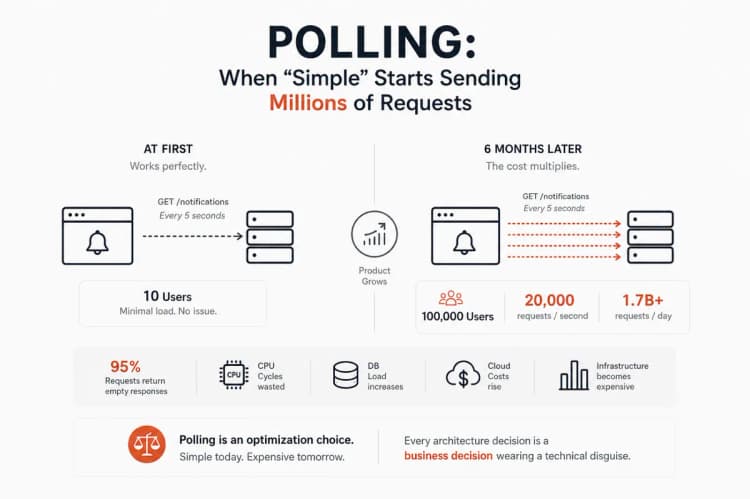
A Quick Recap: Why Polling Started Hurting
Traditional polling looked like this:
Client
   │
   ▼
Anything New?
   │
   ▼
No

(wait)

Client
   │
   ▼
Anything New?
The pattern was simple.
The problem was scale.
Imagine:
200,000 Users
Polling Every Second
Even if almost nothing changed, the infrastructure still processed:
200,000 Requests Every Second
Most of those requests existed only to hear:
No Updates
The servers were working hard to deliver no value.
The Big Idea
One engineer asked:
Why keep asking when the server already knows nothing changed?
Instead of:
Client:
Anything New?

Server:
No.
What if the client said:
Tell me when something changes.
And then simply waited?
That idea became Long Polling.
What Is Long Polling?
Long Polling is a communication pattern where a client sends a request, and the server intentionally delays the response until new data becomes available or a timeout occurs.
Think of it like waiting for a phone call.
You don't call someone every minute asking:
Did something happen?
Instead:
Call me when it happens.
That's Long Polling.
Long Polling Explained Like a Recruiter
Imagine you're hiring for a company.
Traditional polling:
Recruiter:
Any new applicants?

System:
No.

Recruiter:
Any new applicants?

System:
No.
Long Polling:
Recruiter:
Call me when someone applies.

System:
Understood.
Hours later:
New Application Submitted
          │
          ▼
Phone Rings
The recruiter isn't constantly checking.
The system reaches out when something meaningful happens.
What Actually Happens Under the Hood?
Suppose a user opens a chat application.
The browser sends:
GET /messages
The server checks for new messages.
If nothing exists:
Request Arrives
      │
      ▼
Check For Updates
      │
      ▼
Nothing Found
      │
      ▼
Keep Connection Open
Now the server waits.
Maybe:
10 Seconds
30 Seconds
60 Seconds
If a new message arrives:
New Message
      │
      ▼
Immediate Response
Example:
{
  "message": "Hello!"
}
The browser receives the response and immediately starts another Long Poll request.
Request
   │
Wait
   │
Response
   │
Reconnect
   │
Wait Again
To users:
Feels Real-Time
To infrastructure:
Still HTTP
Just used differently.
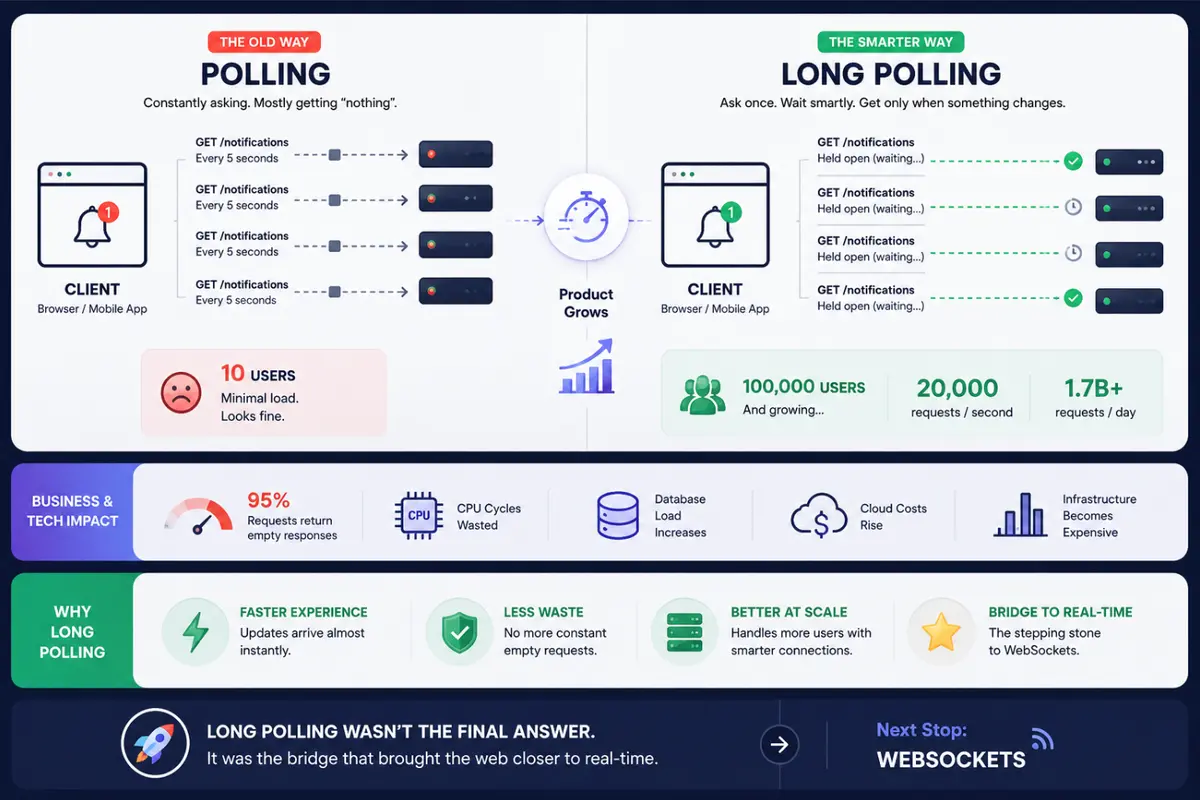
A Visual Mental Model
Traditional Polling
Ask
 │
 ▼
No

Ask
 │
 ▼
No

Ask
 │
 ▼
Yes
Long Polling
Ask Once
    │
Wait
    │
Wait
    │
Wait
    │
Yes
Much less wasted communication.
Why Businesses Loved Long Polling
Businesses don't buy communication patterns.
They buy outcomes.
Without Long Polling:
Customer Sends Message
          │
          ▼
Agent Sees It Later
With Long Polling:
Customer Sends Message
          │
          ▼
Agent Sees It Immediately
That often means:
- Faster support
- Better customer satisfaction
- Higher engagement
- More retained customers
The customer doesn't care about Long Polling.
They care that the product feels alive.
Why Developers Loved It
Long Polling solved a real problem without requiring entirely new infrastructure.
Most teams already had:
- HTTP
- Load Balancers
- Reverse Proxies
- Application Servers
The implementation was often an evolution rather than a complete rewrite.
That made adoption relatively easy.
Why Operations Teams Became Nervous
Traditional polling creates:
Many Requests
Short Connections
Long Polling creates:
Fewer Requests
Long Connections
That sounds great.
Until scale arrives.
Imagine:
500,000 Active Users
Now you may have:
500,000 Waiting Connections
simultaneously.
The waste decreases.
But new challenges appear:
- Memory usage
- Connection management
- Load balancer limits
- Timeouts
- Reconnection storms
The bottleneck didn't disappear.
It moved.
Polling vs Long Polling
| Feature | Polling | Long Polling |
|---|---|---|
| Request Frequency | High | Low |
| Response Delay | Fixed | Event Driven |
| Infrastructure Waste | Higher | Lower |
| User Experience | Moderate | Better |
| Connection Duration | Short | Long |
| Scalability Challenges | Request Volume | Connection Volume |
Neither approach is perfect.
Both involve tradeoffs.
The Scaling Wall
As systems approached:
1 Million Connected Users
a new reality emerged.
The infrastructure now needed to remember:
- Who is connected
- Which connection belongs to whom
- How long they've been waiting
- When to timeout
- When to reconnect
At this point the system started behaving less like a website and more like a real-time platform.
And HTTP wasn't originally designed for that role.
The Architect's Lesson
Long Polling teaches a valuable principle:
Every solution eventually exposes the next problem.
The evolution looked like this:
Polling
    │
    ▼
Too Much Waste
    │
    ▼
Long Polling
    │
    ▼
Too Many Open Connections
    │
    ▼
Search For Something Better
Long Polling wasn't the destination.
It was the bridge.
A smart compromise between:
- User expectations
- Browser limitations
- Existing infrastructure
- Engineering constraints
For many years, some of the largest platforms on the internet relied on that compromise.
TL;DR Quick Recap
- Long Polling reduces unnecessary requests.
- The client sends a request and waits.
- The server responds only when data becomes available or a timeout occurs.
- User experiences feel significantly more real-time.
- Request volume decreases dramatically.
- Open connection counts increase.
- Long Polling solved many polling problems but introduced new scaling challenges.
- It became an important stepping stone toward modern real-time communication.
Final Thoughts: The Web Wanted to Feel Alive 🧠
Polling taught us that asking constantly creates waste.
Long Polling taught us that waiting intelligently creates efficiency.
But it also revealed a deeper truth:
Users no longer wanted websites that refreshed.
They wanted applications that reacted.
Applications that felt alive.
Long Polling was the web's first serious attempt at delivering that experience using existing technology.
It worked remarkably well.
Until the internet wanted something even more interactive.
And that search eventually led to:
WebSockets.
A Little Engineering Joke to End On 😄
Why did Long Polling get promoted?
Because unlike Polling,
it knew how to wait for the right opportunity.
Frequently Asked Questions
What is Long Polling?
Long Polling is a technique where the client sends a request and the server waits before responding until new data becomes available or a timeout occurs.
How is Long Polling different from Polling?
Polling repeatedly sends requests at fixed intervals.
Long Polling keeps a request open and responds only when something changes.
Is Long Polling real-time?
Not truly.
But it often feels real-time to users because updates are delivered immediately after they occur.
Why is Long Polling more efficient than Polling?
Because it dramatically reduces the number of unnecessary requests that return no new data.
Why didn't Long Polling replace WebSockets?
Long Polling still relies on repeated HTTP requests and large numbers of open connections.
WebSockets provide a more efficient bidirectional communication model.
Key Takeaways
- Long Polling evolved from traditional Polling.
- It reduces unnecessary requests.
- It improves perceived responsiveness.
- It keeps HTTP connections open while waiting for updates.
- It shifts scaling challenges from request volume to connection volume.
- It served as a bridge between Polling and WebSockets.
- Understanding Long Polling helps explain why modern real-time architectures evolved the way they did.
If you found this article useful, share it with fellow backend engineers, system architects, platform engineers, and distributed systems enthusiasts exploring communication patterns at scale.
About the Author
Anik Sikder is a Software Engineer specializing in Backend Systems, SaaS Architecture, Cloud Infrastructure, Python, Django, FastAPI, distributed systems, and scalable software engineering.
He writes about system design, networking, distributed systems, cloud computing, software architecture, and modern engineering practices.