Hey engineers! 👋
Have you ever wondered why some applications update instantly while others seem to check for updates every few seconds?
Think about:
- WhatsApp messages appearing immediately
- Slack notifications arriving in real time
- Live stock market dashboards updating continuously
- Food delivery apps tracking drivers live
Now compare that with:
- Refreshing a webpage
- Checking order status manually
- Reloading an email inbox
- Refreshing a monitoring dashboard
Both approaches solve the same problem.
How do systems discover change?
And surprisingly, that simple question leads to one of the most important architectural decisions in distributed systems:
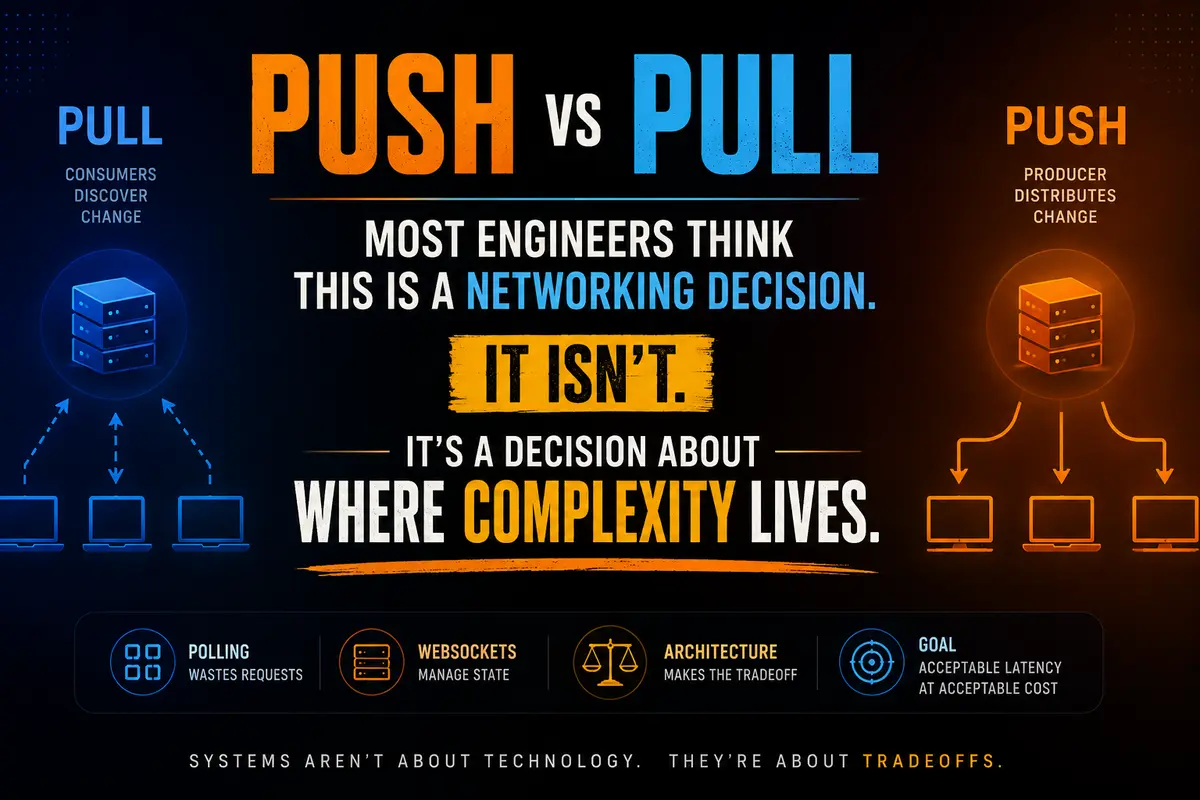
Push vs Pull.
Most engineers initially think this is a networking discussion.
It isn't.
It's a discussion about where complexity lives.
Let's dive in. 🚀
Why This Topic Matters
Every distributed system eventually faces a challenge.
Information changes.
Multiple consumers care about that change.
The system must decide:
Who is responsible for discovering updates?
There are only two answers.
Either:
Consumers discover change
Or:
Producers distribute change
Everything else is implementation details.
Polling.
Long Polling.
Server-Sent Events.
WebSockets.
Pub/Sub.
All of them are simply different ways of implementing those two fundamental ideas.
Understanding this tradeoff is essential for:
- Backend Engineers
- System Architects
- DevOps Engineers
- Platform Engineers
- Software Architects
Because at scale, you're never choosing between technologies.
You're choosing between costs.
The Real Problem Isn't Communication
Imagine an order is created.
Order Created
Several systems care about it:
- Inventory Service
- Analytics Service
- Notification Service
- Billing Service
- Fraud Detection Service
Creating information isn't difficult.
Delivering information is.
And there are only two ways to solve that problem.
What Is Pull?
In a Pull model, consumers are responsible for discovering changes.
Analytics ----> Order Service

Inventory ----> Order Service

Notifications -> Order Service
Each consumer repeatedly asks:
Anything new?
The producer remains passive.
The responsibility belongs to the consumer.
A Real-World Analogy
Imagine checking a mailbox.
You walk outside.
Open the mailbox.
Look inside.
Nothing.
You return later.
Check again.
Eventually:
New Letter Found
That's Pull communication.
You are responsible for discovering change.
The postal service never contacts you.
Why Pull Refuses To Die
A common misconception is:
Pull is old.
Push is modern.
Reality is far more interesting.
Many of the world's largest systems intentionally use Pull.
Not because they can't implement Push.
Because Pull offers operational advantages.
Kubernetes: A Famous Pull Architecture
Consider a Kubernetes cluster containing thousands of worker nodes.
Many engineers assume the control plane constantly pushes updates.
It doesn't.
Workers repeatedly ask:
Any new work for me?
The nodes pull instructions.
Why?
Because Push would require the control plane to maintain massive coordination state.
Control Plane
      |
      +--> Node 1
      +--> Node 2
      +--> Node 3
      ...
      +--> Node 10,000
The control plane would need to know:
- Which nodes are online
- Which nodes are reachable
- Which nodes need updates
- Which nodes failed
Complexity becomes centralized.
With Pull:
Node 1 ---->

Node 2 ---->

Node 3 ---->

Node N ---->
Responsibility moves to the edges.
This pattern appears repeatedly in distributed systems.
When coordination becomes expensive, responsibility often shifts outward.
Polling: The Simplest Pull Strategy
Polling is the most straightforward Pull implementation.
The client repeatedly asks:
Anything new?
For example:
GET /orders/123/status
Response:
{
  "status": "PROCESSING"
}
Five seconds later:
{
  "status": "PROCESSING"
}
Again:
{
  "status": "PROCESSING"
}
Eventually:
{
  "status": "DELIVERED"
}
Simple.
Predictable.
Reliable.
But wasteful.
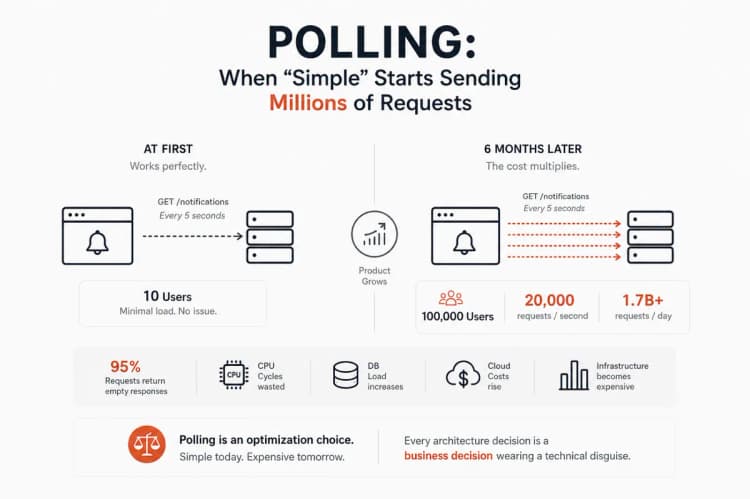
The Polling Waste Problem
Imagine:
100,000 Clients

Polling Every 5 Seconds
That creates:
20,000 Requests Per Second
Even when nothing changes.
Most requests provide no new information.
This leads many engineers to conclude:
Polling doesn't scale.
But that's only partially true.
Why Polling Is Surprisingly Scalable
Polling wastes requests.
But it dramatically reduces state.
A polling server:
Receive Request

Return Response

Forget Client
Immediately.
No connection tracking.
No heartbeats.
No presence management.
No subscription state.
Stateless systems are operationally simple.
Sometimes infrastructure simplicity is worth more than network efficiency.
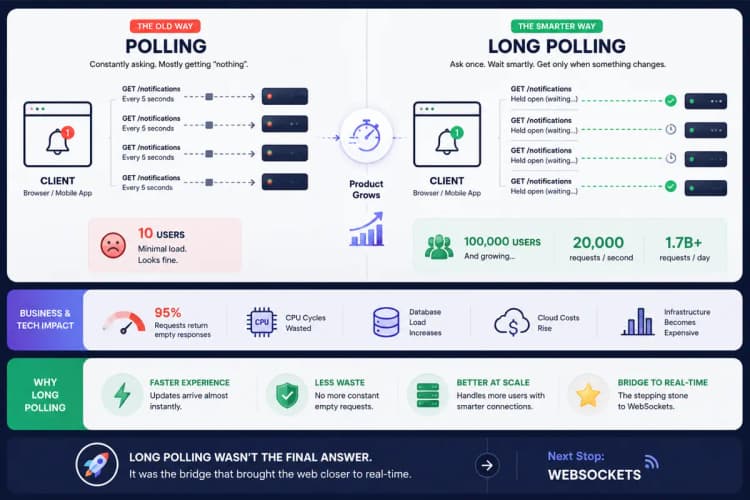
Long Polling: The Bridge Between Pull and Push
Eventually engineers notice something.
Most polling requests look like:
Request

No Change
Again.
Request

No Change
Again.
Request

Actual Update
Most requests are wasted.
Long Polling improves this.
Instead of asking:
Anything New?
The client asks:
Tell Me When Something Changes
The connection remains open.
Client ---------------- Server
            Waiting
When new information appears:
Update Available
The server responds immediately.
The client reconnects.
This dramatically reduces unnecessary requests.
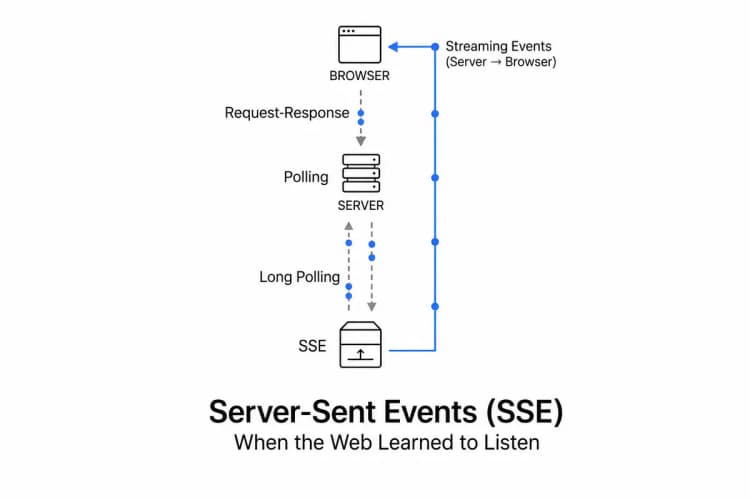
Server-Sent Events (SSE)
Long Polling still requires frequent reconnects.
After every event:
Connection Closed
A new connection must be created.
SSE removes that overhead.
A single connection remains open.
Client -------------------------- Server
The server continuously streams updates.
Example:
CPU Usage: 42%

CPU Usage: 48%

CPU Usage: 44%
No repeated requests.
No constant reconnects.
Just a stream of updates.
Where SSE Excels
SSE works beautifully for:
- Monitoring Dashboards
- Analytics Platforms
- Reporting Systems
- Internal Tools
- Financial Dashboards
- Live Metrics
It's often overlooked because it isn't flashy.
But operationally, it's incredibly simple.
And boring systems are often excellent systems.
Enter Push
Everything changes when producers become responsible for delivery.
Instead of:
Consumer Discovers Change
We get:
Producer Distributes Change
Order Service
      |
      +----> Analytics

      +----> Inventory

      +----> Notifications
Responsibility shifts.
The producer now owns delivery.
WebSockets: Full Duplex Communication
WebSockets provide true bidirectional communication.
Instead of:
Request

Response
We get:
Client <---------------> Server
Either side can communicate at any time.
This enables:
- Chat Applications
- Multiplayer Games
- Collaborative Editors
- Live Trading Platforms
- Real-Time Notifications
The user experience becomes incredibly responsive.
Real-World Examples
When someone sends:
Hello 👋
The message appears almost instantly.
Polling would feel sluggish.
WebSockets are a natural fit.
Google Docs
Multiple users edit simultaneously.
Changes must propagate instantly.
Push communication is essential.
Online Gaming
Players cannot wait several seconds for updates.
Push becomes mandatory.
The Cost Nobody Talks About
Most discussions focus on latency.
Experienced architects worry about something else.
State.
Polling wastes requests.
Push accumulates state.
A polling server can forget clients immediately.
A WebSocket server cannot.
It must continuously track:
- User IDs
- Connection IDs
- Subscription Lists
- Heartbeats
- Presence Information
And it must maintain this information for every active connection.
Imagine 10 Million Connections
Now consider:
10 Million Connected Users
You're no longer managing APIs.
You're managing connections.
And connection management becomes infrastructure.
This is why large realtime platforms eventually build:
- Connection Gateways
- Presence Services
- Fanout Systems
- Event Brokers
- Realtime Clusters
Complexity didn't disappear.
It moved.
The Business Perspective
Engineers often ask:
Which solution is technically better?
CTOs usually ask:
Which solution costs less to operate?
Polling may consume more requests.
Push may require entire teams dedicated to realtime infrastructure.
Both have costs.
The question isn't:
Which Is Better?
The question is:
Which Cost Is Cheaper?
How Systems Usually Evolve
Most systems don't start with WebSockets.
They evolve gradually.
Polling

↓

Long Polling

↓

SSE

↓

WebSockets

↓

WebSockets + Pub/Sub

↓

Realtime Infrastructure Platform
This progression appears throughout the industry.
Not because engineers love complexity.
Because scale eventually demands it.
Push vs Pull: Quick Comparison
| Characteristic | Pull | Push |
|---|---|---|
| Complexity Location | Consumer | Producer |
| State Management | Low | High |
| Infrastructure Simplicity | High | Medium |
| Request Volume | Higher | Lower |
| Latency | Higher | Lower |
| Scalability | Excellent | Excellent (with more complexity) |
| Operational Cost | Lower | Higher |
| Best For | Status Checks, APIs | Realtime Experiences |
The Mental Model That Actually Matters
Junior engineers often ask:
Should we use WebSockets?
Senior engineers ask:
Where should complexity live?
Should consumers discover changes?
Or should producers distribute them?
That's the real decision.
Because Push vs Pull isn't really a networking discussion.
It's a complexity allocation discussion.
And every architecture eventually pays the bill.
The only question is:
Who pays it?
TL;DR Quick Recap
- Pull means consumers discover changes.
- Push means producers distribute changes.
- Polling is the simplest Pull strategy.
- Long Polling reduces wasted requests.
- SSE streams updates efficiently.
- WebSockets enable true realtime communication.
- Polling wastes requests.
- Push systems accumulate state.
- Complexity never disappears.
- Architecture is largely about deciding where complexity belongs.
Final Thoughts
Every Pull system eventually asks:
Why are we wasting so many requests?
Every Push system eventually asks:
Why are we managing so much state?
Neither approach is universally better.
Neither approach eliminates complexity.
The goal of architecture isn't to remove complexity.
The goal is to decide where it lives.
And once you understand that, Push vs Pull stops being a networking decision.
It becomes a systems design decision.
A Little Joke to End On
Why did the WebSocket server need therapy?
Because it was carrying millions of connections and couldn't let go. 😄
Frequently Asked Questions
What is Pull communication?
Pull communication requires consumers to actively check for updates.
What is Push communication?
Push communication allows producers to proactively deliver updates.
Is polling bad?
Not necessarily.
Polling is simple, reliable, and often easier to operate at scale.
What is Long Polling?
Long Polling keeps requests open until updates become available.
What is Server-Sent Events (SSE)?
SSE allows servers to continuously stream updates over a single connection.
What are WebSockets?
WebSockets provide persistent bidirectional communication between clients and servers.
Why do large systems still use Pull?
Because Pull distributes responsibility and reduces centralized coordination complexity.
Why are WebSockets harder to operate?
Because they require persistent connection management and state tracking.
Is Push always faster?
Usually yes for delivering updates, but it comes with additional infrastructure complexity.
What is the real Push vs Pull tradeoff?
Polling wastes requests.
Push systems accumulate state.
Architectures choose which cost is cheaper.
Key Takeaways
- Push and Pull solve the same problem differently.
- Pull distributes complexity.
- Push centralizes delivery responsibility.
- Polling is simple but wasteful.
- Long Polling reduces unnecessary requests.
- SSE provides efficient streaming.
- WebSockets enable realtime experiences.
- State management becomes a major challenge in Push systems.
- Complexity never disappears it moves.
- Great architects focus on where complexity should live.
If you found this article useful, share it with fellow backend engineers, system architects, platform engineers, and distributed systems enthusiasts exploring communication patterns at scale.
About the Author
Anik Sikder is a Software Engineer specializing in Backend Systems, SaaS Architecture, Cloud Infrastructure, Python, Django, FastAPI, distributed systems, and scalable software engineering.
He writes about system design, networking, distributed systems, cloud computing, software architecture, and modern engineering practices.