Hey developers! 👋
Welcome back to our journey through web communication and internet architecture.
Throughout this series, we've seen the same pattern repeat itself again and again:
Every generation of web infrastructure solved one bottleneck only to expose another.
The evolution looked something like this:
HTTP/1.0
    ↓
Connection Setup Overhead
    ↓
HTTP/1.1
    ↓
Persistent Connections
    ↓
Head-of-Line Blocking
    ↓
Connection Pooling
    ↓
Connection Overhead
    ↓
HTTP/2 Multiplexing
Each improvement solved a real problem.
Each improvement also revealed a new one.
Today we're exploring one of the most important architectural shifts in the history of the web:
Connection Pooling vs Multiplexing
Because this wasn't just a protocol upgrade.
It fundamentally changed how browsers, servers, CDNs, load balancers, and modern applications communicate.
The Problem Nobody Intended to Create
Imagine it's 2012.
A user opens your e-commerce homepage.
The browser suddenly needs:
- HTML
- CSS files
- JavaScript bundles
- Product images
- Recommendation widgets
- Analytics scripts
- Tracking pixels
- Fonts
A single page can easily require:
100+ Requests
The browser isn't struggling to find content.
It's struggling to retrieve everything efficiently.
The HTTP/1.1 Limitation
HTTP/1.1 introduced persistent connections.
That was a huge improvement.
Instead of creating a new TCP connection for every request:
Create TCP
Request
Response
Close
the browser could reuse connections.
However, requests on a connection were still processed sequentially.
Connection 1

Request A
Response A

Request B
Response B

Request C
Response C
At first glance this seems reasonable.
Until Request A becomes slow.
The Hidden Bottleneck
Imagine:
Request A = Large Image
While that image downloads:
Request B Waits
Request C Waits
Request D Waits
Everything behind the slow request becomes blocked.
This became known as:
Head-of-Line Blocking
One slow operation delayed unrelated work.
The browser quickly discovered something painful:
More Assets
      ↓
More Waiting
      ↓
Slower Pages
The First Large-Scale Workaround
Browser vendors couldn't redesign HTTP overnight.
So they asked a different question.
Instead of:
How do we make one connection faster?
They asked:
What if we open more connections?
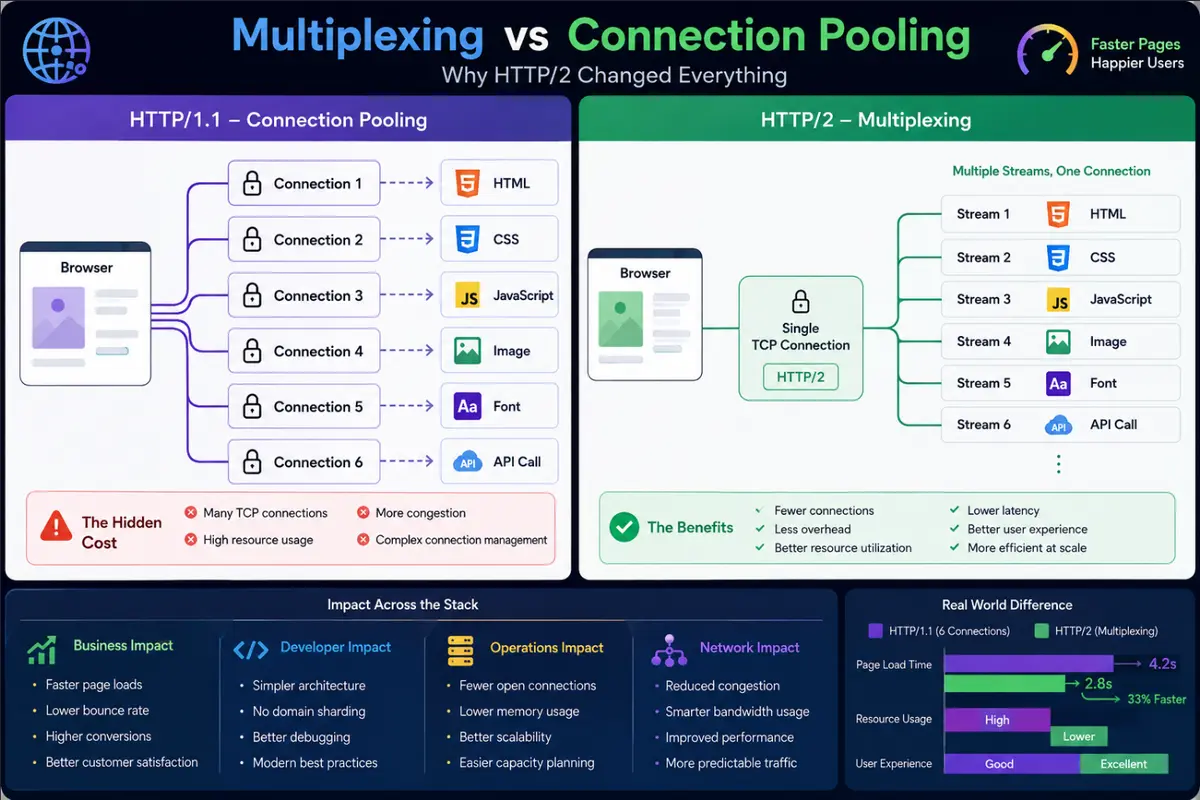
The result looked like this:
Connection 1
Connection 2
Connection 3
Connection 4
Connection 5
Connection 6
Instead of one connection handling everything, work was distributed.
Example:
Connection 1 → CSS
Connection 2 → JavaScript
Connection 3 → Image
Connection 4 → Image
Connection 5 → Font
Connection 6 → API
Requests could now progress simultaneously.
Page performance improved dramatically.
This workaround became known as:
Connection Pooling
What Is Connection Pooling?
Connection Pooling means maintaining a collection of reusable connections instead of creating new connections repeatedly.
Without pooling:
Request
Create TCP
TLS Handshake
Send
Close
For every operation.
With pooling:
Pool

Connection 1
Connection 2
Connection 3
Connection 4
Connection 5
Connection 6
Incoming requests use existing connections.
Request A → Connection 1
Request B → Connection 2
Request C → Connection 3
This reduces:
- TCP handshake overhead
- TLS handshake overhead
- Connection setup latency
- Resource waste
For years, it worked surprisingly well.
Why Businesses Loved Connection Pooling
Most executives never heard the term.
They simply noticed results.
Before pooling:
Slow Pages
Higher Bounce Rates
Lower Conversions
After pooling:
Faster Pages
Lower Bounce Rates
Better User Experience
For businesses:
Faster Experiences
        =
Better Outcomes
The technical implementation didn't matter.
The business impact did.
The Scaling Problem Nobody Talks About
Now imagine a large marketplace.
Traffic:
500,000 Active Users
Browser behavior:
6 Connections Per Origin
Potential active connections:
3,000,000 TCP Connections
Suddenly infrastructure teams notice something strange.
Servers aren't overwhelmed by requests.
They're overwhelmed by connections.
The Hidden Cost of Connection Pooling
Every TCP connection consumes resources.
Client
   │
TCP State
TLS State
Receive Buffer
Send Buffer
Kernel Metadata
   │
Server
Now multiply that by millions.
The cost becomes significant.
Infrastructure teams start asking:
Are we spending more resources managing connections than serving content?
At scale, the answer can be surprisingly close to yes.
Another Problem: Congestion Control
Each TCP connection behaves independently.
Imagine:
Connection 1
Connection 2
Connection 3
Connection 4
Connection 5
Connection 6
Each connection maintains:
- Its own congestion window
- Its own packet retransmissions
- Its own packet loss recovery
- Its own flow control
The browser is effectively pretending to be six separate clients.
The protocol wasn't designed for this behavior.
It was simply the best available workaround.
The Dangerous Question HTTP/2 Asked
Engineers eventually looked at the situation and asked:
Why are we opening six connections just to achieve parallelism?
What if one connection could handle many requests simultaneously?
Instead of:
Connection 1
Connection 2
Connection 3
Connection 4
Connection 5
Connection 6
What if we used:
Connection 1
 ├─ Request A
 ├─ Request B
 ├─ Request C
 ├─ Request D
 └─ Request E
One connection.
Many conversations.
That idea became:
Multiplexing
Understanding Multiplexing
HTTP/2 introduced a new concept:
Streams
Requests no longer owned connections.
They owned streams.
TCP Connection
     │
 ┌───┼───────────┐
 │   │           │
Stream 1
Stream 2
Stream 3
Stream 4
Stream 5
Each request receives its own stream.
Example:
Stream 1 → CSS
Stream 2 → JavaScript
Stream 3 → Image
Stream 4 → API
Stream 5 → Font
All streams share a single TCP connection.
Think of It Like a Highway
Connection Pooling says:
Build Multiple Roads
Road 1
Road 2
Road 3
Road 4
Road 5
Road 6
Traffic spreads across them.
Multiplexing says:
Build One Intelligent Highway
Highway
 ├─ Lane 1
 ├─ Lane 2
 ├─ Lane 3
 ├─ Lane 4
 └─ Lane 5
Many vehicles travel simultaneously.
But they share the same infrastructure.
That's the key difference.
The Magic Behind Multiplexing
HTTP/1.1
Request A
Response A

Request B
Response B

Request C
Response C
Everything waits its turn.
HTTP/2
A1
B1
C1

A2
B2
C2

A3
B3
C3
Data from multiple streams becomes interleaved.
The connection continuously carries work from multiple requests.
No single request owns the connection.
The connection belongs to everyone.
This is true multiplexing.
Real Example: Product Page Loading
Imagine a product page requiring:
HTML
5 CSS Files
10 JS Files
20 Images
2 APIs
Total:
38 Resources
HTTP/1.1
Connection Pool

Connection 1
Connection 2
Connection 3
Connection 4
Connection 5
Connection 6
Resources are distributed across the pool.
Some connections become overloaded.
Others sit idle.
The browser constantly manages balancing.
HTTP/2
Single Connection

Stream 1
Stream 2
Stream 3
...
Stream 38
All resources travel simultaneously through the same connection.
The browser no longer plays connection management games.
The protocol handles concurrency natively.
Why Developers Loved HTTP/2
Before HTTP/2, frontend engineers invented creative workarounds.
CSS Sprites
Instead of:
icon1.png
icon2.png
icon3.png
they combined them into:
sprites.png
JavaScript Bundling
Instead of:
20 JavaScript Files
they shipped:
app.bundle.js
Domain Sharding
Instead of:
cdn.example.com
they used:
img1.example.com
img2.example.com
img3.example.com
This forced browsers to create additional connection pools.
These techniques existed largely because HTTP/1.1 had connection limitations.
Multiplexing removed many of those constraints.
Why Business Leaders Care
Most buyers never hear words like:
Multiplexing
Streams
Congestion Windows
They see metrics.
Before:
Page Load Time: 4.2s
Bounce Rate: Higher
Conversion Rate: Lower
After optimization:
Page Load Time: 2.8s
Bounce Rate: Lower
Conversion Rate: Higher
Users don't care whether the improvement came from:
- HTTP/2
- Multiplexing
- Compression
- CDN optimization
- Better caching
They simply experience speed.
And for many businesses:
Speed
   =
Revenue
The Postmortem Nobody Expected
Many teams upgraded to HTTP/2 expecting:
6 Connections
      ↓
1 Connection
      ↓
6× Faster
Reality was more complicated.
Because HTTP/2 still runs on:
TCP
And TCP still experiences packet loss.
Imagine:
Packet Lost
TCP responds:
Wait
Retransmit
Recover
The problem?
All streams share the same connection.
Meaning:
Stream 1 Waits
Stream 2 Waits
Stream 3 Waits
Stream 4 Waits
HTTP/2 eliminated Head-of-Line Blocking at the HTTP layer.
But exposed it at the TCP layer.
Once again:
Problem Solved
      ↓
New Problem Discovered
The recurring story of internet engineering.
Connection Pooling vs Multiplexing
| Feature | Connection Pooling | Multiplexing |
|---|---|---|
| Connections | Many | One |
| Parallelism | Multiple Connections | Multiple Streams |
| Resource Usage | Higher | Lower |
| TCP State | Per Connection | Shared |
| Congestion Control | Per Connection | Shared |
| Scalability | Good | Better |
| Introduced In | HTTP/1.1 Era | HTTP/2 |
The Architect's Lesson
Connection Pooling was never the final destination.
It was a clever workaround.
Multiplexing was the architectural correction.
The web spent years fighting HTTP/1.1 limitations by creating more and more connections.
HTTP/2 changed the question entirely.
Instead of asking:
How many connections do we need?
Engineers started asking:
How much work can a single connection perform?
That shift may sound small.
But it fundamentally changed how browsers, servers, load balancers, CDNs, and modern applications communicate.
TL;DR Quick Recap
- HTTP/1.1 suffered from Head-of-Line Blocking.
- Browsers worked around the issue using Connection Pooling.
- Connection Pooling reuses multiple TCP connections.
- At scale, managing connections becomes expensive.
- HTTP/2 introduced Multiplexing.
- Multiplexing allows many streams to share one connection.
- This improves connection utilization and efficiency.
- HTTP/2 removed many HTTP/1.1 workarounds.
- TCP-level Head-of-Line Blocking still remained.
- This limitation eventually inspired HTTP/3 and QUIC.
Final Thoughts: One Smarter Connection 🧠
For years, the web believed performance required more connections.
More connections meant more parallelism.
More parallelism meant faster pages.
HTTP/2 challenged that assumption.
Instead of multiplying connections, it multiplied capabilities.
One connection could now carry many independent streams.
The result was a simpler, more efficient, and more scalable communication model.
And like every major infrastructure improvement before it, Multiplexing solved a bottleneck while revealing the next one.
Because the history of internet architecture is often the same story repeated:
Every solution changes the question.
And HTTP/2 changed it dramatically.
A Little Engineering Joke to End On 😄
Why did HTTP/2 stop opening six connections?
Because it realized one connection could multitask better than six stressed-out ones.
Frequently Asked Questions
What is Connection Pooling?
Connection Pooling is the practice of maintaining reusable network connections rather than creating new ones for every request.
What is Multiplexing?
Multiplexing allows multiple independent streams to share a single connection simultaneously.
Why did browsers use Connection Pooling?
To work around HTTP/1.1 Head-of-Line Blocking and improve parallel request processing.
Why is HTTP/2 Multiplexing better?
It provides concurrency without requiring many separate TCP connections.
Does HTTP/2 eliminate Head-of-Line Blocking completely?
No.
It removes HTTP-layer blocking but TCP-level packet loss can still block all streams.
Why did HTTP/3 emerge?
HTTP/3 and QUIC were designed to eliminate TCP-level Head-of-Line Blocking and further improve connection efficiency.
Key Takeaways
- Connection Pooling solved HTTP/1.1 scalability problems.
- Browsers achieved parallelism using multiple TCP connections.
- Managing millions of connections creates operational overhead.
- HTTP/2 introduced Multiplexing through streams.
- Multiplexing improves connection utilization and efficiency.
- Developers could eliminate many HTTP/1.1 optimization hacks.
- Businesses benefited from faster page loads and better user experience.
- HTTP/2 exposed TCP-level limitations that eventually led to HTTP/3 and QUIC.
If you found this article useful, share it with fellow backend engineers, system architects, platform engineers, and distributed systems enthusiasts exploring communication patterns at scale.
About the Author
Anik Sikder is a Software Engineer specializing in Backend Systems, SaaS Architecture, Cloud Infrastructure, Python, Django, FastAPI, distributed systems, and scalable software engineering.
He writes about system design, networking, distributed systems, cloud computing, software architecture, and modern engineering practices.