Hey telecom and software engineers!
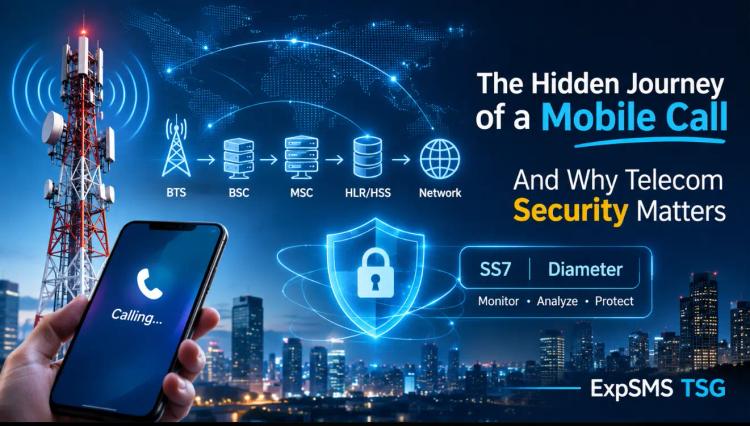
In our discussion about telecom network architecture, we explored how mobile networks communicate through signaling protocols such as SS7 and Diameter.
But understanding how a network communicates is only one side of the equation.
There is another important question:
How do we know whether the communication happening inside a telecom network is actually legitimate?
Think about it.
A network may have trusted signaling connections, authorized operators, and properly configured infrastructure.
But does that automatically mean every message coming through those connections is safe?
Not necessarily.
A legitimate signaling connection can still carry an unauthorized operation. An authorized peer can behave abnormally. And a message that looks perfectly valid at the network level may violate the operator's security policies.
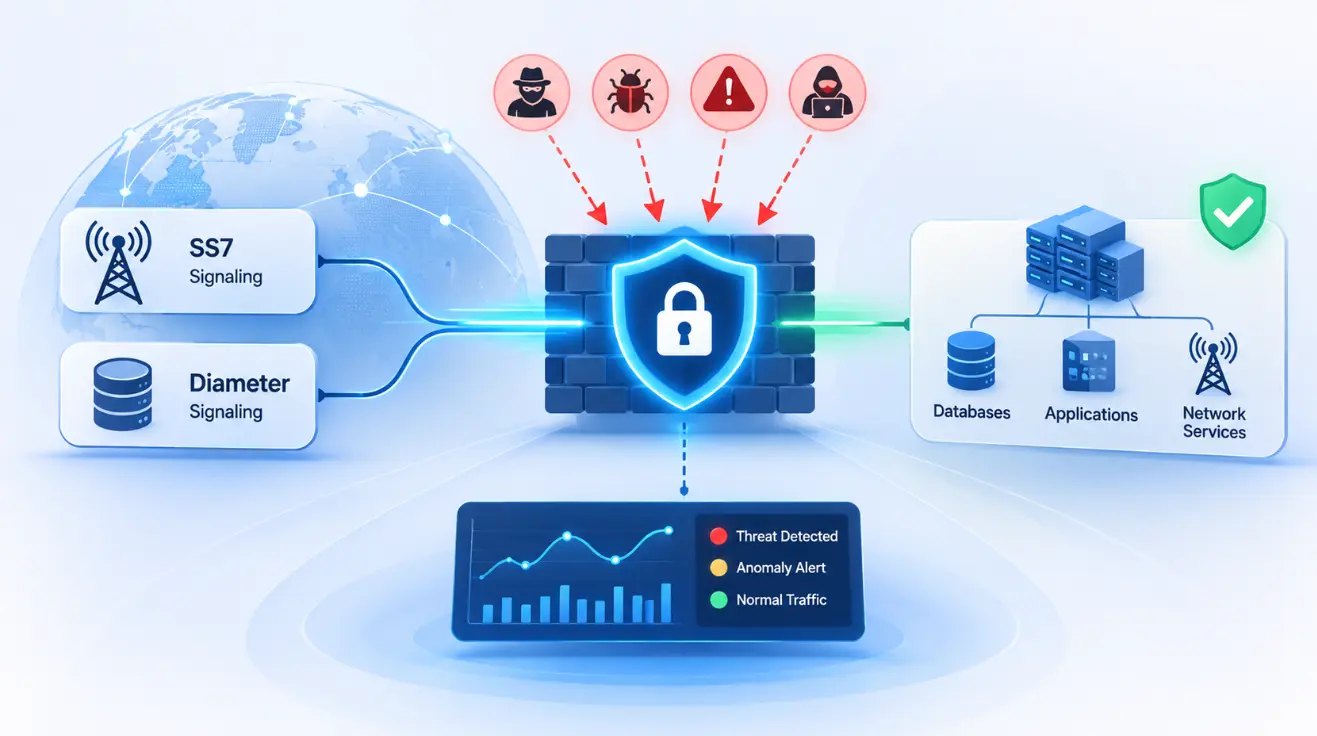
This is where Telecom Firewalls become important.
Before designing a specialized Telecom Security Gateway, I think it is worth understanding the security architecture behind traditional firewalls, how traffic inspection works, and why telecom signaling requires a different level of visibility.
Let's explore.
What Is a Firewall?
At its core, a firewall is a security system that monitors network traffic and makes decisions based on predefined security policies.
Think about a typical enterprise network.
An organization may have:
- Application servers
- Database servers
- Internal services
- External network connections
- Administrative interfaces
Not every system should communicate with every other system.
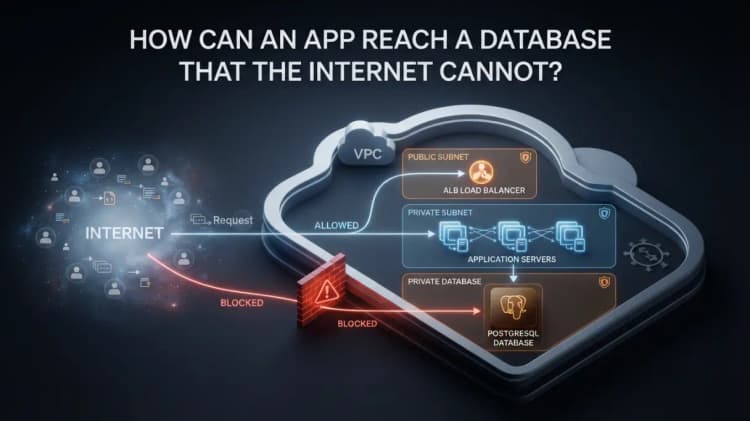
For example, a database server may accept connections from an authorized application server but should never be directly accessible from the public internet.
A firewall enforces these boundaries.
A simplified firewall policy might look like this:
| Traffic | Decision |
|---|---|
| Authorized HTTPS connection | Allow |
| Unauthorized SSH connection | Block |
| Unknown port access | Block |
| Known malicious source | Block |
| Approved application traffic | Allow |
The important thing is that a firewall does not simply block everything.
It evaluates communication against security policies.
A firewall is essentially a policy enforcement point between network communication and the resources being protected.
Understanding Different Types of Firewalls
Not every firewall inspects traffic in the same way.
Some examine packet headers. Others maintain connection information. More advanced systems inspect application-level communication.
Understanding these differences is important because they define how much information a security system can use when making decisions.
Packet Filtering Firewall
This is one of the most fundamental firewall architectures.
A packet filtering firewall examines information available in network packet headers.
Typically, it evaluates:
- Source IP address
- Destination IP address
- Source port
- Destination port
- Protocol (TCP/UDP)
For example, imagine an application server:
Server IP: 192.168.1.100
Allowed Port: 443
Protocol: TCP
The firewall can enforce a rule like this:
Source: Any
Destination: 192.168.1.100
Protocol: TCP
Destination Port: 443
Action: ALLOW
Any traffic that does not match the permitted policy can be rejected or dropped.
This approach is efficient and useful for controlling network access.
However, it has a limitation.
It generally does not understand what is happening inside the application communication.
For example, allowing TCP port 443 does not automatically mean that every HTTPS request is legitimate.
The firewall may know where the packet is going, but it does not necessarily understand the operation being performed.
Stateful Firewall
Traditional packet filtering treats packets largely as individual units.
A stateful firewall introduces connection awareness.
Instead of examining every packet independently, it maintains information about active connections.
Consider a TCP connection:
Client                  Server
  |                        |
  |-------- SYN ---------->|
  |                        |
  |<------ SYN-ACK --------|
  |                        |
  |-------- ACK ---------->|
  |                        |
  |     ESTABLISHED        |
The firewall tracks the connection lifecycle.
For example:
| Source | Destination | State |
|---|---|---|
| 10.0.0.5:5000 | 10.0.0.10:443 | ESTABLISHED |
| 10.0.0.8:6000 | 10.0.0.10:443 | ESTABLISHED |
Now, when a response packet arrives, the firewall can determine whether it belongs to an existing connection.
This is important because communication is not simply a collection of unrelated packets. It has context and state.
There is an interesting connection with telecom signaling here.
SS7 and Diameter also involve relationships between messages, requests, responses, and transactions.
However, TCP connection tracking and telecom signaling transaction tracking are not the same thing.
A single TCP connection can carry multiple Diameter transactions. Understanding those transactions requires protocol-level inspection.
This distinction becomes important when designing a Telecom Security Gateway.
Application Layer Firewall
Now we move beyond network headers and connection states.
An application-aware firewall can inspect information within application-level communication.
Consider an HTTP request:
GET /admin/users HTTP/1.1
Host: example.com
A basic packet filtering firewall may only see TCP port 443.
An application-aware security system can inspect:
- HTTP methods
- Request URLs
- Headers
- Application payloads
- Protocol behavior
This provides a much deeper understanding of what is actually happening inside a connection.
Several technologies are associated with application-aware inspection:
- Deep Packet Inspection (DPI)
- Application identification
- Content inspection
- Protocol validation
- Intrusion detection
One important distinction:
DPI is an inspection capability, not a complete firewall product.
It provides the ability to examine traffic deeply. Other components are responsible for interpreting the information, evaluating policies, and making security decisions.
Meet IDS and IPS
Two important concepts in network security are IDS and IPS.
They are often mentioned together, but they have different responsibilities.
Intrusion Detection System (IDS)
An IDS monitors network activity and identifies suspicious behavior.
Its primary responsibility is detection.
A simplified architecture looks like this:
       Network Traffic
              |
       +------+------+
       |             |
       v             v
   Destination      IDS
                     |
                     v
                Analyze Traffic
                     |
                     v
               Detect Threats
                     |
                     v
                Generate Alert
The IDS observes traffic and generates security events.
In a passive monitoring deployment, it does not modify or block the original communication.
This is particularly useful when an organization wants to monitor its existing network without introducing additional dependencies into the production traffic path.
Intrusion Prevention System (IPS)
An IPS goes one step further.
It monitors traffic, detects potential threats, and can take enforcement actions according to security policies.
          Incoming Traffic
                 |
                 v
                IPS
                 |
          Policy Evaluation
                 |
          +------+------+
          |             |
          v             v
        ALLOW          BLOCK
          |             |
          v             v
     Destination    Drop Traffic
The difference is significant.
An IDS primarily observes and reports.
An IPS can actively interfere with communication.
That means an IPS deployed inline becomes part of the production traffic path.
Its reliability, processing latency, throughput, and failure-handling mechanisms directly affect network operations.
IDS vs IPS
| Feature | IDS | IPS |
|---|---|---|
| Traffic monitoring | Yes | Yes |
| Threat detection | Yes | Yes |
| Alert generation | Yes | Yes |
| Traffic blocking | Generally No | Yes |
| Typical deployment | Out-of-band | Inline |
| Direct impact on traffic | Usually No | Yes |
This distinction is especially important when designing telecom security infrastructure.
Why Traditional Firewalls Are Not Enough for Telecom Networks
Now comes the interesting part.
A traditional IP firewall understands network-level information such as:
Source IP:      10.10.10.5
Destination IP: 10.10.10.10
Protocol:       TCP
Port:           443
But telecom signaling contains much more meaningful information.
Consider an SS7 message.
Its security relevance may depend on:
- Originating signaling peer
- Point Code
- Global Title
- SCCP addressing information
- MAP operation
- Subscriber-related information
- Transaction context
Diameter introduces another set of protocol-specific information:
- Origin-Host
- Origin-Realm
- Application-ID
- Command-Code
- Session information
- Peer authorization
A conventional IP firewall may allow the transport connection while remaining unaware of whether the signaling operation carried through that connection is legitimate.
For example:
A signaling peer may be authorized to communicate with an operator.
However, that does not automatically mean it is authorized to perform every MAP operation or Diameter command.
This is the fundamental difference.
Network-level trust and signaling-level trust are two different security decisions.
A Telecom Firewall needs to understand both.
Understanding Telecom Signaling Security Threats
Telecom signaling supports some of the most sensitive operations inside a mobile network.
Depending on the protocol and network architecture, signaling is involved in:
- Subscriber authentication
- Location management
- Call routing
- SMS routing
- Subscriber information queries
- Mobility management
If these signaling interfaces are abused, they can create serious security risks.
Let's consider a few practical scenarios.
Unauthorized Signaling Peer
Imagine an MNO has a defined list of trusted signaling peers.
| Peer | Global Title | Status |
|---|---|---|
| Operator A | 123456 | Authorized |
| Operator B | 789012 | Authorized |
Now an incoming SS7 message arrives:
Protocol: SS7

Source GT:      555555
Destination GT: 123456

MAP Operation: AnyTimeInterrogation
A conventional IP firewall might check whether the source IP address is permitted.
But a Telecom Security Gateway needs to evaluate additional information.
For example:
- Is the originating signaling peer authorized?
- Is its Global Title recognized?
- Is the requested MAP operation permitted?
- Is this peer allowed to perform this operation?
- Does the message violate the operator's security policy?
If the message violates a configured security policy, the platform can generate an alert.
An important consideration: an unknown Global Title does not automatically mean an attack. The system must understand the operator's actual network topology and trusted-peer configuration.
Subscriber Information Query Abuse
Now imagine an authorized signaling peer.
It normally performs subscriber-related queries as part of legitimate network operations.
But suddenly, its behavior changes.
| Time | Query Count |
|---|---|
| 10:00–10:01 | 50 |
| 10:01–10:02 | 45 |
| 10:02–10:03 | 55 |
| 10:03–10:04 | 8,000 |
The peer is trusted, but its behavior is unusual.
This is where static allowlists become insufficient.
A security platform needs behavioral visibility.
It should be able to evaluate:
- Request frequency
- Operation distribution
- Subscriber query patterns
- Peer-specific traffic baselines
- Unusual activity over time
An abnormal increase can trigger a security alert.
However, an increase in traffic is not necessarily an attack. Legitimate network events can also produce traffic spikes.
This is why a mature detection engine should distinguish between an observed anomaly, a policy violation, and a confirmed security incident.
Abnormal Diameter Activity
Diameter introduces another set of security considerations.
Imagine an unknown Diameter host attempting to communicate with an operator's signaling infrastructure.
A protocol-aware security system needs to inspect fields such as:
Origin-Host
Origin-Realm
Application-ID
Command-Code
Session-Id
It can then evaluate:
- Is the peer authorized?
- Is the origin identity expected?
- Is the Application-ID permitted?
- Is the Command-Code allowed?
- Does the message follow expected protocol behavior?
A violation of the configured policy can generate a security event.
The important architectural point is that the system must understand Diameter semantics, not simply the transport connection carrying Diameter.
How Does a Telecom Security Gateway Process Traffic?
Understanding individual security concepts is useful.
But the real engineering challenge is combining them into a reliable processing architecture.
A Telecom Security Gateway is not simply a packet analyzer with a dashboard.
It requires several cooperating components.
Consider a simplified processing pipeline:
        Telecom Signaling Network
                   |
                   v
            Traffic Acquisition
                   |
                   v
              Packet Capture
                   |
                   v
             Protocol Decoder
               /         \
              v           v
             SS7       Diameter
               \         /
                v       v
              Event Processing
                   |
                   v
            Security Detection
                   |
             +-----+-----+
             |           |
             v           v
           Normal    Suspicious
             |           |
             v           v
         Metrics      Alert Engine
                          |
                          v
                  Incident Management
                          |
                          v
                    Management UI
Let's look at why these components exist.
Traffic Acquisition
The platform first needs access to signaling traffic.
Depending on the network deployment, traffic can be acquired through:
- Network TAP
- SPAN / mirror ports
- Supported packet-feed mechanisms
For passive monitoring, the platform receives a copy of the original traffic.
It does not need to become a forwarding device.
Packet Capture
Once traffic reaches the platform, the packet capture subsystem receives raw network packets.
Its responsibility is to capture traffic efficiently and provide it to the processing pipeline.
It should not be responsible for making high-level security decisions.
For a production telecom environment, capture performance matters significantly.
If packets are lost at this stage, downstream components may never see the messages needed to identify suspicious activity.
Protocol Decoder
Raw packets are not particularly useful to a security analyst.
The system needs to understand the protocols carried inside them.
This is the responsibility of the protocol decoder.
For the initial ExpSMS TSG scope, the protocol engine needs to understand:
- SS7
- Diameter
SS7 decoding involves understanding the relevant protocol layers and their relationships.
Diameter decoding involves parsing its message structure, headers, commands, and relevant attributes.
The output should be structured protocol information rather than raw packet data.
Event Processor
The event processor converts decoded protocol information into structured events that downstream components can consume.
For example:
{
  "protocol": "SS7",
  "source_gt": "555555",
  "destination_gt": "123456",
  "operation": "AnyTimeInterrogation",
  "timestamp": "2026-11-13T10:00:00Z"
}
This is an illustrative event structure.
The important architectural principle is separation of responsibilities.
The protocol decoder understands the protocol.
The event processor organizes decoded information into a consistent representation.
This also makes the architecture easier to extend when additional signaling protocols are introduced.
Security Detection Engine
This is where protocol intelligence becomes security intelligence.
The detection engine evaluates structured events against security policies and behavioral conditions.
Examples include:
- Unauthorized signaling peers
- Unexpected MAP operations
- Abnormal subscriber query activity
- Unexpected Diameter hosts
- Unauthorized Diameter commands
- Unusual signaling traffic patterns
The detection engine should not need to understand packet capture internals or raw protocol encoding.
It should work with structured events and well-defined detection rules.
Alert and Incident Management
Detecting suspicious activity is only part of the problem.
Security teams need to understand what happened and investigate it.
The alert subsystem handles notification and security event visibility.
An incident management layer can help analysts:
- Review suspicious activity
- Investigate related events
- Track incident status
- Record investigation findings
- Maintain an audit trail
These responsibilities transform a packet monitoring engine into an operational security platform.
Why Passive Monitoring Makes Sense for ExpSMS TSG
There is an important architectural decision behind the initial ExpSMS TSG design.
Should the platform simply observe signaling traffic, or should it actively control that traffic?
These are two different operational models.
Passive Monitoring
In passive mode:
- The system receives a copy of network traffic.
- It decodes signaling protocols.
- It analyzes messages.
- It detects suspicious behavior.
- It generates alerts and reports.
- It does not modify or block original traffic.
             Original Traffic
                    |
                    v
                Network
                    |
                    v
                Destination

                    |
               Mirrored Copy
                    |
                    v
                 ExpSMS TSG
                    |
                    v
              Decode & Analyze
                    |
                    v
               Threat Detection
                    |
                    v
                  Alert
Active Enforcement
In active mode, the security platform participates directly in the traffic path.
          Incoming Signaling
                    |
                    v
                ExpSMS TSG
                    |
               Policy Engine
                    |
             +------+------+
             |             |
             v             v
           ALLOW          REJECT
             |             |
             v             v
         Destination    Drop Message
Now the platform is responsible for more than detecting threats.
It must make enforcement decisions without introducing unacceptable latency or disrupting legitimate signaling communication.
This introduces additional engineering requirements:
- High availability
- Failover behavior
- Throughput
- Processing latency
- Policy synchronization
- Network integration
- Failure handling
For an MNO, incorrectly blocking a signaling message can have consequences beyond a normal application request.
That is why active enforcement should not be treated as a simple extension of passive monitoring.
For ExpSMS TSG, the initial architectural decision is:
Passive monitoring first. Active enforcement later.
The immediate objective is to establish reliable signaling visibility, protocol decoding, and threat detection without becoming a dependency in the production signaling path.
Why First-Class Component Responsibilities Matter
One thing I would emphasize when designing this kind of platform is component responsibility.
A common architectural mistake is trying to make one large application responsible for packet capture, protocol decoding, threat detection, alerting, and reporting.
It may work for an early prototype.
But as traffic volume increases and new capabilities are introduced, the responsibilities become difficult to manage independently.
Consider the following separation:
| Component | Primary Responsibility |
|---|---|
| Traffic Acquisition | Receive network traffic |
| Packet Capture | Capture packets |
| Protocol Engine | Understand SS7 and Diameter |
| Event Processor | Generate structured events |
| Security Engine | Detect threats |
| Policy Engine | Evaluate security policies |
| Peer Management | Maintain trusted peers |
| Alert Management | Generate and manage alerts |
| Incident Management | Support investigations |
| Reporting | Provide security visibility |
| Management Console | Central administration |
| High Availability | Maintain service continuity |
| Enforcement Engine | Control traffic in active mode |
Each component has a different responsibility.
For example, adding another protocol should not require rewriting the entire detection engine.
A new decoder should be able to produce events that follow a common event model.
Similarly, introducing a new detection rule should not require changes to packet capture.
This separation creates a foundation for an extensible enterprise security platform.
Why Telecom Firewall Architecture Matters
This is where the discussion becomes particularly interesting from a system design perspective.
Building a Telecom Security Gateway is not simply a matter of writing detection rules.
It requires a reliable processing pipeline where every stage contributes to the quality of the final security decision.
Consider what happens if:
- Packet capture loses messages.
- The protocol decoder cannot interpret certain valid messages.
- Event processing loses transaction context.
- The detection engine evaluates incomplete information.
- Alert management fails to deliver important security events.
Even if the detection rules themselves are sophisticated, the overall platform will not be reliable.
The system must therefore be designed around the integrity of the complete pipeline.
For ExpSMS TSG, the initial engineering priorities should be:
- Reliable packet acquisition
- Accurate SS7 and Diameter decoding
- Consistent event representation
- Configurable security policies
- Peer-level visibility
- Behavioral monitoring
- Reliable alert generation
- Operational observability
These are not isolated features.
They are interconnected capabilities that determine whether the platform can provide trustworthy security visibility inside a real MNO environment.
Why This Architecture Is Important for ExpSMS TSG
The goal of ExpSMS TSG is to build a vendor-neutral Telecom Security Gateway capable of monitoring and analyzing SS7 and Diameter signaling traffic.
The initial product is designed around passive monitoring.
That means its primary responsibility is to:
- Observe signaling traffic.
- Decode telecom protocols.
- Generate structured events.
- Evaluate security policies.
- Detect suspicious activities.
- Generate actionable alerts.
- Provide visibility through a centralized management interface.
The platform should also be designed with future extensibility in mind.
However, extensibility does not mean implementing every possible feature from the beginning.
The initial priority is to build a reliable foundation.
A system that accurately captures, decodes, and analyzes signaling traffic is much more valuable than a feature-rich dashboard built on top of unreliable packet processing.
Final Thoughts
What makes Telecom Firewall engineering interesting is that the security problem exists at multiple layers.
An IP address may be trusted, a transport connection may be established, and a signaling peer may be authorized.
Yet the actual operation being performed can still violate security policies.
That is why telecom security cannot stop at network-level filtering.
It needs protocol awareness, transaction context, behavioral analysis, and a reliable processing architecture.
For ExpSMS TSG, the initial objective is not to build the biggest possible security platform.
It is to build a reliable system that can observe SS7 and Diameter signaling, understand what is happening, and provide meaningful security intelligence to telecom operators.
Everything else should build on that foundation.
A Little Thought to End On
A network firewall asks whether traffic is allowed to enter. A Telecom Security Gateway also needs to understand what that traffic is trying to do.
Key Takeaways
- Firewall architecture is about more than blocking IP addresses.
- Security decisions depend on how deeply a system understands network communication.
- Stateful inspection introduces connection awareness.
- Application inspection introduces application-level visibility.
- Telecom signaling requires specialized protocol awareness.
- SS7 and Diameter messages contain security-relevant information beyond IP headers.
- IDS and IPS represent different operational models.
- Reliable packet capture and protocol decoding are foundational to detection accuracy.
- Component separation makes the platform easier to extend and maintain.
- ExpSMS TSG starts with passive monitoring and a long-term path toward active enforcement.
If you found this article useful, share it with fellow telecom and software engineers.
About the Author
Anik Sikder is a Software Engineer and Assistant System Engineer at ExpSMS, working across software engineering, system architecture, and business technology solutions.
His areas of focus include SaaS and ERP architecture, Python, Django, FastAPI, multi-tenant systems, business automation, and system design.