Hey dev friends! 👋
If you’ve ever scratched your head wondering…
-
What actually is a JavaScript object?
-
Why can a simple string like
"hello"suddenly use methods like.toUpperCase()? -
What’s this wild “prototype chain” everyone keeps mentioning?
You’re in the right place. Today, we’re diving deep (but keeping it chill) into how JavaScript treats objects, primitives, and prototypes the stuff that makes JS magical yet sometimes confusing.
Ready? Let’s go! 🎢
What’s a JavaScript Object Anyway?
Think of an object as your favorite Swiss Army knife it holds all kinds of tools (properties and methods) in one neat package.
For example:
const user = {
  name: "Anik",
  age: 25,
  greet() {
    console.log(`Hey! I’m ${this.name}`);
  }
};

user.greet(); // Hey! I’m Anik
Here, user is our Swiss Army knife with name, age, and a greet function.
Not Everything Is an Object (Shocking, Right?)
JavaScript’s data falls into two camps:
1. Primitives: The Simple Data Types
-
Strings (
"hello") -
Numbers (
42) -
Booleans (
true/false) -
nullandundefined -
Symbols (unique tokens)
-
BigInts (huge numbers)
These are not objects, they’re simple values.
2. Objects: The Complex Ones
-
Arrays (
[1,2,3]) -
Functions (surprise, functions are objects too!)
-
Dates
-
Your own custom objects
Objects can have properties and methods.
So… How Can Primitives Use Methods?
Good question! If primitives aren’t objects, how can "hello".toUpperCase() work?
JavaScript uses a clever trick called wrapper objects. When you call a method on a primitive, JS temporarily wraps it in an object so it can access methods.
It’s like putting on a superhero costume just long enough to save the day:
"hello".toUpperCase(); // Behind the scenes: new String("hello").toUpperCase()
Once done, the costume comes off, and you’re back to a plain string.
Just a heads-up:
nullandundefineddon’t get this treatment, calling methods on them throws errors.
Meet the Prototype Chain: Your Object’s Family Tree
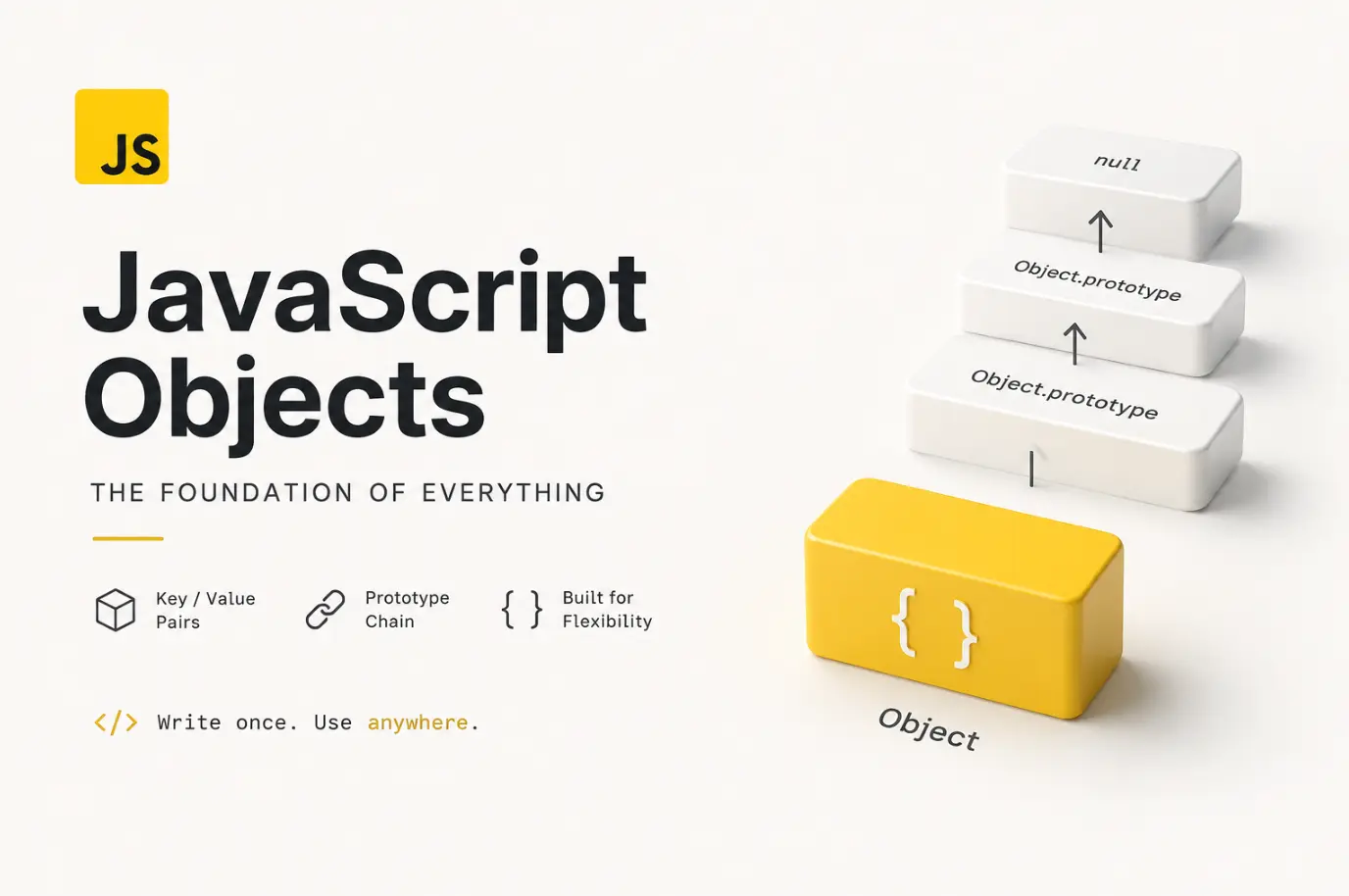
Every object secretly keeps a link to its prototype, its parent object. When you ask for a property or method that doesn’t exist on the object, JavaScript climbs this prototype chain to find it.
Imagine looking for your favorite snack:
-
You check your own kitchen (the object itself)
-
If it’s not there, you ask your roommate (the prototype)
-
If still no luck, you ask the landlord (prototype’s prototype)
-
Eventually, you might have to settle for something else or nothing (end of chain)
Example:
const arr = [1, 2, 3];
arr.push(4); // push is found on Array.prototype, not directly on arr
console.log(arr); // [1, 2, 3, 4]
Classes? Just Prototype Sugar
With ES6, JavaScript introduced classes, which look fancy but are just easier ways to write prototype-based code.
class Person {
  constructor(name) {
    this.name = name;
  }
  greet() {
    console.log(`Hi, I’m ${this.name}`);
  }
}

const anik = new Person("Anik");
anik.greet(); // Hi, I’m Anik
Behind the scenes, greet lives on Person.prototype and is shared among all instances. It’s memory-friendly and neat!
Why Should You Care About Prototypes?
Imagine if every object had its own copy of every method, your app would get bloated fast.
Thanks to prototypes, JavaScript shares methods between objects, keeping things lean and fast. It’s like everyone in your group sharing a single Netflix account instead of each buying their own. Win-win!
Bonus: Functions Are Special Objects Too!
Did you know functions in JavaScript are objects? They can have properties and even prototypes.
function sayHi() {
  console.log("Hi!");
}

sayHi.language = "English";
console.log(sayHi.language); // English
TL;DR Quick Recap
-
Primitives: Simple values, not objects
-
Wrapper Objects: Temporary objects allowing primitives to use methods
-
Objects: Collections of properties and methods
-
Prototype Chain: Lookup chain for properties and methods
-
Classes: Cleaner syntax for prototype-based inheritance
-
Functions: Objects that can have properties and prototypes
Final Thoughts: You’re Now a JavaScript Object Ninja! 🥷
Understanding these core concepts unlocks a whole new level of JS mastery. Next time you write code with strings, arrays, or classes, you’ll know exactly what’s happening behind the curtain.
A Little Joke to End On
Why don’t JavaScript devs like repeating themselves?
Because they love prototypes! 😄
Frequently Asked Questions
What is an object in JavaScript?
An object in JavaScript is a collection of key-value pairs that can store data and behavior. Objects can contain properties, methods, arrays, functions, and even other objects.
Are JavaScript primitives objects?
No. Primitive values such as strings, numbers, booleans, null, undefined, symbols, and BigInts are not objects.
However, JavaScript temporarily wraps some primitives with object wrappers when methods are accessed.
How can a string use methods if strings are primitives?
JavaScript automatically creates a temporary String object behind the scenes. This process is known as autoboxing or wrapper object creation.
"hello".toUpperCase();
The primitive remains unchanged, but the wrapper object provides access to methods.
What are wrapper objects in JavaScript?
Wrapper objects are temporary objects created by JavaScript to provide methods and properties to primitive values.
Examples include:
new String("hello");
new Number(42);
new Boolean(true);
In modern JavaScript, creating wrapper objects manually is rarely recommended.
What is the JavaScript prototype chain?
The prototype chain is JavaScript's mechanism for property and method lookup.
If a property is not found on an object, JavaScript searches its prototype, then the prototype's prototype, and continues until it reaches null.
Why do arrays have methods like push() and map()?
Array methods are not stored directly on every array instance.
Instead, they are inherited from Array.prototype through the prototype chain.
const items = [1, 2, 3];

items.push(4);
items.map((x) => x * 2);
Why are functions considered objects in JavaScript?
Functions are special objects that can be invoked.
They can also have properties, methods, and prototypes.
function greet() {}

greet.language = "English";
This dual behavior makes functions one of the most powerful features of JavaScript.
What is the difference between a primitive string and a String object?
Primitive string:
const name = "Anik";
String object:
const name = new String("Anik");
Primitive strings are recommended because they are simpler, faster, and less error-prone.
What is the difference between __proto__ and prototype?
prototype is a property found on constructor functions.
__proto__ is a reference to an object's internal prototype.
Although related, they serve different purposes and should not be confused.
Do JavaScript classes use prototypes?
Yes.
JavaScript classes are syntactic sugar over the prototype system.
Methods defined inside a class are stored on the class prototype and shared across all instances.
Why is understanding prototypes important?
Understanding prototypes helps developers:
- Write memory-efficient applications
- Understand inheritance
- Debug property lookup issues
- Master JavaScript internals
- Perform better in technical interviews
What happens when JavaScript cannot find a property?
JavaScript walks up the prototype chain searching for the property.
If it reaches the end of the chain without finding it, the result is:
undefined
Can developers create custom prototype chains?
Yes.
Developers can use:
Object.create()
or constructor functions and classes to create custom inheritance relationships.
What is prototypal inheritance in JavaScript?
Prototypal inheritance allows objects to inherit properties and methods directly from other objects without using traditional class-based inheritance systems.
Are prototypes still relevant in modern JavaScript?
Absolutely.
Even though ES6 introduced classes, the JavaScript engine still relies on prototypes internally.
Understanding prototypes remains essential for:
- Advanced JavaScript development
- Framework internals
- Performance optimization
- Technical interviews
What JavaScript interview questions commonly involve prototypes?
Common interview topics include:
- Prototype chain lookup
- Difference between
prototypeand__proto__ - Prototypal inheritance
Object.create()- Function prototypes
- Class inheritance internals
- Property shadowing
- Method sharing and memory optimization
How does JavaScript property lookup work?
When a property is accessed, JavaScript first checks the object itself.
If the property is not found, it searches the prototype chain until it either finds the property or reaches null.
Why are prototypes more memory efficient?
Methods stored on prototypes are shared across all object instances.
Instead of creating duplicate methods for every object, JavaScript stores a single method on the prototype and allows all instances to use it.
How do modern frameworks use JavaScript objects and prototypes?
Frameworks such as React, Next.js, Angular, and Vue are built on JavaScript's object model.
Understanding objects and prototypes helps developers better understand:
- Framework internals
- Component behavior
- State management
- Application performance
What should every frontend engineer know about JavaScript objects?
Every frontend engineer should understand:
- Objects and properties
- Primitive values
- Wrapper objects
- The prototype chain
- Prototypal inheritance
- Functions as objects
- ES6 classes and their relationship to prototypes
These concepts form the foundation of modern JavaScript development.
Key Takeaways
- JavaScript primitives are not objects.
- Wrapper objects allow primitives to access methods.
- Objects store properties and methods.
- The prototype chain enables inheritance and property lookup.
- Functions are objects and can have properties.
- ES6 classes are built on top of JavaScript's prototype system.
- Understanding prototypes is essential for modern JavaScript development.
If you found this helpful, please share and follow for more JavaScript goodness!
About the Author
Anik Sikder is a Software Engineer specializing in Frontend Development, Backend Systems, DevOps, Cloud Infrastructure, and Software Architecture.
He writes about JavaScript, Python, Django, FastAPI, System Design, distributed systems, and scalable software engineering practices.