Hey dev friends! 👋
In the previous article, we explored why HTTP/1.1 eventually became a bottleneck.
The web evolved.
Browsers stopped loading a handful of files and started loading hundreds.
To compensate, browsers began opening multiple TCP connections simultaneously just to keep websites responsive.
For years, this workaround seemed good enough.
But engineers eventually realized something important:
The problem wasn't that websites needed more connections.
The problem was that HTTP wasn't using connections efficiently.
That realization led to one of the most important protocol upgrades in web history:
HTTP/2
Today we'll dive deep into:
- Why HTTP/1.1 struggled
- Why opening more connections wasn't a real solution
- How multiplexing changed everything
- Binary framing explained
- HPACK header compression
- Stream prioritization
- Remaining TCP limitations
- Why HTTP/3 eventually became necessary
Ready?
Let's dive in. 🚀
Quick Recap: The HTTP/1.1 Problem
Imagine loading a modern web application.
Your browser requests:
HTML
CSS
JavaScript
Fonts
Images
Videos
Analytics
API Calls
Tracking Scripts
Chat Widgets
Potentially hundreds of requests.
HTTP/1.1 wasn't designed for this reality.
Browsers responded by opening multiple connections:
Browser
 ├── TCP Connection 1
 ├── TCP Connection 2
 ├── TCP Connection 3
 ├── TCP Connection 4
 ├── TCP Connection 5
 └── TCP Connection 6
This improved performance.
But it also introduced:
- More TCP handshakes
- More memory usage
- More CPU overhead
- More connection management
The web became dependent on opening additional connections just to stay fast.
That wasn't sustainable.
The Fundamental Shift Behind HTTP/2
HTTP/1.1 largely followed this model:
Request
   ↓
Response
Repeat.
Again.
And again.
And again.
HTTP/2 approached the problem differently.
Instead of asking:
How can we create more connections?
It asked:
How can we make one connection dramatically smarter?
That simple idea became the foundation of the entire protocol.
Why More Connections Were Never the Real Solution
Imagine managing a busy warehouse.
You suddenly receive 1,000 orders every hour.
You have two options:
Option 1
Hire more managers.
Option 2
Improve the workflow itself.
HTTP/1.1 effectively chose Option 1.
Need more performance?
Open more connections.
Need even more?
Open more.
The result:
More Traffic
      ↓
More Connections
      ↓
More Overhead
Performance improved.
Efficiency suffered.
HTTP/2 focused on improving the workflow instead.
The Birth of Multiplexing
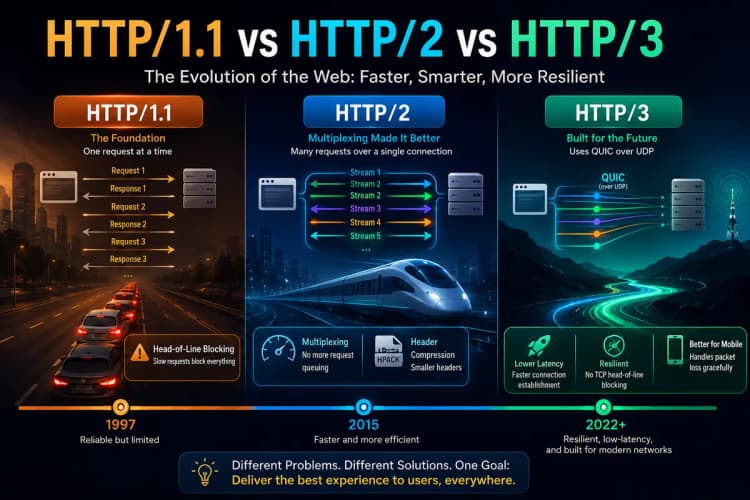
Multiplexing is the biggest innovation introduced by HTTP/2.
Imagine a browser requesting:
1. HTML
2. CSS
3. JavaScript
4. Images
5. Fonts
In HTTP/1.1 these resources often competed with one another.
HTTP/2 introduced streams.
TCP Connection
│
├── Stream 1 → HTML
├── Stream 2 → CSS
├── Stream 3 → JavaScript
├── Stream 4 → Images
└── Stream 5 → Fonts
Everything shares a single connection.
Instead of waiting for one resource to finish before another can progress, the server can send pieces of many resources simultaneously.
Example:
HTML Chunk
CSS Chunk
Image Chunk
JavaScript Chunk
HTML Chunk
Font Chunk
Image Chunk
The browser automatically reassembles everything correctly.
This dramatically improves connection utilization.
Think of Multiplexing Like an Airport
Imagine a runway.
HTTP/1.1 behaves like:
✈️ Plane 1 lands
✈️ Plane 2 waits
✈️ Plane 3 waits
✈️ Plane 4 waits
HTTP/2 behaves more like:
✈️ Plane 1 unloads passengers
✈️ Plane 2 unloads cargo
✈️ Plane 3 boards passengers
✈️ Plane 4 refuels
Multiple operations happen concurrently.
The runway stays busy.
Resources are utilized efficiently.
That's multiplexing.
What Happens Under the Hood?
Most explanations stop at:
HTTP/2 allows multiple requests at the same time.
That's true.
But the interesting part is how.
HTTP/2 introduces frames.
Every request and response gets split into smaller pieces.
Request
   ↓
Frames
   ↓
Stream
   ↓
Connection
Think of a giant book.
Instead of shipping the entire book at once:
Book A Page 1
Book B Page 1
Book C Page 1
Book A Page 2
Book B Page 2
Book C Page 2
Pages from different books travel together.
The browser knows exactly where each page belongs.
This allows the network connection to remain busy almost continuously.
Binary Framing: The Invisible Revolution
One of HTTP/2's biggest changes is something users never see.
HTTP/1.1 is text-based.
Example:
GET /products HTTP/1.1
Host: example.com
Humans can read it.
Machines can too.
But computers fundamentally work with binary data.
HTTP/2 introduces a binary framing layer.
Instead of:
HTTP Message
The protocol becomes:
HTTP Message
      ↓
Binary Frames
      ↓
TCP
Benefits include:
- Faster parsing
- Lower processing overhead
- More predictable performance
- Better scalability
Humans lose readability.
Computers gain efficiency.
And protocols exist primarily for computers.
The Hidden Cost Nobody Talks About: Headers
Modern requests contain lots of headers.
Example:
Cookie: ...
Authorization: ...
User-Agent: ...
Accept-Language: ...
Cache-Control: ...
Most of these values repeat repeatedly across requests.
HTTP/1.1 keeps transmitting them over and over again.
Imagine sending your full home address every time you order coffee.
That's wasteful.
HPACK: Header Compression
HTTP/2 introduces HPACK.
Instead of repeatedly sending identical headers:
Authorization: Bearer abc123...
The protocol stores previously transmitted values.
Conceptually:
Header Table

#1 Authorization
#2 Cookie
#3 User-Agent
#4 Accept-Language
Future requests simply reference the table entry.
Example:
Use Header #1
Use Header #3
Use Header #4
Much less data travels across the network.
Benefits:
- Reduced bandwidth
- Lower latency
- Faster requests
Especially useful on mobile networks.
Stream Prioritization: Not Everything Is Equally Important
Imagine loading an e-commerce homepage.
Resources include:
Hero Image
Product Grid
Analytics Script
Tracking Pixel
Chat Widget
Clearly not all resources have equal importance.
Users care about visible content first.
Analytics can wait.
HTTP/2 allows browsers to assign priorities to streams.
The browser can effectively tell the server:
Send resources required for rendering first.
Send lower-priority assets later.
This improves perceived performance significantly.
Users see useful content sooner.
Did HTTP/2 Completely Solve Head-of-Line Blocking?
This is a common misconception.
The answer is:
No.
It solved one form of it.
HTTP/1.1 Problem
Large Image
      ↓
CSS waits
JS waits
Fonts wait
This application-level blocking was largely solved through multiplexing.
But another problem remained.
TCP Still Has Its Own Head-of-Line Blocking
Remember:
HTTP/2 still runs on TCP.
TCP guarantees ordered delivery.
Imagine packets arriving like this:
Packet 1
Packet 2
Packet 3
Packet 4
Packet 5
Now Packet 3 gets lost.
Packet 4 ❌ Wait
Packet 5 ❌ Wait
Even if Packets 4 and 5 belong to different streams.
TCP refuses to deliver them until Packet 3 arrives.
This creates transport-layer Head-of-Line Blocking.
HTTP/2 fixed the application layer.
TCP still imposed limitations.
Real-World Impact of HTTP/2
HTTP/2 dramatically improved web performance.
Benefits included:
Fewer Connections
Many Connections
        ↓
Single Efficient Connection
Lower Overhead
Fewer handshakes.
Less connection state.
Less resource consumption.
Better Bandwidth Utilization
Connections stay busy more often.
Less idle time.
Faster Rendering
Critical assets arrive sooner.
Improved Mobile Performance
Particularly noticeable on high-latency networks.
For large-scale websites, the performance gains were substantial.
Why HTTP/3 Eventually Became Necessary
HTTP/2 solved many HTTP/1.1 limitations.
But it couldn't solve TCP itself.
As mobile usage exploded and packet loss became more common, TCP's Head-of-Line Blocking became increasingly expensive.
Engineers started asking:
What if we redesigned the transport layer too?
That question led to:
QUIC
And QUIC eventually became:
HTTP/3
But that's a story for the next article. 😉
TL;DR Quick Recap
- HTTP/1.1 scaled by opening more connections.
- More connections improved performance but increased overhead.
- HTTP/2 introduced multiplexing.
- Multiple streams share a single TCP connection.
- Requests and responses are split into binary frames.
- HPACK compresses repetitive headers.
- Stream prioritization improves perceived performance.
- HTTP-level Head-of-Line Blocking was largely solved.
- TCP-level Head-of-Line Blocking remained.
- That limitation eventually inspired HTTP/3.
Final Thoughts: Smarter Beats Bigger 🧠
One of the most interesting lessons from HTTP/2 is that scaling isn't always about adding more resources.
Sometimes the real solution is improving efficiency.
HTTP/1.1 scaled by opening more connections.
HTTP/2 scaled by making one connection dramatically smarter.
That shift reduced overhead, improved performance, and fundamentally changed how modern websites communicate.
It's one of the clearest examples of engineering solving a workflow problem instead of simply throwing more resources at it.
Frequently Asked Questions
What is HTTP/2?
HTTP/2 is the second major version of the HTTP protocol.
It improves performance through multiplexing, binary framing, header compression, and stream prioritization.
What problem did HTTP/2 solve?
HTTP/2 primarily solved the inefficiencies of HTTP/1.1, particularly the need for multiple parallel TCP connections and application-layer Head-of-Line Blocking.
What is multiplexing in HTTP/2?
Multiplexing allows multiple streams to share a single TCP connection simultaneously.
This enables multiple requests and responses to progress together without blocking one another at the HTTP layer.
What are streams in HTTP/2?
Streams are independent channels inside a single TCP connection.
Each request-response pair gets its own stream.
What are frames in HTTP/2?
Frames are small binary units that carry pieces of requests and responses.
Streams are composed of many frames.
What is HPACK?
HPACK is HTTP/2's header compression mechanism.
It reduces repetitive header transmission by storing previously sent values and referencing them later.
Is HTTP/2 binary?
Yes.
HTTP/2 introduces a binary framing layer, making communication more efficient for machines to process.
Does HTTP/2 eliminate Head-of-Line Blocking?
Partially.
It largely removes HTTP-level Head-of-Line Blocking through multiplexing.
However, TCP-level Head-of-Line Blocking still exists.
Why does HTTP/2 still suffer from Head-of-Line Blocking?
Because HTTP/2 runs on TCP.
If a TCP packet is lost, later packets must wait until the missing packet is retransmitted.
Why was HTTP/3 created if HTTP/2 was already fast?
HTTP/3 replaces TCP with QUIC, allowing the protocol to eliminate TCP-level Head-of-Line Blocking and improve performance on unreliable networks.
Key Takeaways
- HTTP/2 introduced multiplexing to reduce connection overhead.
- Binary framing improved protocol efficiency.
- HPACK reduced redundant header transmission.
- Stream prioritization improved user-perceived performance.
- A single connection became more powerful than many parallel connections.
- TCP remained the final major bottleneck.
- HTTP/2 paved the way for QUIC and HTTP/3.
If you found this helpful, share it with another developer and follow for more deep dives into networking, distributed systems, web protocols, and software architecture. 🚀
About the Author
Anik Sikder is a Software Engineer specializing in Backend Systems, Distributed Architectures, Cloud Infrastructure, Networking Fundamentals, Python, Django, FastAPI, and System Design.
He writes about networking protocols, distributed systems, software architecture, performance engineering, and scalable backend development.