Hey developers! 👋
Today, every browser supports HTTP/2.
HTTP/3 adoption is growing rapidly.
Modern frameworks, CDNs, and cloud providers aggressively optimize network performance.
But have you ever stopped and wondered:
If HTTP/1.1 worked for decades, why did we need HTTP/2 and HTTP/3 at all?
Many developers assume protocol upgrades happen because engineers want newer technology.
That's rarely the real reason.
Protocols evolve because existing systems eventually hit architectural limits.
HTTP/2 and HTTP/3 weren't created because HTTP/1.1 was broken.
They were created because the modern web outgrew it.
To understand HTTP/2 and HTTP/3, we first need to understand the bottlenecks hidden inside HTTP/1.1.
Let's travel back in time and see why the internet eventually needed something better. 🚀
🌐 The Web HTTP/1.1 Was Designed For
Imagine it's 2005.
You open a typical website.
The browser requests:
index.html
style.css
logo.png
That's essentially the entire page.
A handful of resources.
A few hundred kilobytes.
Minimal JavaScript.
No massive frontend frameworks.
No streaming dashboards.
No endless social media feeds.
For that era, HTTP/1.1 worked surprisingly well.
Now fast-forward to today.
Open a modern e-commerce platform, SaaS dashboard, or social network.
Your browser may request:
HTML
CSS
JavaScript Bundles
Fonts
Icons
Images
Videos
API Requests
Analytics Scripts
Tracking Pixels
Chat Widgets
Recommendation Systems
Third-Party SDKs
Instead of three requests, there may be hundreds.
Modern websites are no longer documents.
They're applications.
The internet evolved dramatically.
HTTP/1.1 mostly stayed the same.
🧠 The Real Problem Wasn't File Size
At first glance, downloading hundreds of files doesn't sound difficult.
Computers are fast.
Networks are fast.
Servers are powerful.
So what's the issue?
The challenge isn't the files themselves.
The challenge is coordination.
Imagine a warehouse receiving hundreds of orders every minute.
If workers can process only one order at a time, a queue forms quickly.
The same concept applies to network communication.
The browser wants many resources.
The server has many resources.
The protocol determines how efficiently those resources move between them.
And that's where HTTP/1.1 began showing its age.
🛣️ The Single-Lane Highway Problem
Imagine a highway with only one lane.
🚗 HTML
   ↓
🚗 CSS
   ↓
🚚 Large Image
   ↓
🚗 JavaScript
   ↓
🚗 Font File
Everything must travel through the same road.
When a massive truck enters the lane, smaller vehicles behind it can't pass.
Traffic slows down.
Everyone waits.
This is exactly how serialized communication behaves.
One slow response can delay many others.
The network itself isn't slow.
The process is.
🍽️ The Restaurant Analogy
Let's revisit a familiar analogy.
Imagine a restaurant with only one waiter.
A customer places an order.
Customer 1
    ↓
 Waiter
    ↓
 Kitchen
The waiter:
- Takes the order
- Walks to the kitchen
- Waits for preparation
- Returns with food
Meanwhile:
Customer 2 waits...

Customer 3 waits...

Customer 4 waits...
As the restaurant grows busier, delays increase.
The customers aren't the problem.
The waiter isn't the problem.
The process is the problem.
HTTP/1.1 encountered a similar challenge as websites became more complex and resource-heavy.
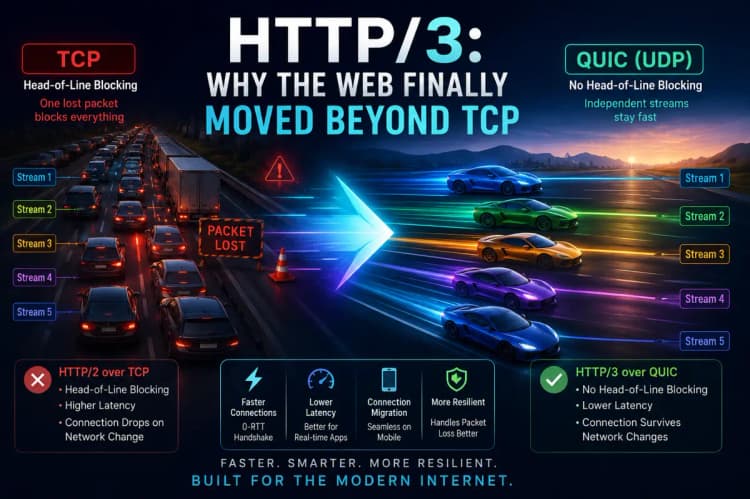
🚧 Understanding Head-of-Line Blocking
One of the most important networking concepts behind HTTP/2 is:
Head-of-Line Blocking
Let's say a browser requests:
1. HTML
2. CSS
3. app.js
4. hero-image.jpg
5. font.woff
Now imagine the image is huge.
Several megabytes.
Results:
HTML             ✅ Complete
CSS              ✅ Complete
hero-image.jpg   ⏳ Slow
app.js           ❌ Waiting
font.woff        ❌ Waiting
The image becomes a bottleneck.
Everything behind it gets delayed.
Even if those resources are small.
Even if they're ready.
Even if the server could send them immediately.
This is Head-of-Line Blocking.
One slow response blocks many faster ones.
Think of it as a traffic accident stopping an entire lane of vehicles.
The accident isn't every car.
But every car suffers.
🔍 Why This Hurt Performance
Modern pages often depend on critical resources:
HTML
 ↓
CSS
 ↓
JavaScript
 ↓
Render Page
If one resource gets delayed:
CSS waiting...
JavaScript waiting...
Rendering waiting...
User waiting...
The page feels slow.
Even if bandwidth is plentiful.
This is why network performance isn't only about speed.
It's also about scheduling.
⚔️ Browser Engineers Fought Back
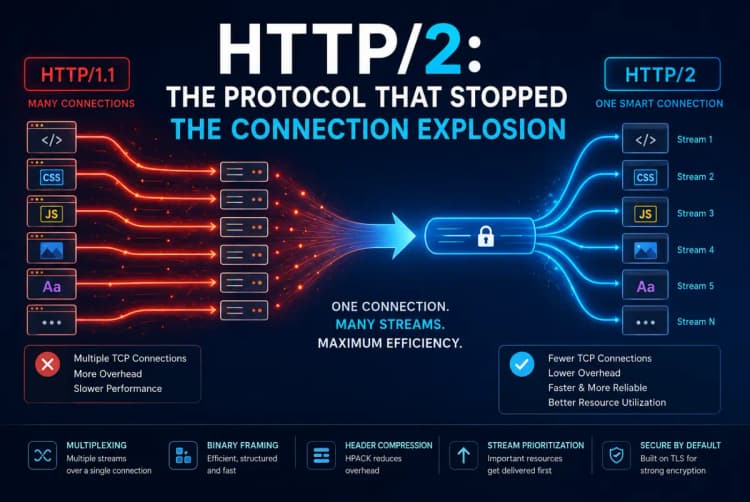
Browser vendors quickly realized that a single connection wasn't enough.
Instead of waiting for one connection to finish, browsers opened multiple TCP connections.
Something like:
Browser
 ├── TCP Connection 1
 ├── TCP Connection 2
 ├── TCP Connection 3
 ├── TCP Connection 4
 ├── TCP Connection 5
 └── TCP Connection 6
Now several files could download simultaneously.
Performance improved dramatically.
For many years, browsers commonly used around six parallel connections per domain.
At first this seemed like the perfect solution.
But it introduced an entirely new set of problems.
⚙️ Why More Connections Create More Overhead
Every TCP connection costs resources.
Before data can flow:
Client
   ↓
 SYN
   ↓
 SYN-ACK
   ↓
 ACK
   ↓
 Connection Established
This process is called the TCP Three-Way Handshake.
Only after this handshake can useful data be transmitted.
Now imagine:
6 Connections
That means:
6 Handshakes
6 Buffers
6 Connection States
6 Congestion Controllers
6 Resource Allocations
Both client and server must work harder.
The network carries additional overhead.
Memory usage increases.
CPU work increases.
Connection management becomes more complex.
The workaround became part of the problem.
🧬 What Happens Inside TCP?
Many developers focus only on HTTP.
But HTTP rides on top of TCP.
Every connection maintains:
- Send buffers
- Receive buffers
- Congestion windows
- Retransmission timers
- Flow-control state
Each additional connection duplicates this work.
This isn't free.
Network engineers realized they were multiplying complexity to compensate for protocol limitations.
That wasn't sustainable.
📈 The Turning Point
By the early 2010s, the web looked completely different.
Developers were building:
- Gmail-like web applications
- Facebook-style feeds
- Streaming platforms
- Real-time dashboards
- Large e-commerce systems
- Rich client-side applications
Pages contained hundreds of resources.
Dozens of API calls.
Megabytes of assets.
The existing model was showing cracks.
The industry needed something better.
The goal became:
Instead of using many TCP connections inefficiently, use one connection intelligently.
That idea became the foundation of HTTP/2.
🏗️ The Big Insight That Changed Everything
Engineers asked a simple question:
What if multiple requests could share a single connection efficiently?
Instead of:
Request 1 → Response 1

Request 2 → Response 2

Request 3 → Response 3
What if communication looked like:
Request 1
Request 2
Request 3
Request 4

Responses arrive independently
This concept eventually became:
Multiplexing
And multiplexing became one of HTTP/2's biggest innovations.
But that's a story for the next article.
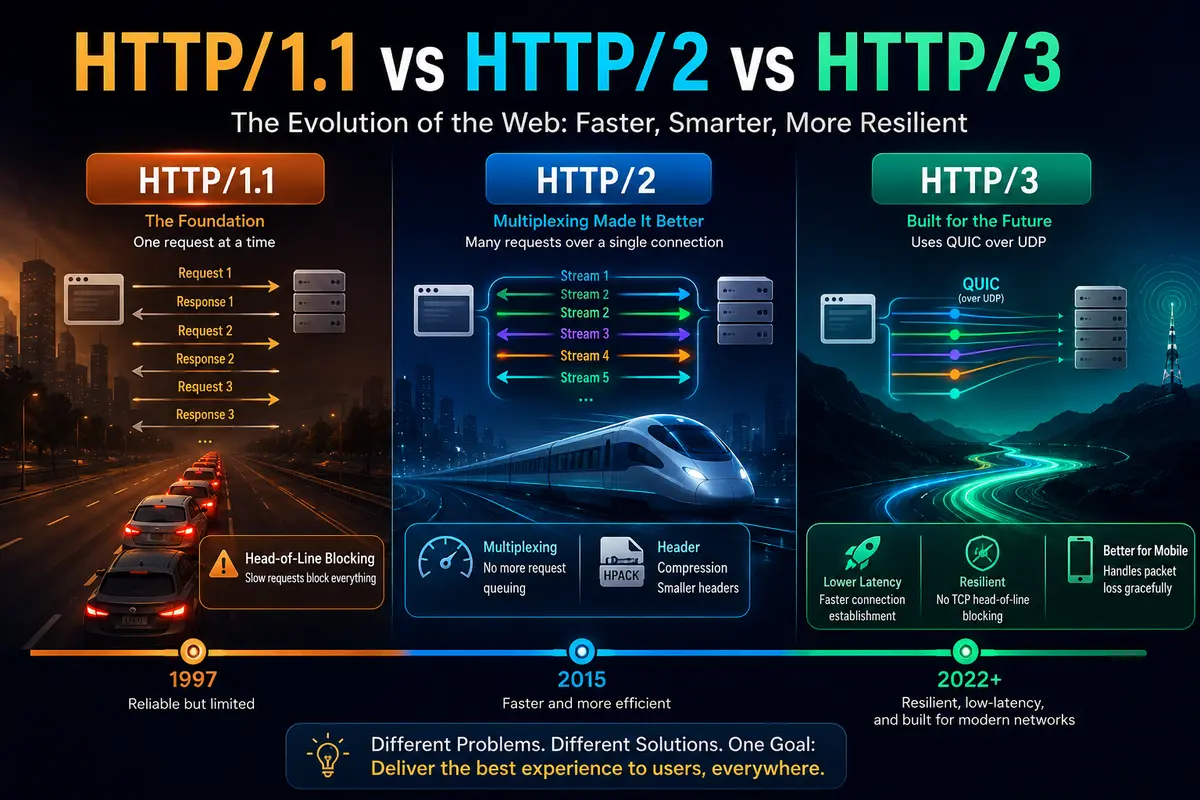
🎨 Mental Model
Think of the evolution like transportation.
HTTP/1.1

Single Road
     ↓
Traffic Jams
     ↓
More Roads
     ↓
Higher Cost


HTTP/2

One Smart Highway
     ↓
Multiple Lanes
     ↓
Better Scheduling
     ↓
Higher Efficiency
The goal wasn't more roads.
The goal was smarter traffic management.
TL;DR Quick Recap
- HTTP/1.1 was designed for a much simpler web.
- Modern applications generate hundreds of network requests.
- Serialized communication created performance bottlenecks.
- Head-of-Line Blocking allowed one slow resource to delay others.
- Browsers worked around the problem using multiple TCP connections.
- Multiple connections improved performance but increased overhead.
- TCP handshakes, buffers, and connection management added complexity.
- The industry needed a smarter solution.
- HTTP/2 was created to solve these architectural limitations.
Final Thoughts: Great Protocols Eventually Outgrow Their Era
One of the most interesting lessons in networking is that success often creates new problems.
HTTP/1.1 wasn't a failure.
It was incredibly successful.
So successful that it helped build a web far larger and more complex than its designers imagined.
Eventually the internet evolved beyond the assumptions HTTP/1.1 was built around.
The protocol didn't suddenly become bad.
The world simply changed.
Understanding these limitations helps explain why HTTP/2 and HTTP/3 exist and why modern network protocols focus so heavily on reducing latency, improving concurrency, and eliminating bottlenecks.
A Little Networking Joke 😄
Why did HTTP/1.1 get stuck in traffic?
Because every request wanted to use the same lane.
Frequently Asked Questions
What is HTTP/1.1?
HTTP/1.1 is the version of the Hypertext Transfer Protocol that powered most of the web for decades.
It introduced persistent connections and many features still used today.
What is Head-of-Line Blocking?
Head-of-Line Blocking occurs when one slow response delays the delivery of other responses behind it.
It's one of the major performance limitations HTTP/1.1 struggled with.
Why did browsers open multiple TCP connections?
Browsers used multiple connections to download resources in parallel and reduce waiting caused by serialized communication.
Why are multiple TCP connections expensive?
Each connection requires:
- A handshake
- Memory buffers
- Connection state management
- Congestion control
These consume network and system resources.
Was HTTP/1.1 a bad protocol?
No.
HTTP/1.1 was highly successful and served the web well for many years.
Its limitations only became apparent as web applications grew significantly more complex.
What problem did HTTP/2 solve?
HTTP/2 introduced multiplexing, allowing multiple requests and responses to share a single TCP connection efficiently.
Is HTTP/1.1 still used today?
Yes.
Many systems still support HTTP/1.1, although HTTP/2 and HTTP/3 are increasingly common across modern websites and cloud infrastructure.
Key Takeaways
- HTTP/1.1 was built for a simpler web.
- Modern applications generate significantly more network requests.
- Head-of-Line Blocking became a major performance bottleneck.
- Browsers compensated using multiple TCP connections.
- More connections improved throughput but increased overhead.
- TCP itself introduces connection-management costs.
- The industry eventually needed a more scalable approach.
- HTTP/2 emerged as the solution to these architectural challenges.
If you found this article helpful, share it with another developer and stay tuned for the next part, where we'll explore how HTTP/2 introduced multiplexing and fundamentally changed the way browsers communicate with servers. 🚀
About the Author
Anik Sikder is a Software Engineer specializing in Backend Systems, Cloud Infrastructure, Networking Fundamentals, System Design, Distributed Systems, Python, Django, and FastAPI.
He writes about networking, software architecture, distributed systems, backend engineering, cloud technologies, and scalable software design.