$ open blueprint
Modern software products are API-driven businesses.
Whether you're building:
- SaaS Platforms
- ERP Systems
- Marketplaces
- Mobile Applications
- Internal Enterprise Tools
Every business operation eventually becomes an API request.
The quality of your API architecture directly impacts:
- Product velocity
- Engineering productivity
- Customer experience
- Platform scalability
- Long-term maintenance costs
For founders, APIs accelerate product growth.
For senior engineers, APIs become the foundation of maintainable systems.
Executive Summary
API architecture is one of the most important technical investments a company can make.
A well-designed API is more than a collection of endpoints. It is a stable contract between systems, teams, customers, partners, and future products.
Strong API architecture enables:
| Business Impact | Engineering Impact |
|---|---|
| Faster product delivery | Cleaner system design |
| Easier integrations | Better maintainability |
| Faster customer onboarding | Stronger security |
| New revenue opportunities | Improved scalability |
| Lower operational costs | Better developer experience |
Whether you are building a startup MVP or a large-scale ERP platform, API quality directly affects how fast the business can grow and how effectively engineering teams can operate.
The Business Problem
Imagine building an ERP platform.
The frontend requires:
- User Management
- Products
- Inventory
- Orders
- Billing
- Reporting
Without a structured API architecture:
- Business logic becomes duplicated
- Integrations become difficult
- Mobile apps become expensive
- Third-party partners cannot connect efficiently
- Engineering complexity grows rapidly
As the company scales, the backend often becomes harder to maintain than the product itself.
This is where API architecture becomes a strategic business decision rather than just a technical implementation detail.
Why Founders Should Care
A poorly designed API creates hidden costs that compound over time.
Common Business Consequences
- Slower feature development
- Expensive partner integrations
- Difficult mobile application expansion
- Customer onboarding challenges
- Increased engineering costs
- Reduced platform flexibility
The Leverage of Great APIs
A well-designed API allows a single backend platform to power:
- Web Applications
- Mobile Applications
- Partner Integrations
- Public Developer Platforms
- Internal Automation Systems
- Future Products
The API becomes a reusable business asset.
Instead of rebuilding functionality repeatedly, the organization creates a scalable platform that supports growth.
Why Senior Engineers Should Care
API architecture influences nearly every aspect of a software platform.
Architectural Impact Areas
- Service boundaries
- Security design
- Authorization strategy
- Scalability planning
- Database performance
- Observability
- Developer experience
A poorly designed API might survive for months.
A poorly designed API platform can create technical debt that lasts for years.
Strong architectural decisions made early often prevent expensive rewrites later.
High-Level Architecture Blueprint
                     ┌───────────────────┐
                     │     Client Apps   │
                     └─────────┬─────────┘
                               │
                               ▼
                     ┌───────────────────┐
                     │    API Gateway    │
                     └─────────┬─────────┘
                               │
          ┌────────────────────┼────────────────────┐
          ▼                    ▼                    ▼
 ┌────────────────┐  ┌────────────────┐  ┌────────────────┐
 │ Authentication │  │ Rate Limiting  │  │ API Versioning │
 └────────┬───────┘  └────────┬───────┘  └────────┬───────┘
          │                   │                   │
          └─────────────┬─────┴─────────────┬─────┘
                        ▼                   ▼
              ┌─────────────────────────────┐
              │       Service Layer         │
              └──────────────┬──────────────┘
                             │
           ┌─────────────────┼─────────────────┐
           ▼                 ▼                 ▼
    ┌─────────────┐  ┌─────────────┐  ┌─────────────┐
    │ PostgreSQL  │  │ Redis Cache │  │ Message Bus │
    └─────────────┘  └─────────────┘  └─────────────┘
Core Responsibilities
| Component | Responsibility |
|---|---|
| Client Applications | Consume APIs |
| API Gateway | Central request entry point |
| Authentication | Identity verification |
| Authorization | Permission enforcement |
| Rate Limiting | Abuse protection |
| Versioning | Backward compatibility |
| Service Layer | Business logic execution |
| PostgreSQL | Persistent data storage |
| Redis | High-speed caching |
| Message Bus | Asynchronous processing |
Request Lifecycle
Every API request should follow a predictable lifecycle.
Client
  │
  ▼
API Gateway
  │
  ▼
Authenticate Request
  │
  ▼
Authorize User
  │
  ▼
Validate Input
  │
  ▼
Execute Business Logic
  │
  ▼
Persist Data
  │
  ▼
Return Response
Why This Matters
A consistent request lifecycle improves:
- Security
- Maintainability
- Debugging
- Testing
- Performance optimization
Each stage has a clear responsibility and should remain isolated from the others.
API Design Principles
Resource-Oriented Design
Resources should represent business entities rather than actions.
Bad
POST /create-product
Good
POST /products
Bad
GET /get-user-orders
Good
GET /orders
Recommended Resource Examples
users
products
orders
invoices
payments
customers
subscriptions
shipments
Benefits
- Predictable APIs
- Easier documentation
- Better developer experience
- Industry-standard conventions
Versioning Strategy
APIs evolve.
Clients rarely upgrade instantly.
Without versioning, a single breaking change can impact production customers.
Recommended Approach
/api/v1/products
/api/v2/products
Benefits
- Backward compatibility
- Controlled migrations
- Safer deployments
- Reduced customer disruption
Common Versioning Methods
| Strategy | Example |
|---|---|
| URL Versioning | /api/v1/products |
| Header Versioning | Accept: application/vnd.company.v1 |
| Query Versioning | ?version=1 |
For most teams, URL versioning is the simplest and most maintainable solution.
Authentication Architecture
Authentication answers:
Who are you?
Recommended Stack
Access Token
Refresh Token
HttpOnly Cookies
Authentication Flow
Login
  │
  ▼
Issue Access Token
  │
  ▼
Issue Refresh Token
  │
  ▼
Validate Request
Avoid
Local Storage Tokens
Because XSS attacks can expose credentials stored in browser-accessible storage.
Recommended Security Practices
- HttpOnly cookies
- Secure cookies
- Short-lived access tokens
- Token rotation
- Refresh token revocation
- Device tracking
Authorization Architecture
Authorization answers:
What are you allowed to do?
Example Roles
Owner
Manager
Accountant
Employee
Example Permission Check
if not user.has_permission(
    "invoice.create"
):
    raise PermissionDenied
Recommended Model
User
  │
  ▼
Role
  │
  ▼
Permissions
Common Permission Examples
invoice.create
invoice.view
invoice.update
invoice.delete
inventory.adjust
user.invite
Role-Based Access Control (RBAC) remains one of the most practical authorization models for business applications.
Input Validation
Never trust client input.
Invalid Example
{
  "price": -500
}
Validation Categories
- Required fields
- Data formats
- Business rules
- Ownership checks
- Permission checks
- Cross-field validation
Why Validation Matters
Validation protects systems from:
- Accidental mistakes
- Corrupted data
- Fraudulent activity
- Security vulnerabilities
Validation should occur before business logic execution whenever possible.
Rate Limiting & Abuse Protection
Without limits, a single client can overwhelm infrastructure.
Example
10000 requests/minute
This can create:
- Service degradation
- Infrastructure cost spikes
- Availability issues
Recommended Baseline
100 requests/minute
Per:
- User
- API Key
- IP Address
- Tenant
Advanced Protection
- Burst limits
- Request quotas
- Geographic restrictions
- Bot detection
- Web Application Firewalls (WAF)
Pagination Strategy
Returning massive datasets creates scalability problems.
Bad
GET /orders
Returning:
500,000 records
Better
GET /orders?page=1&page_size=50
Even Better for Large Datasets
GET /orders?cursor=abc123
Comparison
| Strategy | Best Use Case |
|---|---|
| Offset Pagination | Small to medium datasets |
| Cursor Pagination | Large datasets |
| Keyset Pagination | High-performance querying |
Benefits
- Faster responses
- Lower memory usage
- Reduced database load
- Better user experience
Filtering & Search
Efficient filtering reduces unnecessary processing.
Examples
GET /orders?status=paid
GET /orders?customer=42
GET /orders?created_after=2026-01-01
Recommended Features
- Filtering
- Sorting
- Full-text search
- Date ranges
- Status filtering
- Field selection
Example
GET /orders?status=paid&sort=-created_at
Well-designed filtering significantly improves API usability and performance.
API Documentation
Documentation is part of the product.
Poor documentation creates support costs.
Good documentation accelerates adoption.
Recommended Tools
OpenAPI
Swagger
Redoc
Documentation Should Include
- Authentication
- Endpoints
- Request examples
- Response examples
- Error handling
- Rate limits
- SDK examples
Benefits
- Faster onboarding
- Easier integrations
- Lower support costs
- Better developer experience
A great API without documentation is effectively an incomplete product.
Caching Strategy
Expensive operations should not repeatedly hit the database.
Cache Flow
Request
  │
  ▼
Redis
  │
Cache Hit?
  │
  ├─ Yes → Return Data
  │
  └─ No
       │
       ▼
   Database
       │
       ▼
   Store Cache
Ideal Cache Candidates
- Product catalogs
- Dashboard statistics
- Configuration data
- User permissions
- Frequently accessed records
Benefits
- Reduced latency
- Lower database load
- Improved scalability
- Better customer experience
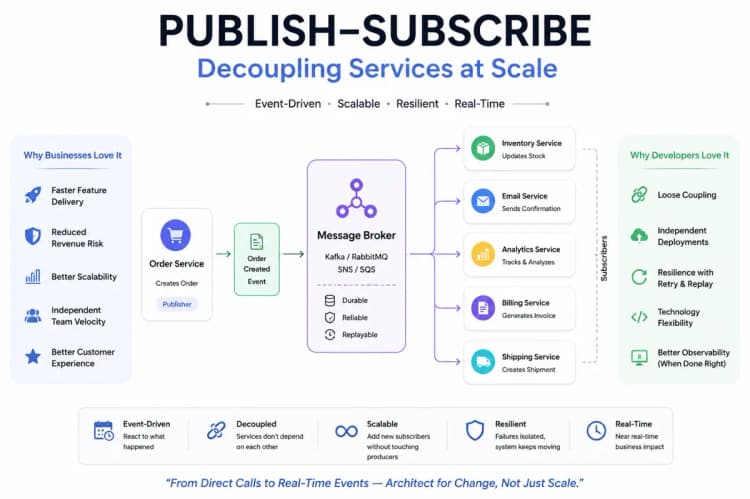
Event-Driven APIs
Not every operation should execute synchronously.
Good Candidates
- Email sending
- Report generation
- File exports
- Notifications
- Audit logging
- Third-party integrations
Request
POST /reports
Response
{
  "status": "queued"
}
Processing Flow
API Request
    │
    ▼
Queue Message
    │
    ▼
Worker Consumes Message
    │
    ▼
Background Processing
This improves responsiveness while maintaining scalability.
Observability
Production systems require visibility.
Without observability, failures become difficult to diagnose.
Essential Metrics
- Request volume
- Response latency
- Error rates
- Database queries
- Cache hit ratios
- Queue depth
- Worker performance
Recommended Logging Structure
{
  "request_id": "abc123",
  "user_id": 42,
  "endpoint": "/orders",
  "status": 200
}
Observability Pillars
| Pillar | Purpose |
|---|---|
| Logs | Event visibility |
| Metrics | System health |
| Traces | Request tracking |
Common API Mistakes
Breaking Existing Clients
Bad
Removing fields unexpectedly.
Good
Use API versioning.
Returning Excessive Data
Bad
GET /users
Returning:
100000 users
Good
Use pagination.
Business Logic Inside Controllers
Bad
Controller = Business Logic
Good
Controller
   │
   ▼
Service Layer
   │
   ▼
Repository
Benefits
- Better testing
- Cleaner code
- Easier maintenance
- Improved reusability
Missing Rate Limiting
This commonly results in:
- Abuse
- DDoS amplification
- Infrastructure cost spikes
- Service instability
Rate limiting should be treated as a core platform capability rather than an optional enhancement.
Evolution Path
Most successful platforms evolve gradually.
Simple CRUD API
       │
       ▼
Authentication
       │
       ▼
RBAC
       │
       ▼
Caching
       │
       ▼
Background Jobs
       │
       ▼
API Gateway
       │
       ▼
Event-Driven Architecture
Avoid prematurely introducing complexity.
Build capabilities when they are justified by business requirements.
Real-World Examples
Stripe
Known for:
- Excellent API design
- Strong versioning strategy
- Industry-leading documentation
- Exceptional developer experience
GitHub
Known for:
- Consistent resources
- Predictable API patterns
- Mature developer ecosystem
Shopify
Known for:
- API-first growth strategy
- Extensive partner ecosystem
- Platform extensibility
These companies demonstrate how strong API design can become a competitive advantage.
What I Would Build Today
If I were building a SaaS backend today, my starting stack would be:
- Django or FastAPI
- PostgreSQL
- Redis
- JWT Authentication
- RBAC Authorization
- OpenAPI Documentation
- Background Workers
- Structured Logging
- Metrics & Monitoring
What I Would Avoid Initially
- Microservices
- Service Meshes
- Kubernetes Complexity
- Premature Distributed Systems
Simple systems scale much further than most teams expect.
Complexity should be introduced only when justified by real operational needs.
Key Takeaways
API architecture is not merely about endpoints.
It is about creating a stable contract between business systems.
A well-designed API provides:
- Faster development
- Better scalability
- Stronger security
- Easier integrations
- Lower maintenance costs
- Better developer experience