Hey backend engineers! 👋
Have you ever clicked a button and wondered what actually happens behind the scenes?
Maybe you're:
- Logging into an application
- Ordering food online
- Streaming a movie
- Checking your bank balance
- Talking to an AI assistant
The action feels instant.
You click.
Something happens.
A response appears.
Simple, right?
Not exactly.
Behind that seemingly simple interaction lies one of the most important communication patterns in software engineering:
Request-Response.
Every modern application depends on it.
Every API relies on it.
Every distributed system builds upon it.
And understanding this pattern is one of the first steps toward understanding how modern backend systems actually work.
Let's dive in. 🚀
Why Request-Response Matters
Most software systems exist to exchange information.
A user wants something.
A system provides it.
That fundamental interaction powers:
- Websites
- Mobile applications
- APIs
- Cloud platforms
- Microservices
- AI systems
Understanding Request-Response helps explain:
- Why applications become slow
- Why APIs fail
- Why distributed systems are difficult
- Why modern architectures evolved beyond simple HTTP calls
Before learning WebSockets, Event Streaming, Message Queues, or Event-Driven Architecture, it's important to understand the communication pattern that started it all.
What Is Request-Response?
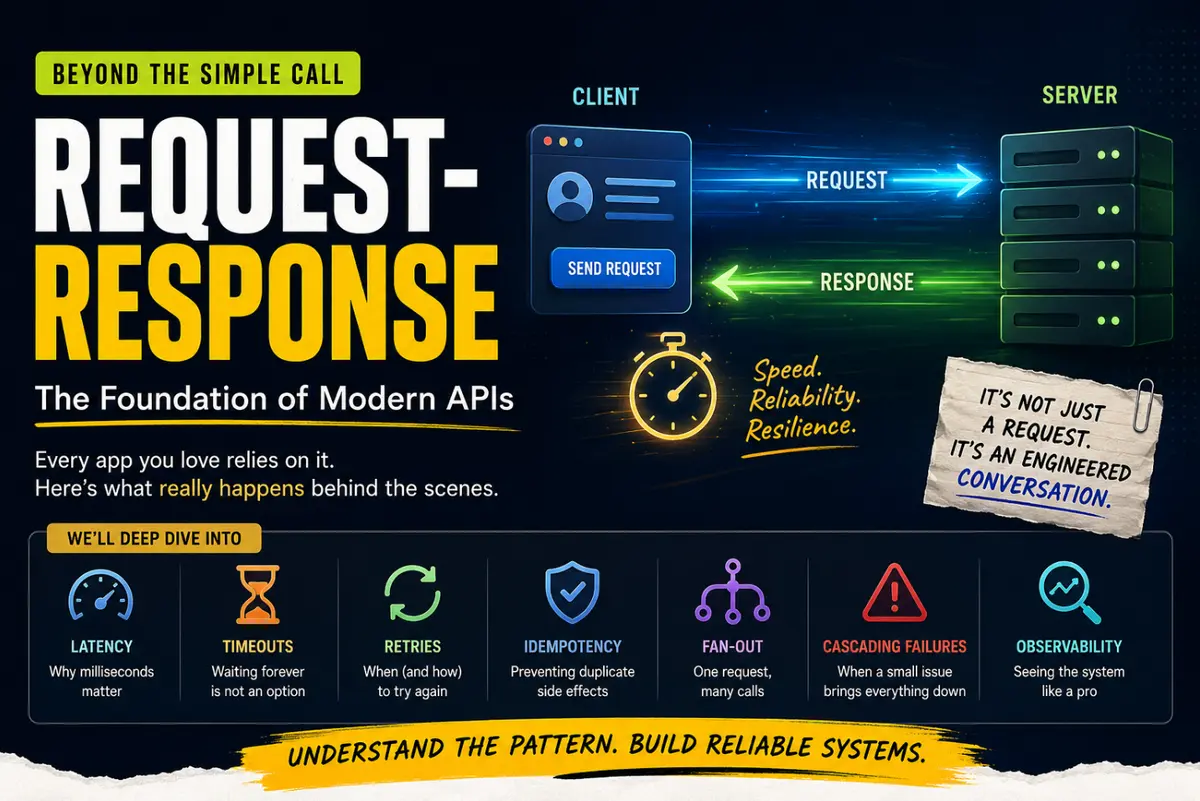
At its core, Request-Response is a conversation between two systems.
One system asks for something.
Another system responds.
Client                    Server
   |                         |
   |------ Request --------->|
   |                         |
   |<----- Response ---------|
   |                         |
The client initiates communication.
The server processes the request and returns a response.
The client typically waits until the response arrives.
This interaction is known as synchronous communication.
In simple terms:
Ask. Wait. Receive.
That pattern powers most of the internet.
A Real-World Analogy
Imagine sitting in a restaurant.
You call a waiter.
I'd like a burger.
The waiter carries your request to the kitchen.
The kitchen prepares the meal.
The waiter returns with your food.
Here's your burger.
This maps surprisingly well to modern systems.
Customer = Client

Waiter = Network

Kitchen = Server

Burger = Response
The customer makes a request.
The kitchen processes it.
The response is delivered.
That's Request-Response.
A Simple API Example
When logging into an application, a browser might send:
POST /login
With data:
{
  "email": "user@example.com",
  "password": "secret"
}
The server validates credentials and returns:
{
  "token": "jwt-token",
  "user": {
    "name": "Anik"
  }
}
From the user's perspective:
Click Login

↓

Dashboard Appears
Behind the scenes, far more is happening.
The Hidden Journey of a Request
Modern systems rarely consist of a single server.
A simple login request may travel through:
Browser
   |
Load Balancer
   |
API Gateway
   |
Authentication Service
   |
Database
Then return through the same chain.
Database
   |
Authentication Service
   |
API Gateway
   |
Load Balancer
   |
Browser
Every hop introduces:
- Latency
- Failure risks
- Resource consumption
- Complexity
The larger the system becomes, the more challenging Request-Response becomes.
Latency: The Hidden Cost of Distance
Latency measures how long a request takes to travel and return.
Request Sent

↓

Processing

↓

Response Received
Users don't think about latency.
They simply experience:
- Fast
- Slow
- Broken
A useful rule of thumb:
| Response Time | User Experience |
|---|---|
| 0–100 ms | Instant |
| 100–300 ms | Fast |
| 300–1000 ms | Noticeable |
| 1–3 sec | Slow |
| 3+ sec | Frustrating |
Reducing latency is one of the most valuable engineering investments a company can make.
Why Latency Exists
Latency comes from many sources.
Examples include:
Network Distance
A request traveling across continents naturally takes longer.
Database Queries
Slow queries increase response times.
Serialization
Data must be converted between formats.
Third-Party APIs
External dependencies introduce additional delays.
Service-to-Service Calls
Microservices often increase network hops.
Even tiny delays accumulate.
How Engineers Reduce Latency
Common techniques include:
- Caching
- CDNs
- Edge Computing
- Database Optimization
- Connection Pooling
- Load Balancing
The fastest request is often the request that never needs to happen.
Timeouts: Waiting Forever Is Not an Option
Imagine calling a restaurant and nobody answers.
How long should you wait?
Five seconds?
Five minutes?
An hour?
Software faces the same challenge.
A timeout defines the maximum waiting period.
Request Sent

↓

Waiting...

↓

Timeout
Without timeouts:
- Threads become blocked
- Resources become exhausted
- Systems become unstable
Every production-grade system uses timeouts.
Retries: Recovering From Failure
Networks are unreliable.
Servers restart.
Packets get lost.
Databases become temporarily unavailable.
Retries allow systems to attempt an operation again.
Attempt #1 → Failed

Attempt #2 → Failed

Attempt #3 → Success
Retries improve reliability.
But they introduce a new problem.
The Retry Problem
What if the first request actually succeeded?
Imagine clicking:
Pay Now
The payment succeeds.
But the response never reaches your device.
Your application retries.
Pay Now
Again.
Without protection:
Charge #1

Charge #2
The customer pays twice.
That's where idempotency becomes critical.
Idempotency: Preventing Duplicate Operations
An idempotent operation produces the same result regardless of how many times it executes.
Payment systems often use unique request identifiers.
Example:
Request-ID: abc123
If the request arrives again:
Request-ID: abc123
The system returns the original result instead of processing a second payment.
This technique is heavily used by:
- Stripe
- PayPal
- Banking Systems
- Order Platforms
Without idempotency, retries become dangerous.
Fan-Out: One Request Becomes Many
A single request rarely stays simple.
Imagine loading a product page.
The backend may need:
Product Service

Review Service

Inventory Service

Pricing Service

Recommendation Service
One request becomes multiple downstream requests.
Client
   |
API Gateway
  /|\
 / | \
P  R  I
This pattern is called Fan-Out.
Fan-Out enables richer experiences.
But it increases complexity.
The Danger of Fan-Out
Imagine five downstream services.
Each has:
99% Availability
Combined reliability drops.
The more dependencies involved, the more opportunities for failure.
A single slow dependency can impact the entire response.
Cascading Failures
Now imagine:
Review Service
becomes overloaded.
Requests begin timing out.
The Product Service waits.
Threads become blocked.
Connection pools fill.
Eventually:
Review Service Slow

↓

Product Service Slow

↓

Gateway Slow

↓

Application Slow
A small problem spreads throughout the system.
This is called a Cascading Failure.
Many large-scale outages begin exactly this way.
Preventing Cascading Failures
Modern systems use defensive techniques such as:
- Circuit Breakers
- Timeouts
- Bulkheads
- Rate Limiting
- Load Shedding
These mechanisms prevent small failures from becoming major outages.
Observability: Understanding System Behavior
Eventually, users report:
The application feels slow.
Where is the problem?
The database?
The cache?
The network?
The authentication service?
Without visibility, engineers are guessing.
That's why observability exists.
The Three Pillars of Observability
Logs
Individual events.
User Logged In

Payment Created

Order Shipped
Metrics
System measurements.
Examples:
- CPU Usage
- Memory Usage
- Request Rate
- Error Rate
- Latency
Traces
The complete journey of a request.
Client

↓

Gateway

↓

Service

↓

Database
Tracing reveals exactly where time is spent.
Modern distributed systems depend heavily on observability.
Why Request-Response Eventually Becomes a Bottleneck
Request-Response is elegant because it's simple.
But simplicity comes with limitations.
The client must wait.
Request

↓

Waiting

↓

Response
No response means no progress.
As systems scale, engineers explore alternatives.
Beyond Request-Response
Modern systems often use:
Polling
Repeatedly asking for updates.
Long Polling
Waiting longer for updates.
Server-Sent Events (SSE)
Server pushes updates to clients.
WebSockets
Bidirectional communication.
Pub/Sub
Publishers and subscribers communicate asynchronously.
Event-Driven Architecture
Services communicate through events rather than direct requests.
These patterns exist because Request-Response isn't always sufficient.
Yet every one of them builds upon concepts introduced by Request-Response.
Why Every Backend Engineer Should Master Request-Response
Understanding Request-Response helps explain:
- API Design
- Reliability Engineering
- Distributed Systems
- Microservices
- Performance Optimization
- Cloud Architecture
Before building complex systems, it's worth mastering the communication pattern that powers almost everything.
TL;DR Quick Recap
- Request-Response is the foundation of modern APIs.
- Clients initiate communication.
- Servers process requests and return responses.
- Latency affects user experience.
- Timeouts prevent indefinite waiting.
- Retries improve reliability.
- Idempotency prevents duplicate operations.
- Fan-Out increases complexity.
- Cascading Failures can spread across systems.
- Observability helps engineers understand system behavior.
Final Thoughts
Request-Response appears deceptively simple.
A client asks.
A server answers.
Yet hidden beneath that simplicity are some of the most important challenges in software engineering.
Latency.
Timeouts.
Retries.
Idempotency.
Fan-Out.
Cascading Failures.
Observability.
These concepts form the foundation of reliable distributed systems.
Before learning advanced topics like event streaming, WebSockets, message queues, or distributed architectures, it's worth mastering the communication pattern that powers nearly every application on the internet:
Request-Response.
A Little Joke to End On
Why did the API request go to therapy?
Because it had too many unresolved responses and couldn't handle the latency anymore. 😄
Frequently Asked Questions
What is the Request-Response pattern?
A communication pattern where a client sends a request and a server returns a response.
Is HTTP based on Request-Response?
Yes.
HTTP is one of the most common implementations of the Request-Response pattern.
What is latency?
Latency is the time required for a request to travel through a system and return a response.
Why are timeouts important?
Timeouts prevent systems from waiting indefinitely for responses.
What is idempotency?
Idempotency ensures an operation produces the same result even if executed multiple times.
Why are retries used?
Retries help recover from temporary failures such as network interruptions or service restarts.
What is fan-out?
Fan-out occurs when one request triggers multiple downstream requests.
What causes cascading failures?
Failures spread when dependent systems become overloaded or unavailable.
What is observability?
Observability helps engineers understand system behavior through logs, metrics, and traces.
Why is Request-Response still important?
Because it remains the foundation of most APIs, web applications, and distributed systems.
Key Takeaways
- Request-Response powers modern APIs and web applications.
- Latency directly affects user experience.
- Timeouts and retries improve reliability.
- Idempotency prevents duplicate operations.
- Fan-out introduces complexity and risk.
- Cascading failures can impact entire systems.
- Observability is essential for troubleshooting.
- Request-Response remains one of the most important patterns in software engineering.
If you found this article useful, share it with fellow backend engineers, software developers, system architects, and distributed systems enthusiasts who want to better understand the foundations of modern APIs.
About the Author
Anik Sikder is a Software Engineer specializing in Backend Systems, SaaS Architecture, Cloud Infrastructure, Python, Django, FastAPI, distributed systems, and scalable software engineering.
He writes about backend engineering, system design, cloud computing, networking, distributed systems, cybersecurity, and modern engineering practices.