$ open blueprint
Software systems rarely become difficult because a single feature is inherently complicated. They become difficult because more people, customers, business rules, integrations, and infrastructure are added over time. What worked when the system was small can become a source of friction when the organization and product grow.
Scalable System Design is therefore less about predicting the future and more about creating boundaries that allow the system to change without every change becoming a system-wide problem.
Executive Summary
Most software systems do not fail because of traffic.
They fail because of complexity.
At the beginning:
1 Developer
1 Product
1 Customer
Everything feels simple.
A few years later:
20 Developers
200 Customers
20 Features
Millions of Records
The challenge is no longer writing code.
The challenge becomes:
How do we continue evolving the system without breaking everything?
Scalable System Design is the discipline of designing software that remains understandable, maintainable, and adaptable as business complexity grows.
For founders, this determines how quickly the company can ship new features.
For senior engineers, this determines whether the platform survives the next five years.
The Real Scaling Problem
Most founders think scaling means:
More Servers
More CPUs
More Memory
That is infrastructure scaling.
The harder problem is:
Organizational Scaling
Engineering Scaling
Business Scaling
Example:
Year 1:
Create Product
Create Order
Create Invoice
Year 4:
Multi-Tenant Organizations

Approval Workflows

Inventory Reservations

Role-Based Access

Multi-Currency Billing

Reporting Pipelines

Third-Party Integrations
The business becomes more complex than the infrastructure.
The system must now handle not only more data, but also more rules, more workflows, more teams, and more dependencies.
That means architectural scalability is ultimately about controlling complexity.
Why Founders Should Care
A poorly designed architecture creates hidden costs.
Symptoms:
Features Take Longer

Bug Count Increases

Hiring Becomes Harder

Engineering Velocity Drops
The company grows.
The software slows down.
Eventually:
Every Feature Feels Expensive
This is architecture debt.
Architecture debt behaves similarly to financial debt: an organization can move quickly at first, but eventually the accumulated cost begins consuming more of the company's resources.
The consequence is not just technical.
It affects:
Product Velocity

Engineering Cost

Customer Satisfaction

Hiring

Time To Market
Why Senior Engineers Should Care
As systems evolve:
Everything becomes connected.
A small change causes:
Unexpected Bugs

Broken APIs

Database Issues

Deployment Risks
The goal of scalable architecture is:
High Cohesion

Low Coupling

Clear Boundaries
Architectural principles such as separation of concerns, bounded contexts, and dependency management exist specifically to reduce long-term complexity.
A scalable system should make it possible to change one area without accidentally changing everything else.
The Core Principle
The most important question in system design is:
Where does the business logic live?
Bad systems spread business logic everywhere.
Example:
Controllers

Views

Database Triggers

Frontend

Background Jobs
When business rules are distributed across unrelated layers, understanding the system becomes difficult.
A developer changing one rule may have to search through:
API Code

Database Code

Frontend Code

Worker Code

Scheduled Tasks
Good systems centralize business rules.
The business rules should have a clear home, and other layers should interact with those rules through explicit boundaries.
Architecture Evolution
Stage 1 Simple CRUD
Controller
    │
    ▼
Database
Works initially.
Fails eventually.
This architecture can be perfectly reasonable for a small application.
The problem appears when controllers begin accumulating:
Validation

Business Rules

Transactions

Integrations

Notifications

Database Logic
At that point, the application becomes harder to understand and test.
Stage 2 Layered Architecture
Controller
    │
    ▼
Service
    │
    ▼
Repository
    │
    ▼
Database
More maintainable.
Still manageable.
Responsibilities become clearer:
Controller
→ HTTP / transport concerns

Service
→ Application and business workflow

Repository
→ Data access

Database
→ Persistence
This separation creates a more understandable structure while keeping the architecture relatively simple.
Stage 3 Clean Architecture
Domain
    ▲
Application
    ▲
Infrastructure
    ▲
Framework
Business logic becomes protected from technical changes.
Clean Architecture places business rules at the center while infrastructure depends on the core, not the reverse.
The important idea is not the exact number of folders.
It is dependency direction.
The architecture should make it possible to change:
Database

Framework

Cloud Provider

External Services
without rewriting the core business rules.
The Cost of Tight Coupling
Imagine:
class OrderService:
    def create():
        postgres.save()
        stripe.charge()
        send_email()
Problem:
Everything depends on everything.
Changing one dependency impacts the entire flow.
For example:
PostgreSQL
Stripe
Email Provider
are all directly embedded in the same business operation.
This creates:
Fragile Systems
A failure in one external dependency can make the entire operation harder to test, change, or recover.
It also makes future changes expensive.
Changing Stripe to another payment provider could require modifying business logic.
Changing the email provider could require modifying the same service.
Changing persistence technology could have the same effect.
A better architecture isolates those volatile dependencies.
High-Level Blueprint
                    ┌─────────────────┐
                    │   Presentation  │
                    └────────┬────────┘
                             │
                             ▼
                    ┌─────────────────┐
                    │ Application     │
                    │ Use Cases       │
                    └────────┬────────┘
                             │
                             ▼
                    ┌─────────────────┐
                    │ Domain Layer    │
                    └────────┬────────┘
                             │
                             ▼
                    ┌─────────────────┐
                    │ Infrastructure  │
                    └─────────────────┘
The important relationship is that the outer layers depend on the inner business concepts.
The core should not become coupled to the technical implementation details.
Clean Architecture
One of the most important architectural patterns for long-term systems.
Goal:
Protect Business Logic
The business domain should not depend on:
Django

FastAPI

PostgreSQL

Redis

AWS
Because all of these can change.
The business usually remains.
For example:
Payment Approval
Inventory Reservation
Ownership Transfer
Invoice Creation
are business concepts.
Whether those operations are implemented using:
Django

FastAPI

PostgreSQL

Redis

AWS
is an implementation detail.
Clean Architecture enforces inward dependencies so infrastructure can evolve without rewriting business rules.
The Dependency Rule
Dependencies must always point inward.
Infrastructure
       │
       ▼
Application
       │
       ▼
Domain
Never:
Domain
       │
       ▼
Database
The domain should remain independent.
Another way to think about the rule is:
Outer Layers
    ↓
Inner Layers
but not:
Inner Layers
    ↓
Outer Layers
This principle is central to Clean Architecture.
Domain-Driven Design (DDD)
Most teams design systems around technology.
DDD designs systems around business domains.
Instead of:
Users Module

Database Module

API Module
DDD asks:
What business are we building?
Example:
Inventory

Billing

Procurement

Sales

Accounting
These become domains.
The objective is to make the software structure reflect meaningful business capabilities rather than the technical structure of the application.
DDD focuses software design around business models and collaboration with domain experts.
Ubiquitous Language
One of the most powerful DDD concepts.
Everyone should speak the same language.
Example:
Bad:
Client
Customer
Buyer
Account
All describing the same thing.
Good:
Customer
Used consistently:
- Documentation
- Meetings
- Code
- APIs
- Database
When different teams use different words for the same concept, ambiguity enters the architecture.
For example:
Customer
should mean the same business concept across:
Requirements

Architecture Discussions

Code

API Contracts

Documentation
DDD emphasizes a shared language between business and engineering teams.
Bounded Contexts
A large business contains multiple domains.
Example:
Inventory
Billing
CRM
Accounting
Each has different rules.
Each should own its own model.
Example:
Customer
Inside CRM:
Lead
Prospect
Customer
Inside Billing:
Paying Customer
Same word.
Different meaning.
This is where bounded contexts become valuable.
Instead of forcing one universal model to represent every interpretation of a business concept, each context can define the model that makes sense for its own rules.
Bounded contexts prevent model confusion and help define service boundaries.
Service Boundaries
One of the hardest architecture decisions.
Bad:
User Service

Database Service

Notification Service
Technology-based boundaries.
These boundaries often reflect implementation details rather than business capabilities.
Good:
Billing Service

Inventory Service

Procurement Service

Reporting Service
Business-based boundaries.
Each boundary represents a meaningful business capability.
AWS recommends defining services around business domains and bounded contexts rather than technical layers.
A good service boundary should answer:
What business responsibility does this component own?
rather than:
Which technology does this component contain?
Modular Monolith vs Microservices
Most startups should start here:
Modular Monolith
Structure:
inventory/

billing/

sales/

reporting/
One deployment.
Strong internal boundaries.
This gives a team many of the organizational benefits of service separation without immediately introducing the operational complexity of distributed systems.
The modules can have clear ownership of:
Business Logic

Data Access

Use Cases

Domain Models
while remaining inside one application.
Move to microservices only when:
Team Size Grows

Independent Scaling Needed

Deployment Bottlenecks Appear
Additional reasons can include:
Independent Failure Isolation

Strong Organizational Boundaries

Different Runtime Requirements
Premature microservices often increase complexity.
The goal is not to have many services.
The goal is to have clear boundaries.
Service Layer Pattern
Business logic belongs here:
Controller
    │
    ▼
Service Layer
    │
    ▼
Repository
Example:
CreateInvoiceService
ApprovePaymentService
TransferOwnershipService
These services represent application operations.
Benefits:
Reusable Logic

Testability

Maintainability
The controller becomes responsible for transport concerns.
For example:
Parse Request
Authenticate
Validate Input
Call Use Case
Return Response
The service handles the business workflow.
The repository handles persistence concerns.
Business Workflow Orchestration
Real businesses are workflows.
Example:
Order Placement:
Create Order
      │
      ▼
Reserve Inventory
      │
      ▼
Process Payment
      │
      ▼
Generate Invoice
      │
      ▼
Send Notification
These workflows should live in application services.
Not controllers.
Not databases.
The application layer should orchestrate the sequence because that sequence represents a business operation.
For example:
PlaceOrder
ApproveInvoice
TransferOwnership
CompletePurchase
are application-level use cases.
They coordinate multiple domain operations and external dependencies while keeping the transport layer thin.
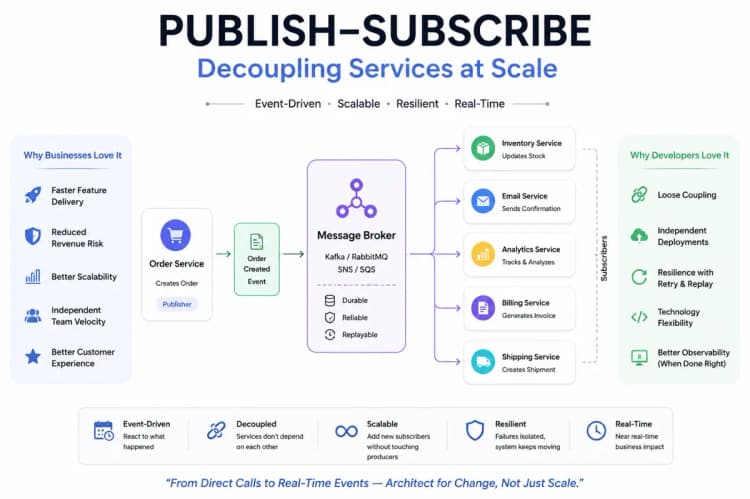
Event-Driven Growth
As complexity grows:
Direct calls become dangerous.
Example:
Order Created
Instead of:
Call Inventory

Call Billing

Call Email
Publish:
OrderCreated
Events.
Consumers react independently.
For example:
OrderCreated
     │
     ├── Inventory
     ├── Billing
     ├── Reporting
     └── Notifications
Benefits:
Loose Coupling

Independent Evolution

Better Scalability
The order system no longer needs to know every downstream consumer.
New consumers can be added later without modifying the original business operation.
This is particularly useful when secondary operations do not need to block the primary transaction.
Designing for Change
The biggest architecture question:
What will change?
Examples:
Database

Cloud Provider

Payment Gateway

Frontend Framework
Architecture should isolate volatility.
The domain should remain stable while infrastructure evolves.
For example:
Business Logic
       │
       ▼
Payment Interface
       │
       ├── Stripe
       └── Another Provider
The business should depend on the abstraction it needs rather than becoming tightly coupled to one external provider.
The same concept can apply to:
Storage

Email

Search

Messaging

Payments

Cloud Infrastructure
The less volatile core should not be forced to change every time a volatile implementation changes.
Real-World Example
Imagine BizNex OS.
Bad Design:
Order Module
knows

Inventory

Billing

Accounting

Notifications

Reports
Everything connected.
A change to one dependency can create unexpected consequences across the entire order workflow.
Better Design:
Order Domain
Publishes:
OrderCreated
Then:
Inventory

Billing

Accounting

Reporting
React independently.
The order domain remains responsible for creating a valid order.
Other business capabilities can respond to the event without creating direct coupling between every subsystem.
This makes the system easier to evolve.
Architecture Boundaries in BizNex OS
A practical modular structure could look like:
BizNex OS

├── Identity
├── Organizations
├── Sales
├── Inventory
├── Procurement
├── Finance
├── Payroll
└── Reporting
Each module should have clear responsibilities.
For example:
Sales
    │
    ├── Orders
    ├── Customers
    └── Pricing
while:
Inventory
    │
    ├── Products
    ├── Warehouses
    ├── Stock
    └── Reservations
and:
Finance
    │
    ├── Invoices
    ├── Payments
    ├── Accounts
    └── Ledger
The goal is not to make modules completely isolated.
The goal is to control how they communicate.
Cohesion and Coupling
Two concepts are fundamental to scalable design.
High Cohesion
Related responsibilities stay together.
Inventory
 ├── Stock
 ├── Reservations
 ├── Warehouses
 └── Inventory Rules
This makes the module easier to understand because related concepts live together.
Low Coupling
A module should know as little as reasonably possible about the internal implementation of another module.
Bad:
Billing
directly edits
Inventory tables
Better:
Billing
   │
   ▼
Application Interface / Event
   │
   ▼
Inventory
High cohesion and low coupling create boundaries that allow systems to evolve more safely.
Common Scaling Mistakes
Business Logic Inside Controllers
Bad:
@api.post("/invoice")
Contains:
Validation

Business Rules

Database Logic

Email Logic
Everything mixed.
This makes the endpoint responsible for too many concerns.
A better structure is:
HTTP Request
    │
    ▼
Controller
    │
    ▼
CreateInvoiceService
    │
    ├── Domain Rules
    ├── Repository
    └── Events
Database-Centric Design
Bad:
Tables First

Business Later
Result:
Database Drives Product
Instead:
Business Drives Database
Database structures should support business concepts rather than forcing the business model to conform to arbitrary storage structures.
The database is an important part of the architecture.
It should not become the architecture.
Shared Domain Models Everywhere
Bad:
Single Customer Model
Used by:
CRM

Billing

Accounting
Eventually becomes impossible to change.
Different domains often need different representations of the same real-world concept.
For example:
CRM Customer
Billing Customer
Accounting Customer
may refer to the same real-world organization but have different business responsibilities and attributes.
Bounded contexts allow each domain to define the model it actually needs.
Premature Microservices
Most systems do not need:
50 Services
They need:
Better Boundaries
Splitting a poorly designed monolith into 50 services does not automatically improve architecture.
It can simply transform:
In-Process Complexity
into:
Distributed Complexity
with additional problems such as:
Network Failures

Deployment Coordination

Observability

Distributed Transactions

Service Discovery
Start with good boundaries.
Extract services when there is a clear reason.
Framework-Centric Design
A common mistake is allowing the framework to define the business architecture.
For example:
Django Models
→ Everything

Django Views
→ Everything

Django Signals
→ Business Workflows
The framework becomes the architecture.
Instead:
Domain
Application
Infrastructure
Framework
The framework should support the architecture rather than own the business logic.
Global Shared Utilities
Another common problem is creating a massive collection of global helpers:
utils.py
helpers.py
common.py
services.py
Eventually, everything depends on everything.
A better approach is to place behavior near the domain or application boundary where it belongs.
Testing Architecture Boundaries
Scalable systems need more than unit tests.
Different architectural boundaries benefit from different forms of testing.
Domain Tests
Test business rules without infrastructure.
Invoice Approval
Inventory Reservation
Ownership Transfer
Application Tests
Test workflows:
Create Order
Approve Payment
Transfer Ownership
Integration Tests
Test real infrastructure boundaries:
Database
Redis
Queue
External APIs
API Tests
Verify:
Authentication
Authorization
Request Validation
Response Contracts
The goal is to ensure that architectural boundaries are real rather than merely folder structures.
Database Boundaries
A scalable system should also decide who owns data.
For example:
Inventory
owns

Products
Stock
Reservations
while:
Finance
owns

Invoices
Payments
Ledger
Other modules should interact through defined interfaces rather than directly manipulating another module's internal data whenever possible.
This becomes especially important when modules are eventually extracted into independent services.
Event Contracts
When modules communicate through events:
OrderCreated
PaymentCompleted
InventoryReserved
InvoiceGenerated
the event itself becomes a contract.
A good event should have:
Event Name
Event ID
Timestamp
Organization ID
Actor ID
Resource ID
Version
Example:
{
  "event_id": "evt_123",
  "event_type": "OrderCreated",
  "version": 1,
  "organization_id": "org_42",
  "actor_id": "user_100",
  "order_id": "order_500",
  "occurred_at": "2026-08-15T17:00:00Z"
}
Event contracts should evolve deliberately because multiple consumers may depend on them.
Observability as an Architectural Concern
As architecture becomes more complex, observability becomes part of system design.
A request may move through:
API
  │
  ▼
Application Service
  │
  ▼
Database
  │
  ▼
Event Bus
  │
  ├── Inventory
  ├── Billing
  └── Notifications
Without:
Metrics

Logs

Traces

Correlation IDs
it becomes difficult to understand where failures occur.
Scalable architecture therefore requires not only good boundaries, but visibility across those boundaries.
Evolution Blueprint
CRUD Application
       │
       ▼
Layered Architecture
       │
       ▼
Service Layer
       │
       ▼
Clean Architecture
       │
       ▼
DDD
       │
       ▼
Modular Monolith
       │
       ▼
Event-Driven Modules
       │
       ▼
Selective Microservices
This is not a mandatory progression.
A smaller application may remain a layered monolith for years.
A large organization may adopt bounded contexts and event-driven communication earlier.
The important point is to evolve architecture in response to actual complexity.
What I Would Build Today
For a serious SaaS platform:
Multi-Tenant Foundation

Clean Architecture

DDD Lite

Modular Monolith

Service Layer Pattern

Event-Driven Workflows

Background Jobs

Audit Logs

Strong Domain Boundaries
I would avoid:
Premature Microservices

Framework-Centric Design

Database-Centric Design

Shared Global Models
A practical starting architecture could be:
                    ┌────────────────────┐
                    │    Presentation    │
                    └─────────┬──────────┘
                              │
                              ▼
                    ┌────────────────────┐
                    │   Application      │
                    │   Use Cases         │
                    └─────────┬──────────┘
                              │
                              ▼
                    ┌────────────────────┐
                    │      Domain        │
                    │ Business Rules     │
                    └─────────┬──────────┘
                              │
                ┌─────────────┼─────────────┐
                ▼             ▼             ▼
          PostgreSQL        Redis        Event Bus
This provides:
Clear Boundaries

Simple Deployment

Testable Business Logic

Room For Growth

Gradual Distribution
The system can remain simple while still being prepared for future complexity.
Architecture Decision Framework
Before introducing a new architectural pattern, ask:
What problem are we solving?

Is the problem real?

How frequently does it occur?

What is the cost of the current design?

What complexity will the new solution introduce?

Can we solve the problem without distributing the system?

Will this decision make future changes easier?
This prevents architecture from becoming a collection of fashionable technologies.
The right architecture is the one that reduces meaningful complexity.
Key Takeaways
Scalability is not primarily a server problem.
It is a complexity problem.
The most successful systems protect business logic, define clear boundaries, model domains explicitly, and evolve architecture gradually.
High cohesion keeps related responsibilities together.
Low coupling reduces the impact of change.
Clean Architecture protects the domain from infrastructure.
DDD helps architecture reflect the business.
Bounded contexts prevent unrelated models from becoming one giant global model.
Modular monoliths provide a strong starting point for many growing SaaS platforms.
Event-driven architecture can reduce coupling as the system grows.
Microservices should be introduced selectively when there is a real business or operational reason.
For founders, scalable architecture preserves delivery speed.
For senior engineers, it creates systems that remain maintainable even after years of growth.
The ultimate goal is not building software that works today.
The goal is building software that is still easy to change five years from now.
A scalable architecture should therefore optimize for:
Understandability
+
Maintainability
+
Changeability
+
Reliability
+
Controlled Complexity
The strongest systems are not the systems with the most layers, services, patterns, or infrastructure.
They are the systems where every boundary exists for a reason, every dependency is intentional, and the business can continue changing without the architecture becoming the bottleneck.