Most organizations think about DNS as a website configuration tool.
A domain points to a server.
A browser loads a page.
The story ends there.
For SaaS companies, however, DNS becomes something very different.
It becomes part of the product itself.
As we explored in our previous article, Cloudflare DNS vs Route 53 vs Google Cloud DNS, managed DNS providers focus on reliability, performance, security, automation, and global scale.
For most websites, choosing a DNS provider is primarily an infrastructure decision.
For SaaS platforms, DNS becomes much more than infrastructure.
The moment customers ask:
Can I use my own domain?
The Moment DNS Becomes a Product Feature
Consider a simple SaaS platform.
Users access the application through:
yourapp.com
or:
tenant.yourapp.com
The architecture is straightforward.
User
   ↓
tenant.yourapp.com
   ↓
Application
DNS remains relatively simple.
Many early-stage SaaS companies operate successfully with this model.
Then growth happens.
Customers begin requesting:
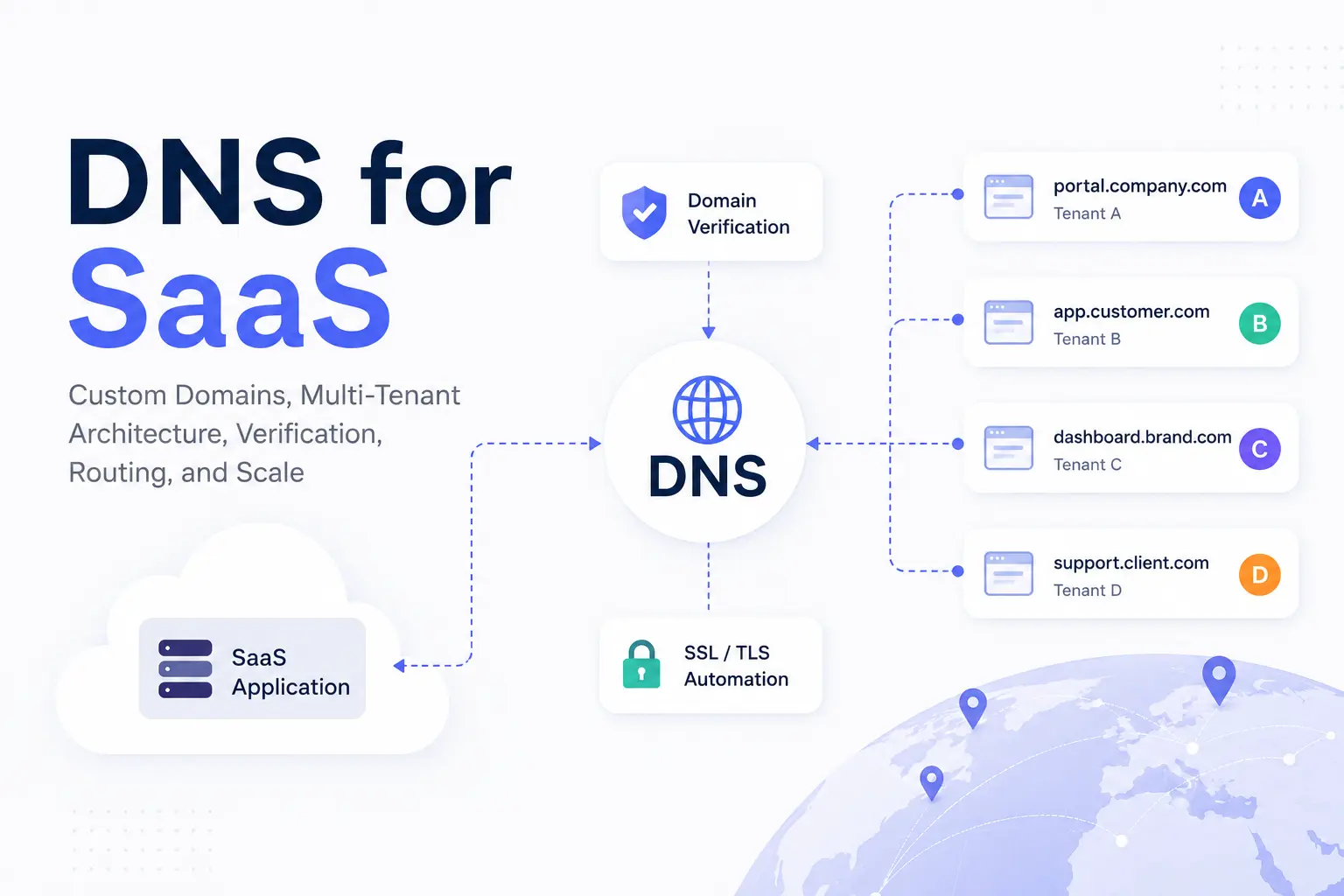
portal.customer.com
instead of:
customer.yourapp.com
This requirement fundamentally changes the architecture.
Why Customers Want Custom Domains
From a buyer's perspective, custom domains create:
Brand Consistency
Customers prefer:
portal.company.com
over:
company.yourapp.com
because it strengthens brand identity.
Trust
Users trust domains they recognize.
A custom domain feels more professional and integrated.
White Label Experiences
Many SaaS products operate behind the scenes.
Customers want the software experience to appear as part of their own platform.
Custom domains make this possible.
Understanding Multi-Tenant Architecture
Before discussing DNS, we need to understand tenants.
A tenant represents an isolated customer environment inside a shared application.
Conceptually:
Tenant A
Tenant B
Tenant C
all share:
Application Infrastructure
while maintaining:
Data Isolation
This architecture is known as:
Multi-Tenant SaaS
Most modern SaaS platforms use some variation of this model.
The Traditional SaaS Domain Model
Many SaaS platforms start with subdomains.
Example:
customer1.yourapp.com
customer2.yourapp.com
customer3.yourapp.com
DNS is simple.
A wildcard record can handle everything.
Example:
*.yourapp.com IN CNAME app.yourapp.com
This scales well.
However, it doesn't solve the custom domain problem.
The Custom Domain Challenge
Now imagine a customer wants:
support.company.com
Instead of:
company.yourapp.com
The customer controls:
company.com
You control:
yourapp.com
The challenge becomes:
How do we securely connect those two worlds?
Domain Ownership Verification
One of the first problems is ownership validation.
Without verification, an attacker could attempt to claim:
google.com
inside your platform.
That would be disastrous.
The SaaS platform must verify:
The customer actually owns the domain they are attempting to connect.
How SaaS Domain Verification Works
Most platforms use TXT records.
Example:
_acme-challenge.company.com TXT abc123xyz
The process looks like:
Customer
    ↓
Adds TXT Record
    ↓
DNS Verification
    ↓
Ownership Confirmed
This proves domain ownership without requiring direct access to the customer's DNS provider.
Why TXT Records Are Ideal
TXT records offer several advantages:
- Non-disruptive
- Easy to automate
- Supported everywhere
- Safe for verification
This is why Google Workspace, Microsoft 365, Search Console, and countless SaaS products rely on them.
Custom Domain Mapping
After verification, the platform must route traffic correctly.
Imagine:
portal.company.com
needs to reach:
Tenant ID = 4837
inside your application.
The platform maintains mappings similar to:
portal.company.com
      ↓
Tenant 4837

support.company.com
      ↓
Tenant 8201
The domain itself becomes a lookup key.
DNS Architecture for Custom Domains
A typical flow looks like:
User
 ↓
DNS Lookup
 ↓
Custom Domain
 ↓
SaaS Edge Network
 ↓
Tenant Resolution
 ↓
Application
Notice something important.
DNS only gets traffic to the platform.
Tenant identification happens afterward.
This distinction is critical.
Why Wildcards Aren't Enough
Many developers initially assume:
*.customer.com
solves everything.
Unfortunately, it doesn't.
You do not control:
customer.com
The customer does.
This means onboarding workflows must coordinate between:
- Customer DNS providers
- SaaS infrastructure
- Verification systems
- SSL automation
SSL Certificates Become a New Problem
DNS onboarding is only the beginning.
Modern browsers require HTTPS.
Every custom domain needs:
TLS Certificate
Without it:
Security Warning
appears.
Trust disappears instantly.
Automated Certificate Provisioning
Platforms typically automate:
Domain Verification
        ↓
Certificate Request
        ↓
Certificate Issuance
        ↓
Deployment
Let's Encrypt has made this dramatically easier.
However, operating at SaaS scale remains complex.
Why DNS Is Required for SSL Validation
Certificate authorities must verify ownership.
DNS-based validation is now common.
Example:
_acme-challenge.company.com TXT token
Certificate Authority:
Checks DNS
       ↓
Validates Ownership
       ↓
Issues Certificate
DNS becomes part of the SSL lifecycle.
Routing Millions of Custom Domains
At scale, SaaS companies may manage:
10,000
100,000
1,000,000+
custom domains.
The challenge becomes:
How do we efficiently route requests?
A common approach looks like:
Incoming Host Header
          ↓
Domain Lookup Service
          ↓
Tenant Identification
          ↓
Application Request
The domain effectively acts as a tenant identifier.
Edge Networks and Global Routing
Platforms such as:
- Cloudflare
- Vercel
- Fastly
often terminate traffic at the edge.
Example:
User
 ↓
Nearest Edge Location
 ↓
Domain Mapping
 ↓
Application Backend
Benefits include:
- Lower latency
- Better scalability
- Global performance
DNS and White Label SaaS
White-label SaaS products depend heavily on DNS.
Examples include:
- Learning management systems
- CRM platforms
- Customer portals
- Ecommerce solutions
Customers expect:
their-brand.com
not:
your-brand.com
DNS makes white-label products possible.
Security Risks in SaaS DNS Architecture
Custom domains introduce new attack surfaces.
Domain Hijacking
Improper verification can allow unauthorized domain claims.
Subdomain Takeovers
Unused DNS records can become security risks.
Certificate Abuse
Certificate issuance must be tightly controlled.
Tenant Impersonation
Domain mappings require strong validation and auditing.
Building a Domain Management Service
As platforms scale, DNS often evolves into its own subsystem.
Responsibilities include:
- Domain registration workflows
- Verification status
- SSL lifecycle management
- DNS monitoring
- Ownership validation
- Routing configuration
Many mature SaaS platforms eventually create dedicated domain-management services.
DNS as a Distributed Systems Problem
Custom domains introduce distributed systems challenges.
Consider:
Customer DNS Provider
        ↓
Global DNS Caches
        ↓
Certificate Authority
        ↓
Edge Network
        ↓
Application
Every component operates independently.
This introduces:
- Eventual consistency
- Delayed propagation
- Verification timing issues
- Operational complexity
The architecture becomes significantly more sophisticated than a simple DNS record.
SEO Benefits of Custom Domains
Many organizations prefer custom domains because they support:
- Brand ownership
- Search visibility
- User trust
- Marketing consistency
For content-driven SaaS platforms, domain strategy often becomes part of SEO strategy.
GEO and AI Discoverability
As AI search systems continue growing, branded domains become increasingly valuable.
Organizations want:
content.company.com
rather than:
company.vendor-platform.com
because ownership and discoverability remain aligned with their brand.
Practical Lessons for SaaS Builders
The biggest lesson is simple:
DNS is not merely infrastructure.
In many SaaS platforms, DNS becomes part of the product experience.
What appears to customers as:
Connect Domain
may require:
- Verification systems
- Certificate automation
- Routing services
- Edge infrastructure
- Monitoring platforms
behind the scenes.
Frequently Asked Questions
What is SaaS DNS Architecture?
The systems and infrastructure used to manage domains, custom domains, verification, routing, and SSL certificates within a SaaS platform.
What is Multi-Tenant DNS?
A DNS strategy that allows multiple customers to use a shared SaaS platform while maintaining domain-level isolation and routing.
Why do SaaS platforms support custom domains?
Custom domains improve branding, trust, white-label capabilities, and user experience.
How do SaaS platforms verify domain ownership?
Typically through DNS TXT records.
Why are DNS records important for SaaS?
They enable custom domains, verification, SSL certificates, routing, security, and tenant identification.
Do custom domains affect SEO?
They can improve brand consistency and ownership while supporting broader SEO and GEO strategies.
Key Takeaways
- DNS becomes part of the product architecture in SaaS platforms.
- Custom domains introduce verification, routing, and security challenges.
- TXT records are commonly used for ownership verification.
- SSL automation depends heavily on DNS validation.
- Multi-tenant SaaS platforms often use domain mapping services.
- DNS architecture becomes increasingly complex at scale.
- White-label SaaS experiences rely heavily on custom domains.
- DNS, security, certificates, and routing are deeply connected.
- Modern SaaS companies treat DNS as programmable infrastructure.
About the Author
Anik Sikder is a Software Engineer specializing in Backend Systems, SaaS Architecture, Networking, Cloud Infrastructure, Python, Django, FastAPI, and Distributed Systems.
He writes about DNS, networking, system design, SaaS engineering, and scalable software architecture.