Most discussions about SEO focus on:
- Keywords
- Content
- Backlinks
- Metadata
- Internal linking
Those things matter.
A lot.
But they all assume one critical condition:
Search engines must be able to consistently access your website.
Before Google can evaluate content...
Before Core Web Vitals can be measured...
Before backlinks can transfer authority...
Before AI systems can retrieve information...
Your infrastructure must work.
And at the foundation of that infrastructure sits DNS.
In our previous article, we explored:
- How DNS translates domain names into IP addresses
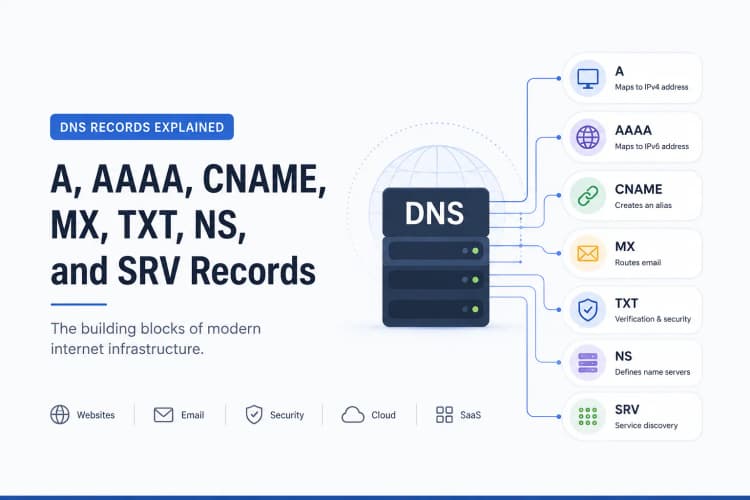
- How DNS records control traffic routing
- Why DNS propagation is fundamentally a caching problem
- How DNS TTL influences infrastructure changes
Those concepts may seem operational at first glance.
However, they directly influence how search engines, users, and AI systems discover and access content.
A website cannot rank if it cannot be reached.
A page cannot be crawled if DNS resolution fails.
And a perfectly executed migration can still create visibility issues if DNS caching and propagation behavior are not properly understood.
This is where DNS and SEO begin to intersect.
The Wrong Question
Many people ask:
Does DNS affect SEO?
The better question is:
Does DNS affect the systems that influence SEO?
The answer is unquestionably yes.
To understand why, we need to stop thinking about SEO purely as a marketing discipline.
Search visibility is ultimately a distributed systems problem.
A search engine must:
- Discover content
- Access content
- Process content
- Evaluate content
- Index content
- Serve content
Every step depends on infrastructure.
DNS is often the first infrastructure dependency in that entire process.
Every Website Visit Starts with DNS
Imagine someone clicks a search result.
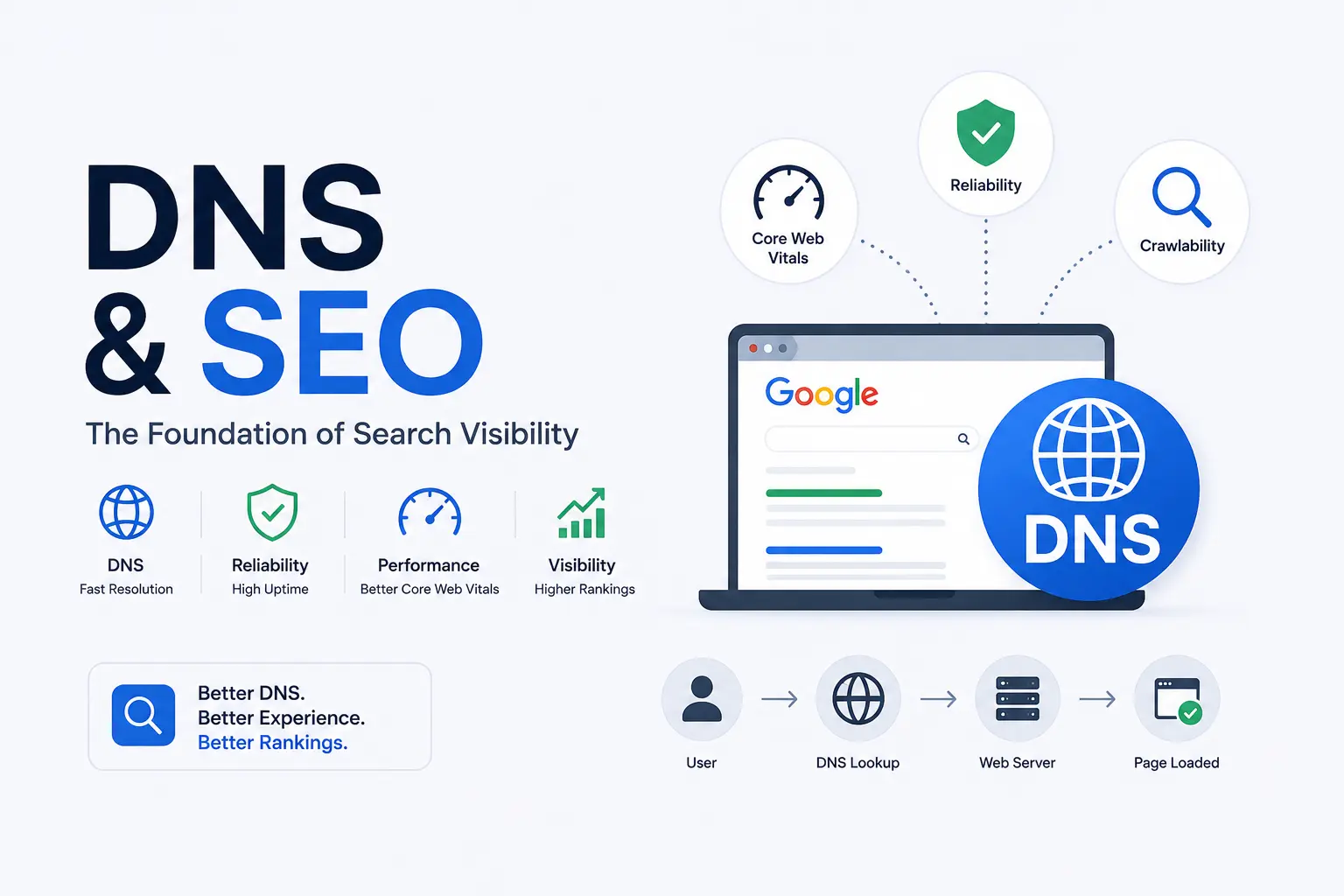
The sequence looks like this:
Search Result
      ↓
DNS Lookup
      ↓
TCP Connection
      ↓
TLS Handshake
      ↓
HTML Response
      ↓
Page Rendering
Most SEO conversations begin at:
HTML Response
But the process actually begins much earlier.
Without successful DNS resolution:
Nothing else happens.
The page never loads.
The crawler never crawls.
The visitor never visits.
The conversion never occurs.
DNS is literally the first step in reaching a website.
DNS Is Not a Ranking Factor
Let's address the most common misconception immediately.
Google has never stated:
Faster DNS providers receive higher rankings.
Simply moving from one DNS provider to another does not create ranking gains.
Switching from:
Provider A
to:
Provider B
will not magically improve search visibility.
Search engines do not rank websites based on DNS brand names.
However, infrastructure quality can influence signals that matter.
That's where the real conversation begins.
DNS and Website Availability
Imagine two websites.
Website A
99.999% uptime
Website B
Frequent DNS outages
Which site will search engines trust more?
The answer is obvious.
Search engines need reliable access to content.
If DNS frequently fails:
- Crawlers encounter errors
- Pages become inaccessible
- Resources fail to load
- Indexing becomes inconsistent
Availability is one of the most underrated SEO factors.
Not because Google directly rewards uptime.
But because inaccessible content cannot compete.
Understanding Crawlability Through a System Design Lens
Search engines operate at enormous scale.
They cannot crawl everything constantly.
Instead they allocate resources strategically.
Think of Google's crawler as a distributed system with finite capacity.
Every time it visits a website, it expects:
DNS Resolution
      ↓
Connection
      ↓
Response
When DNS repeatedly fails:
DNS Error
      ↓
No Response
crawl efficiency declines.
Over time this can affect how frequently content is revisited and updated.
DNS and Crawl Budget
Large websites often discuss:
Crawl Budget
Crawl budget represents the resources search engines allocate to crawling a website.
Reliable infrastructure helps ensure those resources are used effectively.
Imagine a crawler making 10,000 requests.
If DNS failures consume a portion of those requests, fewer resources remain available for content discovery.
This becomes increasingly important for:
- Large ecommerce websites
- News platforms
- SaaS documentation sites
- Enterprise knowledge bases
Infrastructure reliability and crawl efficiency are closely connected.
DNS Performance and SEO
Now we arrive at a more interesting question.
Does DNS speed matter?
The answer is:
Sometimes.
But not always in the way people expect.
Understanding DNS Lookup Time
Before a browser can request a webpage, it often performs a DNS lookup.
Example:
example.com
      ↓
203.0.113.10
That lookup takes time.
Typically measured in milliseconds.
Example:
10ms
25ms
50ms
100ms
A single lookup may seem insignificant.
However, performance is cumulative.
Every delay contributes to the total user experience.
DNS and Page Speed
Modern websites rarely make a single DNS request.
A typical page may load:
Website
CDN
Analytics
Fonts
Images
Scripts
APIs
Each service may require DNS resolution.
Poor DNS performance can introduce additional latency before content even begins loading.
While the impact is often small compared to rendering or JavaScript execution, it is still part of the performance equation.
DNS and Core Web Vitals
Core Web Vitals focus on user experience metrics such as:
- LCP (Largest Contentful Paint)
- INP (Interaction to Next Paint)
- CLS (Cumulative Layout Shift)
DNS does not directly measure these metrics.
However DNS influences the path leading to them.
Consider:
DNS Lookup
      ↓
Connection
      ↓
Resource Delivery
      ↓
Rendering
      ↓
LCP
A slow start affects everything that follows.
This is why infrastructure engineers often describe performance as:
A chain of dependencies.
DNS is one of the earliest links in that chain.
The Hidden SEO Cost of DNS Outages
Performance discussions often focus on milliseconds.
Availability discussions focus on hours.
The latter is usually more dangerous.
Imagine:
Website Content = Excellent
Backlinks = Strong
Technical SEO = Excellent
But:
DNS Failure
causes several hours of downtime.
During that period:
- Users cannot access content
- Crawlers cannot access content
- Transactions cannot occur
- APIs may fail
Infrastructure outages can erase the benefits of otherwise excellent SEO.
DNS, CDN Architecture, and Search Visibility
Many modern websites use CDNs such as:
- Cloudflare
- Fastly
- Akamai
- Amazon CloudFront
DNS plays a critical role in directing traffic to edge infrastructure.
Example:
User
      ↓
DNS
      ↓
Nearest Edge Location
      ↓
Content Delivery
This architecture improves:
- Performance
- Availability
- Geographic distribution
All of which contribute to user experience.
Why Global Infrastructure Matters
A visitor in:
Singapore
should not have the same experience as someone in:
London
or:
New York
Modern DNS systems help direct users toward optimal infrastructure.
This improves:
- Latency
- Reliability
- User experience
Search engines increasingly care about these outcomes.
DNS and GEO (Generative Engine Optimization)
Search is changing.
Traditional search engines are no longer the only discovery mechanism.
Increasingly, information is surfaced through:
- AI search engines
- Large language models
- Retrieval systems
- Answer engines
This introduces a new challenge.
Content must remain consistently accessible.
AI systems cannot reference content they cannot retrieve.
Infrastructure quality therefore becomes part of content discoverability.
Reliability Is Becoming a Competitive Advantage
Historically, SEO focused on:
Content
Links
Keywords
Modern visibility increasingly depends on:
Content
Links
Infrastructure
Reliability
Performance
The websites that remain accessible, fast, and trustworthy have an advantage.
DNS contributes directly to that foundation.
DNS and Website Migrations
Website migrations are among the highest-risk events for search visibility.
Common examples include:
- Server migrations
- Domain migrations
- CDN migrations
- Cloud migrations
DNS often sits at the center of these transitions.
Poor planning can create:
- Downtime
- Broken redirects
- Crawl issues
- Accessibility problems
Successful migrations require careful DNS management long before launch day.
DNS TTL and SEO
In our DNS Propagation article, we explored TTL in depth.
TTL affects:
Caching
Propagation
Infrastructure Changes
During migrations, poorly managed TTL values can prolong inconsistencies.
Search engines may encounter different infrastructure states depending on cache timing.
Reducing TTL before major changes often leads to smoother transitions.
DNS Security and Search Trust
DNS is also a security layer.
Technologies such as:
- DNSSEC
- SPF
- DKIM
- DMARC
help establish trust.
While these mechanisms are not direct ranking factors, they improve ecosystem integrity.
Trustworthy infrastructure contributes to trustworthy digital experiences.
What Matters More: DNS Speed or DNS Reliability?
If forced to choose:
Reliability wins.
Every time.
A website that resolves in:
15ms
but experiences outages is far worse than a website resolving in:
40ms
with exceptional reliability.
Availability remains the foundation.
Performance optimization comes afterward.
The Infrastructure Visibility Model
A useful mental model looks like this:
DNS
 ↓
Availability
 ↓
Accessibility
 ↓
Crawlability
 ↓
Performance
 ↓
User Experience
 ↓
Search Visibility
DNS rarely influences rankings directly.
But it influences multiple layers beneath ranking systems.
That's what makes it important.
Frequently Asked Questions
Does DNS directly affect Google rankings?
Not directly.
However, DNS affects availability, performance, crawlability, and user experience, which influence search visibility.
Is a faster DNS provider better for SEO?
Not necessarily.
Reliability is generally more important than marginal speed improvements.
Can DNS outages hurt SEO?
Yes.
Extended outages can prevent crawlers and users from accessing content.
Does DNS affect Core Web Vitals?
Indirectly.
DNS resolution occurs before page rendering and contributes to overall loading performance.
Does DNS matter for GEO?
Yes.
Reliable infrastructure improves content accessibility for AI search systems and answer engines.
What matters most for DNS SEO?
The three most important factors are:
- Reliability
- Availability
- Consistent performance
Key Takeaways
- DNS is not a direct ranking factor.
- DNS influences availability, crawlability, and performance.
- Search engines must successfully resolve DNS before accessing content.
- DNS reliability matters more than raw DNS speed.
- DNS contributes to Core Web Vitals through the performance chain.
- CDN architectures depend heavily on DNS.
- Website migrations require careful DNS planning.
- Reliable infrastructure supports both SEO and GEO.
- Modern search visibility increasingly depends on technical excellence beyond content alone.
About the Author
Anik Sikder is a Software Engineer specializing in Python, Django, FastAPI, Cloud Infrastructure, DevOps, Networking, and Software Architecture.
He writes about DNS, System Design, Distributed Systems, Cloud Computing, SaaS Architecture, Cybersecurity, and scalable software engineering practices.