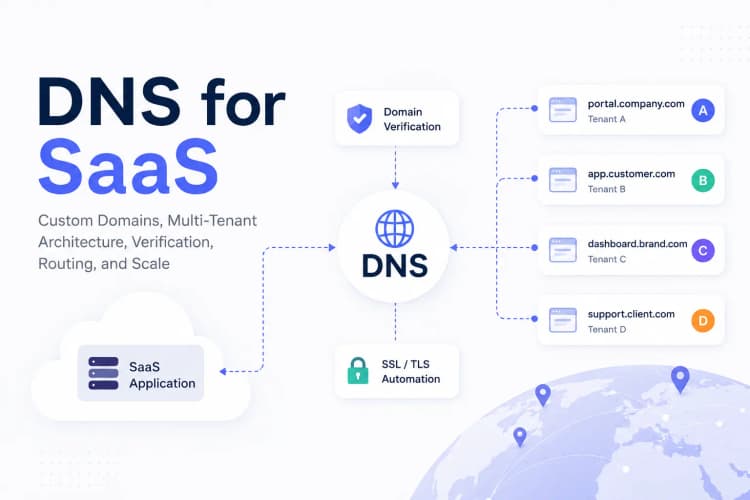
In reality, modern DNS infrastructure sits at the center of nearly every internet experience.
As we explored in our previous article, DNS and SEO: Does DNS Affect Google Rankings?, DNS is not a direct ranking factor, but it influences the infrastructure layers that affect availability, crawlability, performance, user experience, and ultimately search visibility.
Before a browser loads a page...
Before an API receives a request...
Before an email reaches an inbox...
Before an AI system retrieves content...
DNS is involved.
This is why choosing the right managed DNS provider matters far more than most organizations realize.
The provider responsible for answering DNS queries can directly influence:
- Global availability
- Resolution performance
- Infrastructure resilience
- Traffic routing
- Disaster recovery
- Security posture
In this article, we'll compare three of the most widely used managed DNS platforms:
- Cloudflare DNS
- Amazon Route 53
- Google Cloud DNS
We'll analyze them through the lens of:
- Architecture
- Reliability
- Global performance
- Security
- Automation
- GEO infrastructure
- Enterprise scalability
- Pricing
- Operational tradeoffs
Because the best DNS provider is rarely the same for everyone.
Why Managed DNS Matters
Many people think DNS is simply a database.
Technically, that's true.
But it's an extremely specialized distributed database.
Consider what DNS must accomplish.
A DNS provider must:
Serve billions of queries
Across continents
With low latency
24/7
Without downtime
A single outage can make an entire application disappear from the internet.
Not because servers are down.
Not because databases failed.
But because users can no longer find the servers.
This makes DNS one of the most critical layers in modern infrastructure.
The Three DNS Giants
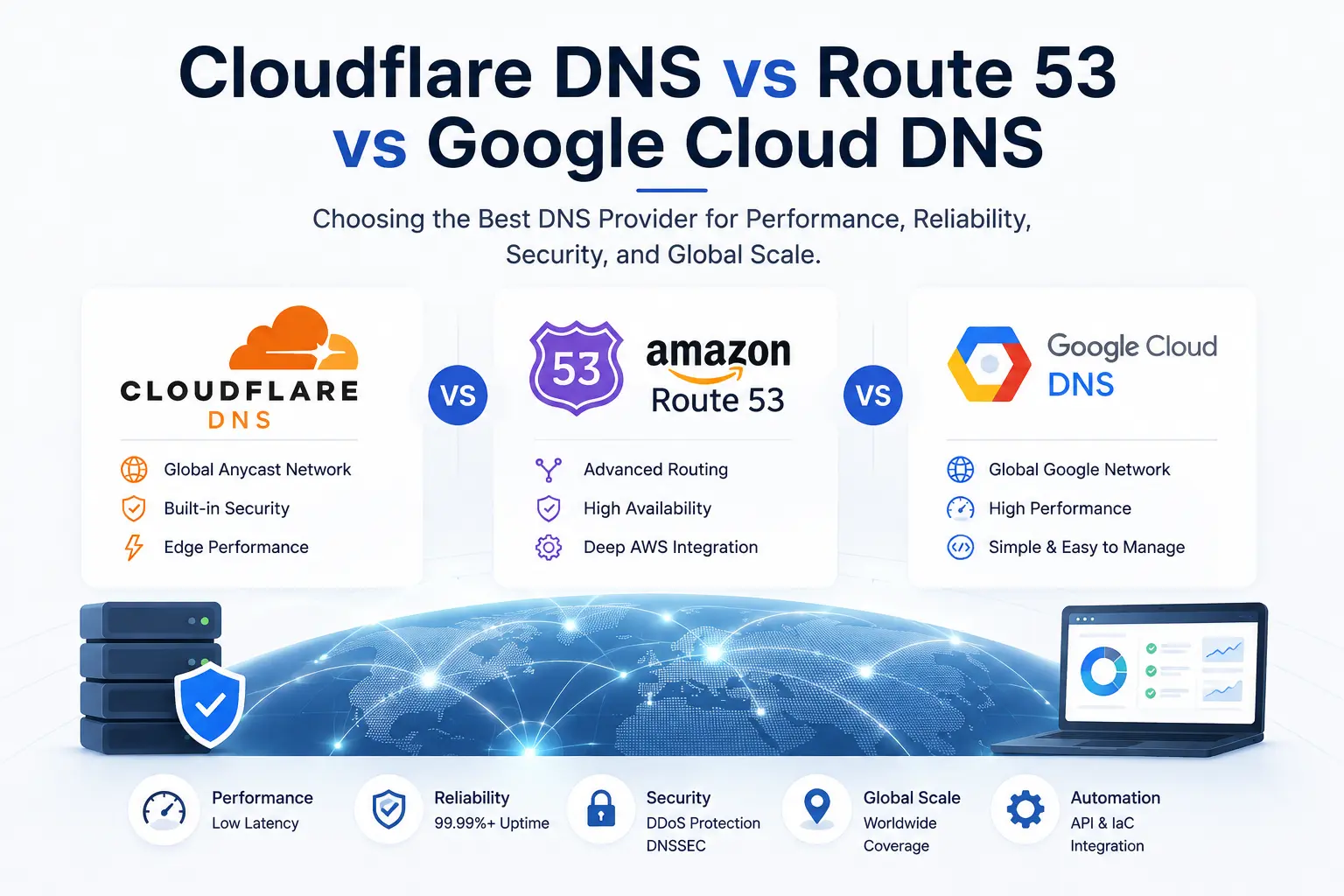
When engineers discuss managed DNS at scale, three names appear repeatedly:
Cloudflare DNS
Known for:
- Massive Anycast network
- CDN integration
- Security features
- DDoS protection
- Developer-friendly tooling
Amazon Route 53
Known for:
- AWS ecosystem integration
- Advanced routing policies
- Enterprise-grade reliability
- Infrastructure automation
Google Cloud DNS
Known for:
- Simplicity
- Global Google network
- High-performance DNS serving
- Strong cloud-native integration
All three are excellent.
The differences emerge when examining architecture and operational requirements.
Understanding the Real Job of a DNS Provider
Many comparisons begin with features.
A better starting point is infrastructure.
The primary responsibilities of a managed DNS platform are:
Availability
Performance
Consistency
Security
Automation
Scalability
Every feature ultimately supports one of these goals.
Architecture Comparison
Before comparing products, we should compare philosophies.
Cloudflare Architecture
Cloudflare built its platform around a massive global Anycast network.
Conceptually:
User
   ↓
Nearest Cloudflare Edge
   ↓
DNS Response
Instead of serving DNS from a small number of centralized regions, Cloudflare distributes services across hundreds of edge locations worldwide.
This architecture prioritizes:
- Low latency
- Geographic proximity
- Massive DDoS resistance
- Edge-based services
DNS becomes part of a broader edge platform.
Route 53 Architecture
Amazon approaches DNS differently.
Route 53 is deeply integrated into AWS infrastructure.
Conceptually:
Application
      ↓
AWS Services
      ↓
Route 53
      ↓
Global Resolution
Route 53 emphasizes:
- Reliability
- AWS automation
- Routing intelligence
- Service discovery
Rather than being primarily an edge platform, Route 53 acts as a highly programmable DNS control plane.
Google Cloud DNS Architecture
Google focuses heavily on automation and simplicity.
The architecture resembles:
Google Global Network
          ↓
Cloud DNS
          ↓
Global Resolution
Google leverages its private global backbone and networking expertise to provide highly scalable DNS services with relatively low operational complexity.
Cloudflare vs Route53 vs Google Cloud DNS: Performance
Performance is often the first thing people evaluate.
However, performance is more nuanced than raw speed.
The question isn't:
Which DNS provider is fastest?
The better question is:
Which DNS provider consistently delivers low latency globally?
Understanding DNS Latency
A DNS query might look like:
User
  ↓
Resolver
  ↓
Authoritative DNS
  ↓
Response
Every millisecond matters.
Especially when multiplied across millions of requests.
Cloudflare Performance
Cloudflare consistently performs well because of its enormous edge footprint.
Advantages include:
- Extensive Anycast presence
- Large global network
- Strong performance in emerging markets
- Excellent geographic coverage
For globally distributed audiences, Cloudflare often provides exceptionally low query latency.
Route 53 Performance
Route 53 also performs extremely well.
AWS operates one of the world's largest cloud infrastructures.
Advantages include:
- Highly optimized global DNS infrastructure
- Consistent performance
- Excellent enterprise reliability
Performance differences compared to Cloudflare are often measured in milliseconds.
For many applications, users will never notice.
Google Cloud DNS Performance
Google benefits from decades of networking expertise.
Advantages include:
- Google's private backbone
- Global edge presence
- Consistent DNS response times
Google Cloud DNS frequently ranks among the fastest authoritative DNS services available.
Why Reliability Matters More Than Speed
Organizations often obsess over:
10ms
vs
20ms
Yet reliability usually matters more.
Consider:
Fast DNS + Outages
versus:
Slightly Slower DNS + Exceptional Availability
The second option wins.
Every time.
Users cannot access content that cannot be resolved.
Managed DNS Comparison: Availability
DNS availability is where premium providers distinguish themselves.
Modern organizations expect:
99.99%
99.999%
or better
availability targets.
Anything less becomes costly.
Cloudflare Reliability
Cloudflare has built substantial resilience through:
- Global Anycast routing
- Massive edge distribution
- Automatic traffic absorption
- Network redundancy
Failures in one region rarely affect the broader platform.
Route 53 Reliability
Route 53 is often considered one of the most reliable DNS services available.
Key strengths include:
- Global redundancy
- Multi-region infrastructure
- Mature operational processes
- Proven enterprise track record
Many large enterprises rely on Route 53 for mission-critical workloads.
Google Cloud DNS Reliability
Google Cloud DNS benefits from:
- Distributed infrastructure
- Global networking architecture
- Automated management systems
It is highly reliable and suitable for large-scale workloads.
DNS Routing Capabilities
This is where major differences emerge.
Not all DNS platforms offer the same routing intelligence.
Route 53 Routing Features
Route 53 is arguably the most sophisticated DNS routing platform among the three.
Capabilities include:
- Latency-based routing
- Geolocation routing
- Geoproximity routing
- Weighted routing
- Failover routing
- Multi-region traffic management
Example:
European Users
      ↓
Frankfurt Region

US Users
      ↓
Virginia Region
This level of control is powerful for large-scale architectures.
Cloudflare Routing
Cloudflare supports advanced traffic management through broader platform services.
Benefits include:
- Load balancing
- Health checks
- Geographic steering
- Edge intelligence
Cloudflare often combines DNS with application-layer traffic management.
Google Cloud DNS Routing
Google Cloud DNS intentionally keeps routing simpler.
It excels at:
- Reliable DNS serving
- Cloud-native integration
- Automation
Organizations requiring highly advanced routing may find Route 53 more flexible.
DNS Security Comparison
Modern DNS is also a security platform.
Attackers frequently target DNS because it sits at the front door of internet services.
Cloudflare Security
Security is one of Cloudflare's biggest strengths.
Features include:
- DNSSEC
- DDoS protection
- Bot mitigation
- WAF integration
- Zero Trust services
Cloudflare views DNS as part of a larger security ecosystem.
Route 53 Security
Route 53 focuses heavily on infrastructure security.
Capabilities include:
- DNSSEC support
- IAM integration
- CloudTrail logging
- AWS security controls
Security aligns closely with AWS operational models.
Google Cloud DNS Security
Google provides:
- DNSSEC
- IAM controls
- Audit logging
- Cloud-native security integration
The security model feels familiar to organizations already operating within Google Cloud.
Automation and Infrastructure as Code
Modern infrastructure is increasingly automated.
DNS changes should not require manual dashboard updates.
Instead:
Git
 ↓
CI/CD
 ↓
Infrastructure Code
 ↓
DNS Updates
This is especially important for SaaS platforms and enterprise environments.
Route 53 Automation
Route 53 excels here.
Popular integrations include:
- Terraform
- AWS CloudFormation
- AWS CDK
- Pulumi
DNS becomes part of application deployment workflows.
Google Cloud DNS Automation
Google Cloud DNS also integrates well with:
- Terraform
- Deployment Manager
- Infrastructure pipelines
Automation is straightforward and reliable.
Cloudflare Automation
Cloudflare provides:
- APIs
- Terraform providers
- CI/CD integrations
Cloudflare has become increasingly developer-friendly over the past few years.
Multi-Cloud and Hybrid Cloud Environments
A common misconception is:
Use AWS DNS if you're on AWS.
Not necessarily.
Modern architectures often look like:
AWS
Azure
Google Cloud
Cloudflare
On-Premise
all operating simultaneously.
The best DNS provider may depend on architecture strategy rather than hosting location.
Best DNS Provider for SaaS Applications
SaaS platforms typically need:
- High availability
- Automation
- Multi-region routing
- Scalability
- Security
For SaaS companies:
Route 53 Advantages
- Deep automation
- Advanced routing
- Enterprise scalability
Cloudflare Advantages
- Security
- Global edge network
- Integrated CDN platform
Google Cloud DNS Advantages
- Simplicity
- Strong performance
- Easy management
All three can support SaaS-scale workloads.
The choice depends on operational priorities.
Best DNS Provider for Content Websites
Content-heavy websites prioritize:
- Performance
- Reliability
- Global reach
- SEO support
- CDN integration
Cloudflare often becomes attractive because DNS and content delivery live within the same ecosystem.
The operational experience is often simpler.
Best DNS Provider for Enterprise Infrastructure
Large organizations usually prioritize:
Governance
Automation
Control
Redundancy
Compliance
In these environments, Route 53 often stands out because of its advanced routing and enterprise automation capabilities.
Pricing Comparison
Pricing should rarely be the primary decision factor.
The operational cost of downtime usually exceeds DNS costs by orders of magnitude.
Still, pricing matters.
Cloudflare Pricing
Generally attractive for:
- Startups
- Content websites
- Small businesses
- SaaS platforms
Many DNS features are available without complex pricing structures.
Route 53 Pricing
Route 53 uses usage-based pricing.
Costs scale with:
- Hosted zones
- Query volume
- Health checks
- Routing features
This model works well for enterprises but can be more complex.
Google Cloud DNS Pricing
Google Cloud DNS typically offers predictable pricing with a relatively simple model.
Many organizations appreciate its straightforward cost structure.
Which Provider Has the Best Global Network?
This question is common.
The answer depends on what "best" means.
If best means:
Edge Presence
Cloudflare is extremely strong.
If best means:
Routing Sophistication
Route 53 often leads.
If best means:
Operational Simplicity
Google Cloud DNS is highly competitive.
The Wrong Way to Choose a DNS Provider
Many organizations choose DNS based on:
Lowest Cost
or
Current Cloud Vendor
Those factors matter.
But they shouldn't be the only factors.
A better framework evaluates:
- Reliability
- Security
- Routing requirements
- Automation needs
- Global reach
- Operational complexity
A Practical Decision Framework
Choose Cloudflare DNS if you prioritize:
- Global performance
- Security
- CDN integration
- Edge architecture
- Simplicity
Choose Route 53 if you prioritize:
- AWS integration
- Advanced routing
- Enterprise automation
- Large-scale infrastructure control
Choose Google Cloud DNS if you prioritize:
- Simplicity
- Strong performance
- Google Cloud integration
- Minimal operational overhead
Frequently Asked Questions
Which is the best DNS provider?
There is no universal winner.
The best DNS provider depends on infrastructure requirements, automation needs, security priorities, and operational preferences.
Is Cloudflare better than Route 53?
Not universally.
Cloudflare often excels in edge performance and security, while Route 53 excels in routing flexibility and AWS integration.
Is Google Cloud DNS faster than Route 53?
Performance differences are usually small and workload-dependent.
Reliability and architecture requirements often matter more than marginal speed differences.
Which DNS provider is best for SEO?
Search engines do not rank websites based on DNS brands.
However, reliable DNS infrastructure improves availability, performance, and crawlability.
Which DNS provider is best for SaaS?
Cloudflare, Route 53, and Google Cloud DNS can all support SaaS-scale workloads.
Route 53 is often preferred for advanced routing, while Cloudflare is frequently chosen for integrated security and edge services.
Key Takeaways
- Cloudflare, Route 53, and Google Cloud DNS are all enterprise-grade managed DNS providers.
- Cloudflare emphasizes edge performance, security, and global distribution.
- Route 53 emphasizes routing intelligence, automation, and AWS integration.
- Google Cloud DNS emphasizes simplicity, performance, and cloud-native operations.
- Reliability matters more than minor latency differences.
- DNS selection should align with infrastructure strategy rather than marketing claims.
- Managed DNS is a critical part of availability, performance, and security architecture.
- Modern SaaS platforms increasingly treat DNS as programmable infrastructure.
- The best DNS provider depends on operational requirements, not brand popularity.
About the Author
Anik Sikder is a Software Engineer specializing in Python, Django, FastAPI, Cloud Infrastructure, DevOps, Networking, and Software Architecture.
He writes about networking, software architecture, distributed systems, backend engineering, cloud technologies, and scalable software design.