Hey engineers! 👋
Have you ever clicked a button and wondered:
Why did that action complete instantly while another one took several minutes?
Or perhaps you've uploaded a video to YouTube and noticed something interesting.
The upload finishes.
You receive a confirmation.
Yet the video continues processing in the background.
Why doesn't YouTube simply wait until everything is finished before responding?
The answer lies in one of the most important concepts in modern software architecture:
Synchronous vs Asynchronous Workloads.
Understanding this distinction explains how companies like YouTube, Netflix, Stripe, Amazon, and Uber build systems that can handle millions of users without collapsing under their own weight.
More importantly, it changes the way you think about scalability.
Let's dive in. 🚀
Why This Topic Matters
Most software starts simple.
A user requests something.
The system performs work.
The system returns a response.
User
  ↓
Request
  ↓
Application
  ↓
Response
Simple.
Predictable.
Easy to understand.
But as systems grow, this model starts breaking down.
Why?
Because waiting is expensive.
And modern systems simply cannot afford to wait.
Understanding synchronous and asynchronous workloads helps explain:
- Why queues exist
- Why background jobs exist
- Why event-driven systems exist
- Why cloud platforms scale
- Why distributed systems behave the way they do
Before learning message brokers, Kafka, RabbitMQ, SQS, Pub/Sub, or Event-Driven Architecture, it's worth mastering this foundational concept.
What Does Synchronous Mean?
Most developers define synchronous communication as:
Request
   ↓
Wait
   ↓
Response
That's correct.
But from a systems perspective, synchronous means something deeper.
The lifetime of the work is coupled to the lifetime of the request.
The work begins.
The request waits.
The work finishes.
Only then does the response return.
Everything is tightly connected.
A Real-World Analogy
Imagine ordering coffee at a café.
You walk to the counter.
You place an order.
The barista immediately begins making your coffee.
You stand there waiting.
Customer
    ↓
Order
    ↓
Coffee Preparation
    ↓
Coffee Delivered
You cannot leave.
The process isn't finished until your coffee arrives.
This is synchronous processing.
The customer and the work remain tightly coupled.
A Simple Login Example
Consider authentication.
POST /login
The system must:
- Validate credentials
- Check the database
- Verify passwords
- Generate a token
Only after these tasks finish can the user continue.
User
   ↓
Login Request
   ↓
Authentication
   ↓
Response
This is an excellent use case for synchronous processing.
Because the user genuinely needs the answer immediately.
When Synchronous Processing Makes Sense
Synchronous workloads are ideal when:
The User Needs An Immediate Answer
Examples:
- Login
- Password validation
- Payment authorization
- Product search
- Fetching profile information
The Work Is Fast
Typically:
Milliseconds

or

A Few Seconds
The Response Determines The Next Action
The user cannot continue without the result.
In these situations, synchronous communication is often the correct choice.
The Hidden Cost of Waiting
Here's something many engineers discover only after working on large systems.
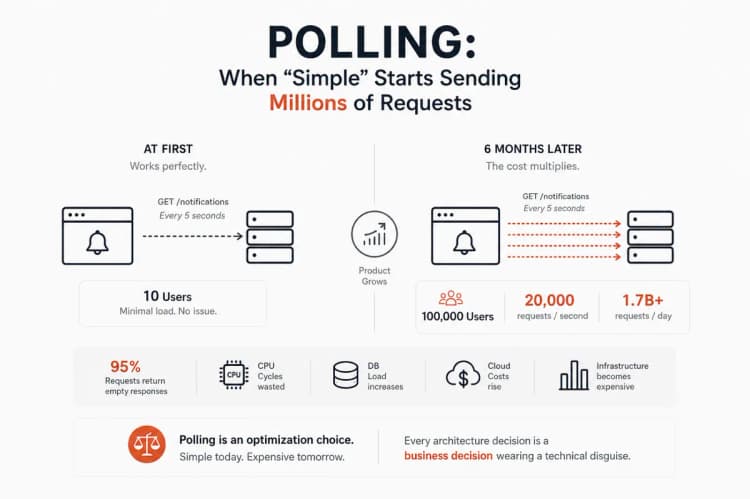
Waiting consumes resources.
While a request is waiting:
- Memory remains allocated
- Connections remain open
- Workers remain occupied
- Load balancers maintain state
- Databases hold resources
- Thread pools become busier
At small scale:
100 Requests

×

100ms
No problem.
At large scale:
100,000 Requests

×

30 Seconds
Everything changes.
The architecture becomes the bottleneck.
The system spends more resources waiting than working.
The YouTube Thought Experiment
Imagine you're building YouTube.
A creator uploads a 4K video.
After upload, the platform must:
- Generate thumbnails
- Create previews
- Transcode multiple resolutions
- Detect copyrighted content
- Run moderation checks
- Extract metadata
- Replicate files globally
- Update search indexes
Processing may take:
2 Minutes

5 Minutes

10 Minutes

20 Minutes
Now ask yourself:
Should the user wait?
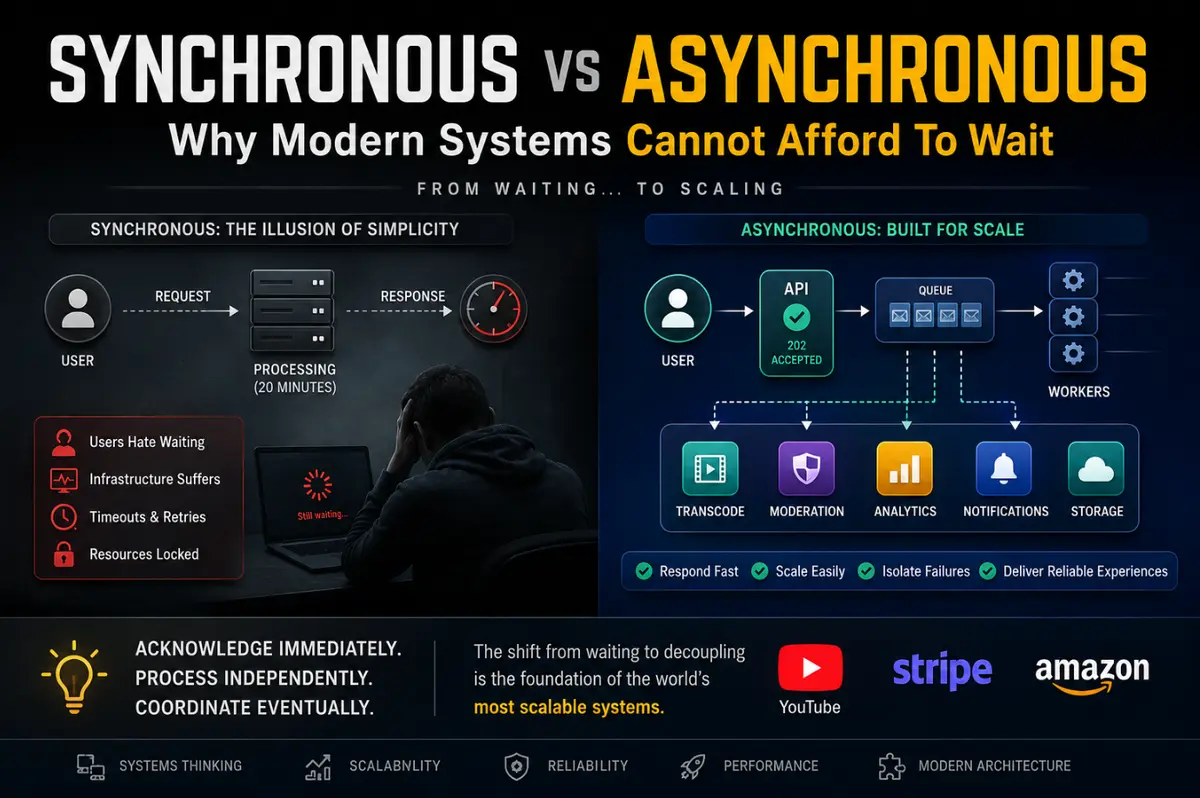
The Wrong Design
A purely synchronous implementation might look like this:
User
   ↓
POST /upload
   ↓
20 Minutes Processing
   ↓
200 OK
Technically correct.
Practically disastrous.
Problem #1: Humans Hate Waiting
Users expect responsiveness.
After several seconds:
Loading...
People become impatient.
After several minutes:
Most assume the application is broken.
Even when it isn't.
Perception becomes reality.
Problem #2: Infrastructure Suffers
Imagine:
50,000 Creators
Uploading videos simultaneously.
If every upload keeps a request open for 20 minutes:
50,000 Active Requests

50,000 Open Connections

50,000 Waiting Contexts
Infrastructure collapses long before CPU becomes the problem.
Problem #3: Timeouts Win Eventually
Every system contains limits.
Examples include:
- Browser timeouts
- API Gateway timeouts
- Reverse proxy timeouts
- Load balancer timeouts
Eventually something gives up.
The work may still be running.
But the user sees failure.
Retries begin.
Duplicate work appears.
System load increases.
A latency problem becomes a reliability problem.
The Fundamental Insight
At some point engineers realized something important.
The question isn't:
Has the work finished?
The question is:
Does the user need the work finished right now?
These are very different requirements.
For video uploads, users don't need:
Video Fully Processed
They need:
Upload Received

Processing Started
That insight changed modern architecture.
What Does Asynchronous Mean?
Asynchronous processing separates:
Request Lifetime
from
Work Lifetime
The response arrives immediately.
The work continues independently.
Instead of:
Accept Request
      ↓
Perform Work
      ↓
Return Response
We do:
Accept Request
      ↓
Return Response
      ↓
Perform Work Later
This simple shift changes everything.
Enter Queues
Once work happens later, a new question appears.
Where does the work wait?
The answer is usually:
A Queue.
Think about a restaurant.
Customers place orders faster than chefs can cook them.
Orders wait.
Customers
     ↓
Order Queue
     ↓
Kitchen
Software systems work exactly the same way.
API
  ↓
Queue
  ↓
Workers
The API accepts work.
Workers process work.
The two become independent.
Why Queues Are So Powerful
Queues solve several major problems simultaneously.
Traffic Spikes
Without queues:
10,000 Uploads

↓

10,000 Immediate Jobs
Chaos.
With queues:
10,000 Uploads

↓

Queue

↓

500 Workers
Work becomes manageable.
Failure Recovery
If a worker crashes:
Message Remains
Work can be retried.
Reliability improves dramatically.
Elastic Scaling
When queue depth increases:
Add More Workers
When demand falls:
Remove Workers
This elasticity is fundamental to cloud computing.
Background Jobs: Removing Work From The Critical Path
A powerful engineering principle states:
Keep the request path as small as possible.
Consider user registration.
Bad Design
Create User

Send Email

Generate Avatar

Sync CRM

Update Analytics

Generate Recommendations

↓

Response
The user waits for everything.
Better Design
Create User

↓

Response
Then:
Send Email

Generate Avatar

Update Analytics

Create Recommendations
All run independently.
The application feels dramatically faster.
Event-Driven Systems: The Next Evolution
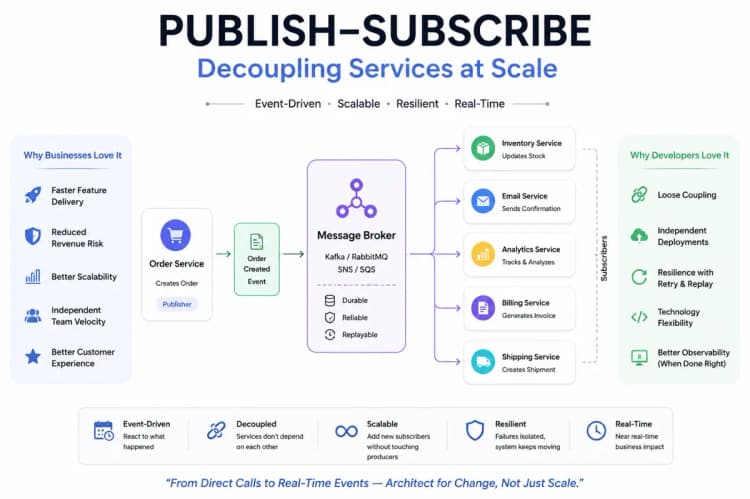
As organizations grow, many systems care about the same event.
Imagine:
Order Created
Interested consumers might include:
- Inventory Service
- Shipping Service
- Payment Service
- Analytics Service
- Email Service
- Fraud Detection Service
A synchronous design creates tight coupling.
Instead, modern systems publish an event.
Order Created
      ↓
Event Broker
      ↓
Many Consumers
The producer doesn't need to know who is listening.
This is Event-Driven Architecture.
Does Asynchronous Mean Better?
No.
This is a common misconception.
Asynchronous systems introduce their own challenges.
Examples include:
Eventual Consistency
Data may not update immediately.
Duplicate Messages
Events may arrive more than once.
Out-of-Order Processing
Messages may not arrive in sequence.
Distributed Debugging
Understanding failures becomes harder.
Observability Complexity
Tracing workflows becomes more difficult.
You're trading waiting problems for coordination problems.
The trade-off is often worthwhile.
But it isn't free.
Synchronous vs Asynchronous: Quick Comparison
| Characteristic | Synchronous | Asynchronous |
|---|---|---|
| User Waits | Yes | Usually No |
| Simplicity | High | Medium |
| Scalability | Limited | Excellent |
| Latency | Higher | Lower Perceived |
| Reliability | Easier | More Complex |
| Resource Usage | Higher | More Efficient |
| Debugging | Easier | Harder |
| Best For | Immediate Responses | Long Running Work |
Real-World Examples
Synchronous Workloads
- Login
- Search
- Checkout Validation
- Password Reset Verification
- Product Details
Asynchronous Workloads
- Video Processing
- Email Delivery
- Analytics Pipelines
- Recommendation Generation
- Search Indexing
- Image Optimization
- Fraud Analysis
TL;DR Quick Recap
- Synchronous means the client waits for completion.
- Asynchronous means work continues after the response.
- Waiting consumes resources.
- Long-running workloads should rarely block users.
- Queues decouple requests from work.
- Background jobs improve scalability.
- Event-driven systems expand asynchronous processing.
- Asynchronous systems introduce new coordination challenges.
- The most scalable systems avoid unnecessary waiting.
Final Thoughts
The distinction between synchronous and asynchronous workloads isn't really about APIs.
It's about understanding the cost of waiting.
Modern systems become dramatically easier to design when you start asking a different question.
Not:
Can this be asynchronous?
But:
Does anyone truly need to wait?
The world's largest platforms are built around a surprisingly simple idea:
Acknowledge immediately.
Process independently.
Coordinate eventually.
Once you start seeing systems through that lens, you'll notice that many modern architectures are really sophisticated mechanisms for avoiding unnecessary waiting.
And that's one of the most important lessons in distributed systems.
A Little Joke to End On
Why did the synchronous request quit its job?
Because it got tired of waiting for everyone else to finish first. 😄
Frequently Asked Questions
What is synchronous processing?
Synchronous processing requires the client to wait until work completes and a response is returned.
What is asynchronous processing?
Asynchronous processing allows work to continue independently after the response has been returned.
Why do modern systems use queues?
Queues decouple request handling from workload execution, improving scalability and reliability.
What are background jobs?
Background jobs are tasks executed outside the critical request-response path.
Does asynchronous mean faster?
Not necessarily.
It often improves perceived performance and scalability but introduces additional complexity.
What is eventual consistency?
A model where updates propagate over time rather than appearing instantly everywhere.
Why is waiting expensive?
Waiting consumes memory, connections, threads, and infrastructure resources.
When should I use synchronous processing?
When users require an immediate result to continue.
When should I use asynchronous processing?
For long-running, expensive, or non-critical operations.
What companies heavily rely on asynchronous systems?
Companies such as YouTube, Netflix, Amazon, Uber, Stripe, and many cloud-native platforms.
Key Takeaways
- Waiting consumes resources.
- Not all work requires immediate completion.
- Synchronous workloads couple work to requests.
- Asynchronous workloads decouple work from requests.
- Queues improve scalability and resilience.
- Background jobs reduce critical path latency.
- Event-driven architectures build upon asynchronous principles.
- Modern distributed systems are designed to minimize unnecessary waiting.
If you found this article useful, share it with fellow backend engineers, software architects, and distributed systems enthusiasts who want to understand how modern platforms scale.
About the Author
Anik Sikder is a Software Engineer specializing in Backend Systems, SaaS Architecture, Cloud Infrastructure, Python, Django, FastAPI, distributed systems, and scalable software engineering.
He writes about system design, distributed systems, cloud computing, networking, software architecture, and modern engineering practices.