$ open blueprint
Multi-tenant architecture is the foundation that allows a SaaS platform to serve many organizations from a shared application and infrastructure while maintaining strict boundaries between their data, users, permissions, and workloads. As a SaaS product grows, tenant isolation becomes much more than a database concern. It affects security, authorization, caching, background jobs, infrastructure, performance, compliance, and the platform's ability to evolve without expensive migrations.
Executive Summary
Multi-tenant architecture is one of the most important design decisions a SaaS company will make.
The decision affects:
- Infrastructure costs
- Product scalability
- Security boundaries
- Customer onboarding
- Compliance requirements
- Engineering velocity
A well-designed multi-tenant platform can support thousands of organizations using shared infrastructure while maintaining strict data isolation.
A poorly designed platform eventually faces:
- Security incidents
- Expensive migrations
- Performance bottlenecks
- Operational complexity
- Slower product delivery
This blueprint explains not only how multi-tenancy works, but why successful SaaS companies adopt it, how it evolves as businesses grow, and what engineering decisions matter most at scale.
The Business Problem
Imagine you're building BizNex OS.
Your first customer signs up.
Everything seems simple:
- One customer
- One database
- One deployment
Three months later:
- 50 customers
- 500 users
- Thousands of invoices
- Millions of records
Twelve months later:
- 500 customers
- Multiple countries
- Enterprise contracts
- Compliance requirements
Now every request must answer a critical question:
Which organization owns this data?
If the answer is wrong, customer data can leak across organizations.
For a SaaS company, this is one of the most severe failures possible.
The fundamental tenant-isolation rule is:
Every business request
must execute inside
the correct organization context.
Real World Scenario
Consider four companies using the same platform:
- ABC Traders
- XYZ Logistics
- Prime Distribution
- Delta Manufacturing
All four companies share:
- Frontend application
- Backend services
- Databases
- Infrastructure
Yet they must never see each other's:
- Products
- Employees
- Purchase Orders
- Invoices
- Reports
- Financial Records
The entire purpose of multi-tenancy is enabling shared infrastructure without shared data.
Conceptually:
                   Shared Platform
                         │
          ┌──────────────┼──────────────┐
          │              │              │
          ▼              ▼              ▼
      Tenant A        Tenant B        Tenant C
          │              │              │
          ▼              ▼              ▼
      Own Data        Own Data        Own Data
The infrastructure can be shared.
The authorization and data boundaries cannot be.
The Cost of Choosing the Wrong Architecture
Multi-tenancy decisions often create years of technical debt.
Early mistakes usually remain hidden until growth begins.
A startup with ten customers can survive weak isolation.
A platform with one thousand customers cannot.
Choosing incorrectly often leads to:
- Emergency migrations
- Customer downtime
- Security incidents
- Compliance failures
- Enterprise contract losses
- Expensive infrastructure redesign
The cost of fixing architecture after growth is significantly higher than designing proper tenant boundaries from the beginning.
The most important principle is therefore:
Design tenant boundaries before the platform becomes large enough to make changing them painful.
What Is a Tenant?
A tenant represents an isolated customer space inside a shared platform.
Examples:
| Platform | Tenant |
|---|---|
| Shopify | Store |
| Slack | Workspace |
| Notion | Workspace |
| HubSpot | Company Account |
| BizNex OS | Organization |
Everything belongs to a tenant.
Examples:
Users
Products
Orders
Invoices
Warehouses
Reports
Permissions
Every business resource should have ownership.
For BizNex OS, the organization is the primary tenant boundary.
High-Level Architecture Blueprint
                               ┌─────────────────────┐
                               │      Browser        │
                               └──────────┬──────────┘
                                          │
                                          ▼
                               ┌─────────────────────┐
                               │     Next.js App     │
                               └──────────┬──────────┘
                                          │
                                          ▼
                               ┌─────────────────────┐
                               │      API Gateway    │
                               └──────────┬──────────┘
                                          │
               ┌──────────────────────────┼──────────────────────────┐
               ▼                          ▼                          ▼
    ┌──────────────────┐      ┌──────────────────┐      ┌──────────────────┐
    │ Tenant Resolver  │      │ Authentication   │      │ Rate Limiter     │
    └────────┬─────────┘      └────────┬─────────┘      └────────┬─────────┘
             │                         │                         │
             └─────────────┬───────────┴─────────────┬───────────┘
                           ▼                         ▼
                  ┌─────────────────────────────────────┐
                  │     Authorization & RBAC            │
                  └────────────────┬────────────────────┘
                                   │
                                   ▼
                  ┌─────────────────────────────────────┐
                  │         Service Layer               │
                  └────────────────┬────────────────────┘
                                   │
                ┌──────────────────┼───────────────────┐
                ▼                  ▼                   ▼
      ┌────────────────┐ ┌────────────────┐ ┌────────────────┐
      │ PostgreSQL     │ │ Redis Cache    │ │ Message Queue  │
      └────────────────┘ └────────────────┘ └────────────────┘
                                                    │
                                                    ▼
                                         ┌──────────────────┐
                                         │ Background Jobs  │
                                         └──────────────────┘
Each request passes through multiple boundaries before it reaches business data.
The important boundaries are:
Tenant Resolution
        │
        ▼
Authentication
        │
        ▼
Authorization
        │
        ▼
Business Logic
        │
        ▼
Data Access
Request Lifecycle
A typical SaaS request should follow a tenant-aware lifecycle:
User Request
     │
     ▼
Resolve Domain
     │
     ▼
Identify Tenant
     │
     ▼
Authenticate User
     │
     ▼
Verify Membership
     │
     ▼
Check Permissions
     │
     ▼
Execute Business Logic
     │
     ▼
Filter Tenant Data
     │
     ▼
Return Response
Every layer should preserve the organization context.
The request should never silently lose:
organization_id
Once tenant context is established, downstream code should use that trusted context instead of trusting arbitrary tenant identifiers supplied by the client.
Tenant Resolution Strategies
There are several common ways to determine which tenant a request belongs to.
Strategy 1: Subdomains
acme.platform.com
globex.platform.com
Tenant is derived from:
acme
globex
Advantages:
- Simple
- Popular
- Easy routing
This works particularly well when the platform controls the domain structure.
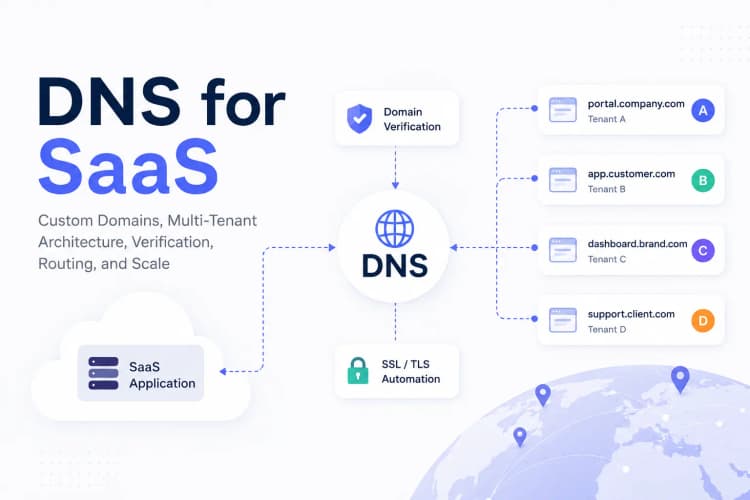
Strategy 2: Custom Domains
portal.acme.com
erp.globex.com
Advantages:
- Enterprise friendly
- Better branding
- Customer ownership
Challenges:
- DNS verification
- SSL management
- Domain routing
Custom domains introduce additional infrastructure concerns because the platform must verify that the customer actually controls the domain and then route requests to the correct tenant.
Strategy 3: Header-Based Resolution
X-Tenant-ID: 42
Common in:
- Internal APIs
- Microservices
- Service-to-service communication
This approach can be useful inside trusted service boundaries.
However, external clients should not be allowed to arbitrarily choose their tenant simply by changing a header.
The server must verify that the authenticated identity is actually a member of that tenant.
Database Design
Shared Database + Shared Schema
Most startups should begin here.
Example schema:
organizations
users
memberships
roles
permissions
products
orders
invoices
payments
Every business table includes:
organization_id UUID NOT NULL
Example:
SELECT *
FROM invoices
WHERE organization_id = current_tenant;
The core principle is simple:
Every tenant-owned business record must be explicitly associated with its organization.
For example:
invoices.organization_id

orders.organization_id

products.organization_id

employees.organization_id

warehouses.organization_id
This makes tenant ownership explicit and queryable.
Choosing the Right Multi-Tenant Model
| Criteria | Shared Schema | Separate Schema | Separate Database |
|---|---|---|---|
| Startup Friendly | Excellent | Good | Poor |
| Infrastructure Cost | Excellent | Good | Poor |
| Isolation | Moderate | Strong | Excellent |
| Operational Complexity | Low | Medium | High |
| Enterprise Support | Moderate | Strong | Excellent |
| Maintenance Cost | Low | Medium | High |
Each model represents a different tradeoff between cost, isolation, operational complexity, and enterprise requirements.
Shared Schema
All tenants use the same tables.
organizations
products
orders
invoices
with:
organization_id
on tenant-owned rows.
This is generally the simplest and most operationally efficient model.
Separate Schema
Each tenant receives its own schema inside a database.
database
 ├── tenant_a
 ├── tenant_b
 └── tenant_c
This provides stronger logical isolation but introduces additional schema management and migration complexity.
Separate Database
Each tenant receives an independent database.
Tenant A → Database A
Tenant B → Database B
Tenant C → Database C
This provides the strongest isolation but has significantly higher operational cost.
Recommended Approach
Start:
Shared Database
Shared Schema
Evolve only when business requirements demand it.
A strong architecture should make migration to more isolated models possible later without requiring every customer to move at once.
The SaaS Growth Journey
Stage 1: Validation
Customers:
1 - 50
Focus:
Product Market Fit
Architecture:
Shared Database
Shared Schema
At this stage, simplicity is a competitive advantage.
The goal is to validate the product rather than build infrastructure for a scale that does not yet exist.
Stage 2: Growth
Customers:
50 - 1000
Focus:
Performance
Reliability
Architecture:
Redis
Background Workers
Read Replicas
As workload increases, move expensive or asynchronous work out of the request path and reduce pressure on the primary database.
Stage 3: Scale
Customers:
1000 - 10000
Focus:
Isolation
Performance
Architecture:
Partitioning
Tenant Aware Caching
At this stage, tenant workload characteristics become increasingly important.
Large tenants can create disproportionate database, cache, and worker workloads.
Stage 4: Enterprise
Customers:
10000+
Focus:
Compliance
Regional Requirements
Architecture:
Dedicated Databases
Regional Deployments
Not every tenant necessarily needs this architecture.
The platform can selectively provide stronger isolation to customers whose contracts, regulations, scale, or operational requirements justify it.
Architecture Evolution Path
                    Startup
                       │
                       ▼
       Shared Database + Shared Schema
                       │
                       ▼
             Redis + Background Jobs
                       │
                       ▼
                 Read Replicas
                       │
                       ▼
              Tenant Partitioning
                       │
                       ▼
         Dedicated Enterprise Databases
                       │
                       ▼
              Regional Deployments
This represents an evolution path rather than a rigid requirement.
A successful SaaS platform should increase architectural complexity only when the business needs it.
The Noisy Neighbor Problem
One customer imports:
500,000 Products
This customer suddenly consumes:
- CPU
- Database Connections
- Memory
- Cache Capacity
Other tenants begin experiencing:
- Slow dashboards
- Slow reports
- Increased latency
This is called the Noisy Neighbor Problem.
The issue is that shared infrastructure means one tenant's workload can affect other tenants.
For example:
Tenant A
Huge Import
      │
      ▼
High CPU
      │
      ▼
Database Pressure
      │
      ▼
Tenant B
Slow Requests
Solutions to the Noisy Neighbor Problem
Possible solutions include:
- Rate limiting
- Workload isolation
- Queue prioritization
- Read replicas
- Resource quotas
You can also separate workloads by priority.
For example:
Critical Requests
        │
        ▼
High Priority Queue

Heavy Reports
        │
        ▼
Low Priority Queue
This prevents expensive background workloads from overwhelming customer-facing operations.
Tenant-Aware Caching
Incorrect:
dashboard_stats
Risk:
Tenant A receives Tenant B's data.
Correct:
tenant:42:dashboard_stats
Every cache key should contain:
- Tenant Identifier
- Resource Type
- Resource Identifier
Examples:
tenant:42:invoice:100
tenant:42:user:5
tenant:42:dashboard
The tenant identifier is part of the cache isolation boundary.
Without it, the cache can become a cross-tenant data leakage vector even if the database queries are perfectly isolated.
Background Job Isolation
Background jobs often become hidden sources of data leaks.
Examples:
- Invoice generation
- Data exports
- Email campaigns
- Scheduled reports
Every job should carry:
organization_id
actor_id
correlation_id
For example:
{
  "organization_id": "org_42",
  "actor_id": "user_100",
  "correlation_id": "req_8f72c1"
}
Never process tenant data without tenant context.
A worker that receives only:
invoice_id = 100
may not have enough information to safely determine which tenant owns that invoice.
The job should either carry trusted tenant context or resolve ownership server-side before performing the operation.
Security Architecture
Tenant isolation must work together with authentication and authorization.
Authentication
Recommended:
JWT Access Tokens
Refresh Token Rotation
HttpOnly Cookies
Authentication answers:
Who is making this request?
Authorization
Use:
RBAC
Example:
Owner
Manager
Accountant
Employee
Authorization answers:
What can this user do?
Tenant Validation
Verify:
- User Exists
- User Belongs To Organization
- Organization Is Active
- Permission Exists
Only then continue.
A complete request decision is therefore closer to:
Authentication
      │
      ▼
Tenant Membership
      │
      ▼
Organization Status
      │
      ▼
Permission
      │
      ▼
Resource Ownership
      │
      ▼
Business Rule
      │
      ▼
Allow / Deny
Production Security Checklist
Before launch:
- Every table contains
organization_id - Every query filters
organization_id - Cache keys contain tenant identifiers
- Jobs carry tenant context
- Audit logs contain tenant identifiers
- RBAC enforcement exists
- Tenant boundary tests exist
- APIs never trust tenant IDs from clients
- Rate limiting exists
- Activity monitoring exists
This checklist should be treated as a minimum tenant-isolation baseline rather than the complete security model.
Common Production Mistakes
Missing Tenant Filters
Bad:
Invoice.objects.all()
This query ignores tenant boundaries.
Good:
Invoice.objects.filter(
    organization=request.organization
)
The service or repository layer should consistently enforce the organization boundary.
Trusting Client Tenant IDs
Bad:
{
  "organization_id": 42
}
The server should determine the tenant from trusted context.
The client can indicate which organization it intends to work with, but the server must verify that the authenticated user actually has access to that organization.
Shared Cache Keys
Bad:
invoice:100
Good:
tenant:42:invoice:100
A tenant-aware cache key prevents identical resource identifiers from colliding across organizations.
Authorization Without Tenancy
Bad:
User has permission
Good:
User has permission
inside this organization
A permission has meaning inside the correct tenant context.
A user can be an administrator in Organization A without being an administrator in Organization B.
Tenant Isolation at the Data Layer
Tenant isolation should not exist only at the application layer.
The application should enforce:
Organization Context
        │
        ▼
Service Layer
        │
        ▼
Repository / ORM
        │
        ▼
Database
For stronger environments, database-level controls such as row-level security can provide an additional defense layer.
The principle is defense in depth:
A single forgotten application filter should not automatically become a cross-tenant data breach.
Tenant-Aware Domain Modeling
Every tenant-owned entity should have an explicit ownership model.
For example:
Organization
   │
   ├── Employees
   ├── Products
   ├── Orders
   ├── Invoices
   ├── Payments
   ├── Warehouses
   └── Reports
A normalized SaaS schema might therefore look like:
organizations
      │
      ├── memberships
      │       │
      │       └── users
      │
      ├── products
      │
      ├── orders
      │
      ├── invoices
      │
      ├── payments
      │
      ├── warehouses
      │
      └── reports
This makes tenant ownership explicit throughout the domain model.
Tenant Isolation and Relationships
A subtle problem appears when records reference other records.
For example:
Invoice
   │
   └── customer_id
The application must not simply verify that:
Invoice.organization_id = Current Organization
It should also ensure that the referenced customer belongs to the same organization.
For example:
Invoice.organization_id
        │
        ▼
Customer.organization_id
should resolve consistently within the same tenant.
Otherwise, cross-tenant references can become another data leakage vector.
Cost Analysis
Without Multi-Tenancy
100 Customers:
100 Databases
100 Deployments
100 Monitoring Stacks
Operational burden grows rapidly.
Every customer may require:
Database Provisioning

Backups

Monitoring

Migrations

Scaling

Incident Management
The operational model becomes expensive as the customer count increases.
With Multi-Tenancy
100 Customers:
1 Database Cluster
1 Deployment Pipeline
1 Monitoring Platform
Benefits:
- Lower hosting costs
- Easier maintenance
- Faster onboarding
- Higher profit margins
Shared infrastructure allows many customers to benefit from the same:
Application Releases

Infrastructure

Monitoring

Operational Tooling
This is one of the fundamental economic advantages of SaaS.
Real Migration Scenario
A startup launches with:
Shared Database
Shared Schema
Two years later:
A healthcare enterprise requires:
- Dedicated database
- Data residency
- Compliance controls
The company migrates only that customer.
Result:
Enterprise Customer
   │
   ▼
Dedicated Database

All Other Customers
   │
   ▼
Shared Platform
This is a hybrid architecture.
It allows the platform to retain the economic benefits of multi-tenancy for the majority of customers while providing stronger isolation where a particular enterprise customer requires it.
The architecture can therefore become:
                    SaaS Platform
                         │
          ┌──────────────┴──────────────┐
          │                             │
          ▼                             ▼
   Shared Tenants                Dedicated Tenants
          │                             │
          ▼                             ▼
 Shared Infrastructure          Isolated Infrastructure
This is often more practical than forcing every customer onto dedicated infrastructure.
What I Would Build Today
If I were building a SaaS platform in 2026:
I would start with:
- PostgreSQL
- Shared Schema
organization_idon every business table- JWT Authentication
- RBAC Authorization
- Redis Cache
- Background Workers
- Audit Logging
The initial architecture would look like:
                    ┌─────────────────┐
                    │    Next.js      │
                    └────────┬────────┘
                             │
                             ▼
                    ┌─────────────────┐
                    │ Django / FastAPI│
                    └────────┬────────┘
                             │
                  ┌──────────┼──────────┐
                  │          │          │
                  ▼          ▼          ▼
             PostgreSQL    Redis      Queue
                  │          │          │
                  │          │          ▼
                  │          │       Workers
                  │          │
                  └──────────┴───────────────┐
                                             ▼
                                      Tenant-Aware
                                      Business Logic
I would not start with:
- Microservices
- Kubernetes
- Separate Databases
- Event Meshes
- Service Discovery Platforms
Premature complexity kills more startups than scalability problems.
Build for today's reality.
Evolve when growth requires it.
The architecture should provide a clear path from:
Shared Infrastructure
to:
Partitioned Workloads
and eventually:
Dedicated Enterprise Infrastructure
without requiring a complete rewrite.
Real-World Examples
Shopify
Millions of merchants.
Shared infrastructure.
Strong tenant isolation.
The platform serves many independent stores while maintaining boundaries between merchant data and operations.
Slack
Millions of workspaces.
Shared platform.
Workspace isolation.
The workspace acts as a major tenant boundary for users, channels, messages, files, and permissions.
Notion
Millions of workspaces.
Shared infrastructure.
Tenant-aware permissions.
The workspace provides the organizational boundary around content and collaboration.
Tradeoffs
| Benefit | Tradeoff |
|---|---|
| Lower Cost | More Complex Authorization |
| Faster Deployment | Strong Tenant Controls Required |
| Shared Infrastructure | Isolation Challenges |
| Better Resource Utilization | Noisy Neighbor Risks |
| Easier Maintenance | More Careful Query Design |
Multi-tenancy is therefore not a free optimization.
The platform gains:
Lower Cost
+
Operational Efficiency
+
Faster Customer Onboarding
but must invest in:
Tenant Isolation
+
Authorization
+
Query Discipline
+
Operational Controls
The Core Tenant Boundary
A useful way to think about the architecture is:
User
  │
  ▼
Membership
  │
  ▼
Organization
  │
  ▼
Role
  │
  ▼
Permission
  │
  ▼
Resource
Every protected operation should be evaluated within this context.
For example:
Can this user
    │
    ▼
perform this action
    │
    ▼
on this resource
    │
    ▼
inside this organization?
That single question captures much of the core multi-tenant authorization problem.
Key Takeaways
Multi-tenancy is not a database strategy.
It is a business scalability strategy.
The best architecture is rarely the most complex architecture.
Start simple.
Enforce tenant boundaries everywhere.
Design for evolution instead of premature scale.
Every tenant-owned record should have an explicit ownership boundary.
Every request should carry trusted tenant context.
Every query should respect the tenant boundary.
Every cache key should be tenant-aware.
Every background job should carry tenant context.
Every sensitive authorization decision should be enforced server-side.
The goal is not supporting one million tenants on day one.
The goal is creating a platform that can grow from one customer to one million customers without forcing a complete rewrite.
A successful multi-tenant architecture therefore balances three things:
Isolation
   +
Operational Efficiency
   +
Evolution
Build the simplest architecture that provides strong tenant isolation today while leaving a deliberate path toward partitioning, dedicated infrastructure, and regional deployments tomorrow.